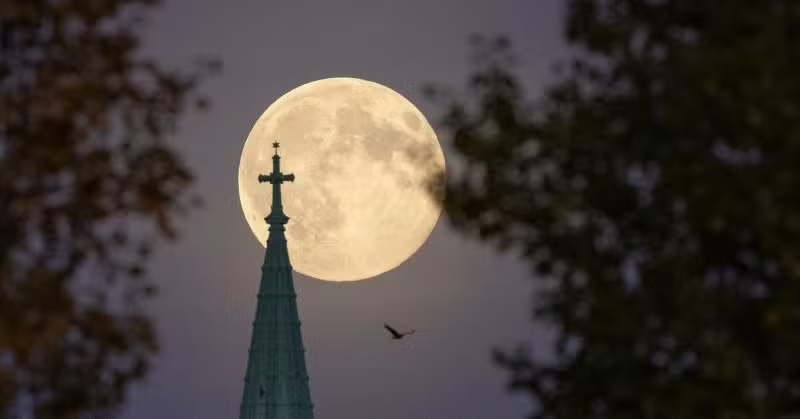
How and when to watch November’s beaver moon | CNN
A CNN article tells readers how and when to watch November's full moon, known as the beaver moon and the first of three consecutive supermoons. According to EarthSky, it peaks at 9:54 a.m. ET the day after publication, but NASA's Noah Petro says it will still look full that evening and for the next two. He says it will appear about 17% larger and 30% brighter than the year's smallest full moon, a supermoon effect arising because the moon's slightly elliptical orbit sometimes brings it closer to Earth. Petro recommends watching from a dark spot with an unobstructed view, while Johns Hopkins' Kevin Lewis suggests looking shortly after sunset, when the low horizon moon offers a particularly striking view.

The last full moon of fall, a supermoon, is coming. When to look up
November's full moon, the Beaver Moon and the last full moon of fall 2026, will be a supermoon, peaking on Tuesday, 24 November at 9:53 a.m. ET, after sunrise in the eastern United States, though it will still look bright on the nights before and after. According to NASA, a supermoon occurs when a full moon is at perigee, its closest point to Earth all month, making it look around 30% brighter and up to 14% larger than usual. It is the first of four supermoons at the end of 2026 and the start of 2027, with the next on Christmas Eve, 24 December 2026, followed by 22 January and 20 February 2027. The Farmer's Almanac says the Beaver Moon is named for the time when beavers take shelter in their lodges ahead of winter.

4 back-to-back supermoons begin with November's full Beaver Moon
A USA TODAY graphic article reports that four back-to-back supermoons will run from late November 2026 through February 2027, starting with the full Beaver Moon at 9:53 a.m. EST on Nov. 24, 2026 and continuing with the Cold Moon, Wolf Moon, and Snow Moon. The Cold Moon, peaking Dec. 23, 2026 about 221,700 miles from Earth, will be the closest full moon of 2026, and the run ends with the Snow Moon on Feb. 20, 2027. A supermoon occurs when a full moon is especially close to Earth, looking up to 14% bigger and 30% brighter than a full moon at its farthest, and it is best viewed near moonrise or moonset, when it appears especially large.

