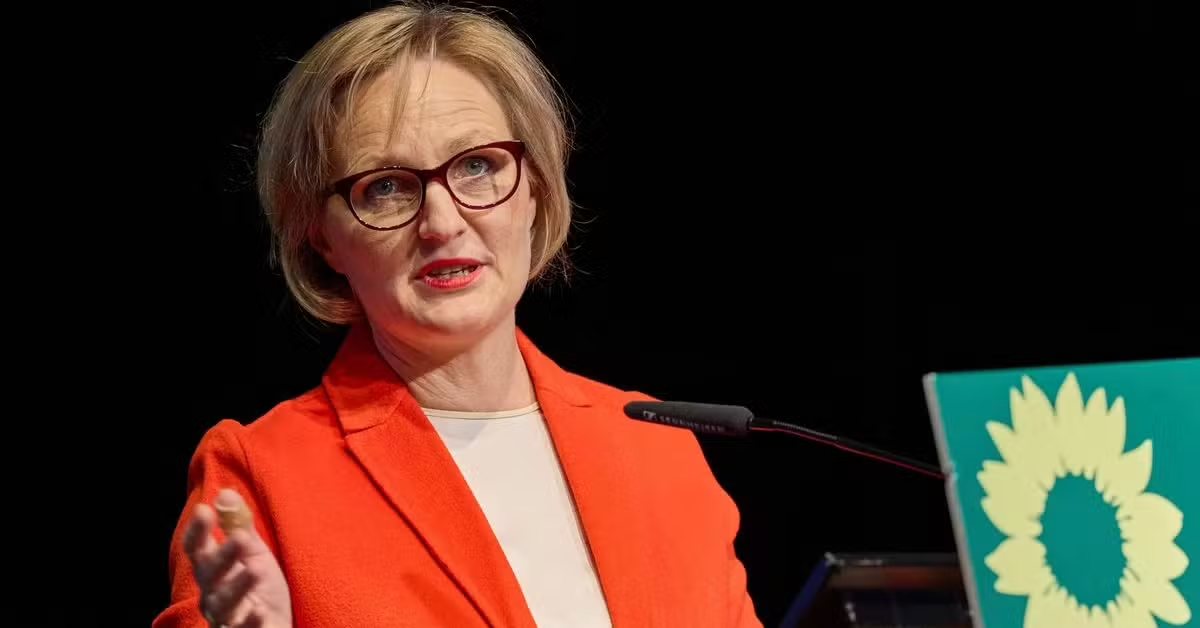
Green co-leader Brantner backs Gen Z protests, accuses German government of cruel policy
Grünenchefin Brantner spricht von »Söder-Geschenken« zulasten der jungen Generation
spiegel.de· 15h
Students rally across Europe over cost of living, war and education cuts
abc.net.au· 35h
Protests held across Europe over wages, services, high living costs
aljazeera.com· 36h
A travers l’Europe, des mobilisations vendredi et tout ce week-end contre la « militarisation », la vie chère et pour l’éducation
lemonde.fr· 38h
LIVE: Students protest in Rome, Italy
youtube.com· 41h
Brantner und Bobga über den GenZ-Protest: „Zum Glück geht ihr da rein“ – „Wir fühlen uns aber allein“
taz.de· 44h
LIVE: Students protest in Italy
Gen Z Is Driving Global Political Change, Aiding Far Left and Far Right
nytimes.com· 2d
Vague de manifestations de la jeunesse à travers l'Europe à partir de vendredi
france24.com· 2d
Gen-Z-Proteste in Europa: Gen-Z-ler aller Länder, vereinigt euch!
Students Around the World Are Skipping Class to Enter Class Struggle
truthout.org· 3d
FRANCE, ITALY, GERMANY - PROTESTS SHIFT INTO NEW TERRITORY!
“Gen Z Regulates”
crimethinc.com· 9d
‘I pay $500 for 5 square metres’: Spain’s protesters, in their own words
A wave of Gen Z protests over housing, living costs and military spending swept Europe, peaking on 20 November 2026 in a coordinated youth strike across 25 countries. It grew from Spain, where the eviction of 87-year-old Maricarmen Abascal sparked nationwide housing protests, and on 11 November many heeded Spain's biggest unions and walked out for wages, housing and prices.
The protests reached Germany on 31 October, when tens of thousands demonstrated in nearly 40 cities under the motto 'Gen Z regelt'. France and Italy drew the highest numbers of ongoing protesters, alongside mounting reports of extreme police brutality against demonstrators in French cities including Paris and Toulouse.
For 20 November the transnational Youth Strike Coalition called students in 25 countries onto the streets, demanding a stop to rearmament and investment in education and the welfare state instead. Tens of thousands answered in what the coalition called the biggest coordinated youth protest of recent years. In Italy the rallies coincided with a general strike, and the CGIL union reported about a hundred demonstrations bringing together more than a million people.
In Germany, GenZ Regelt counted about 21,000 participants in about 70 cities, far below the up to 120,000 of the first protest on 31 October. Most marches were peaceful, though masked activists threw firecrackers in Rome, protesters burned figures of Benjamin Netanyahu and Donald Trump in Milan, and in London police kept young demonstrators apart from right-wing counter-protesters.
Organizers called the day the start of a campaign rather than an isolated event, and governments facing European elections in the new year are grappling with its demands to cut defence spending. On 21 November, Green Party federal co-leader Franziska Brantner backed the protests and accused the German government of a cruel policy, saying less than one percent of one billion euros planned for schools had so far reached them.
On 25 October 2026, protesters at a camp in Puerta del Sol square in Madrid displayed a banner reading 'Power to the people' depicting Maricarmen Abascal, an 87-year-old woman whose eviction sparked nationwide housing protests.
Tens of thousands of young people protested across Spain against the country's acute housing crisis in the weeks before 11 November 2026.
On 11 November 2026, many protesters in Spain went on strike, heeding calls by Spain's biggest unions for a nationwide walkout under the slogan 'Salarios, vivienda y precios', meaning wages, housing, and prices.
Bea Garcia de la Torre said she would join the general strike on 11 November 2026 because it was a good chance to change Spain's housing policy, just as a similar action once won the right to an eight-hour day.
Haris Javaid Sharif said he was joining the strike to try to press the politicians.
Ignacio Redrado said protesters called the general strike because they cannot take any more, that it is not about this government, and that the power should be with the people.
Arturo Leon said this was a perfect example of why he would be joining the general strike.
Student revolt in France was reported to have set off the most intense street confrontations in the country since the Yellow Vest movement.
Albania has seen wave upon wave of clashes since February 2026.
On 31 October 2026, tens of thousands of people took to the streets of nearly 40 German cities under the motto 'Gen Z regelt' as the European youth protests reached Germany.
More demonstrations on the same theme were scheduled for 20 November in Germany.
It was forecast that while a large-scale uprising like the one in France remained unlikely in Germany, the first cracks in the pacification of society were starting to show.
Protests in France, Italy and Germany were reported to be the most dynamic in Europe, with the highest numbers of ongoing protesters in France and Italy.
Mounting reports described extreme police brutality against protesters in France, with Toulouse, Rennes, Marseille, Lille and Paris the cities recording the highest numbers of protesters and brutality.
Protests in Italy kept spreading to more cities and communities, reaching the islands of Sardinia and Sicily, with Milan, Turin, Naples and Rome the cities with the highest numbers of protesters and police brutality.
In Germany, smaller protests continued in the streets and through occupations of university lecture halls after the nationwide protests of 31 October.
Three major organizers called for upcoming nationwide protests in Germany.
A group calling itself Proof Demos called a protest for Saturday 14 November, pressuring the Merz government to finally start legal procedures to ban the neo-Nazi AfD party.
Gen Z called for nationwide protests again on 20 November, gaining support from political parties including the Greens and the Left Party.
Tashi Holla said there were mounting reports of extreme police brutality against protesters in France and that the number of protesters there was difficult to verify.
Tashi Holla forecast that lawsuits would soon be filed by legal representatives of NGOs and severely injured protesters in France.
Tashi Holla said the Merz government was still peddling the narrative that the protests would be violent and that far-left extremists and migrant groups would organize and incite the violence.
The call for the International Youth and Student Strike scheduled for 20 November links education and housing to austerity, climate breakdown and militarization, and emerged from a wider wave of youth revolt stretching from Mayotte and Morocco to Chile, Argentina and Brazil.
The manifesto of the organizers of the 20 November International Youth and Student Strike declares 'Our future will not be given to us.'
It was forecast that on 20 November students and young people in more than 25 European countries would join a coordinated International Youth and Student Strike under the banner 'Fight for Our Future, Not Their Wars.'
School students in the United Kingdom were reported to be preparing walkouts on 20 November as part of the wider International Youth and Student Strike.
After weeks of school blockades, about 100 students packed the Audimax lecture hall of the Alice-Salomon-Hochschule in Berlin-Marzahn on the evening of 18 November for the first general assembly of the university's strike committee, and the initiative 'Gen Z regelt' called nationwide general assemblies for Thursday to decide on university strikes.
The transnational Youth Strike Coalition called on students in 25 countries to leave their classrooms and take to the streets on Friday 20 November, expecting at least hundreds of thousands of protesters on Europe's streets.
The Youth Strike Coalition's core demands are a stop to national rearmament programs and investment in education and the welfare state instead, alongside rejection of military service and solidarity with oppressed people worldwide, especially Palestinians.
In Italy the protests coincide with a general strike, and organizers again expected hundreds of thousands of protesters in France and Spain.
The German initiative 'School Strikes against Conscription' is part of the coalition, for which it is already the fifth nationwide strike call, while 'Gen Z regelt' declared a 'Phase 2' of its protests for Friday with protests announced in more than 80 German cities.
After up to 120,000 people came to the first 'Gen Z regelt' protest on 31 October, fewer than 20,000 registrations were counted for the Friday protests, and the movement said the day could turn out smaller because it falls on a weekday, adding that mobilization now takes place on other platforms.
In Karlsruhe a protest march was banned and only a standing rally allowed, and in Cologne, where police used water cannons at past protests, a city-center march was banned and moved to the Deutzer Werft.
Hamburg's interior senator Andy Grote explicitly warned against taking part in the protests and announced that the police would intervene decisively.
Hesse's interior minister Roman Poseck spoke similarly about Frankfurt am Main, where riots and looting had occurred after the last protests.
A speaker of the Italian school and student network Rete della Conoscenza said at a press conference that Friday would be a 'historic protest' bringing together the youth protests running for weeks in various countries.
It was forecast that in Romania, where the Friday action is the first youth protest, a three-digit number of participants was expected.
In early November 2026, housing-rights unions and associations in Belgium, Britain, Spain, France, Greece, Italy and Portugal jointly called for people to take to the streets on 20, 21 and 22 November 2026.
The joint call put forward six common demands, ranging from a guaranteed right to housing for all and lower prices for housing, food and energy, to higher wages, taxing the rich and an end to rearmament policies.
Italy's main trade union, the CGIL, announced 100 demonstrations across Italy on 20 November against the rise in the cost of living and for accessible housing.
The German collective 'GenZ regelt' expected 15,000 people in Berlin on 20 November and actions in dozens of cities.
Youth demonstrations were expected at midday on 20 November in Spain, notably in Madrid and Barcelona, with demonstrations planned in many French cities on Saturday 21 November.
Strikes and demonstrations were planned in Belgium on Monday 23 November against austerity measures, in convergence with the youth struggles.
Hannes Kramer, a student mobilized in Germany against the possible reintroduction of military service, said 'the militarization and the cuts in social spending go hand in hand: while seemingly unlimited sums of money are poured into the armies and the infrastructure that supports them, the welfare state is dismantled'.
Zennor Tyndale-Biscoe, a 17-year-old planning to demonstrate in Truro in south-west England, said 'it is really an important event to make young people's voices heard across the whole country and to express our need for immediate and systemic changes for our future', adding that like the young people mobilizing in France, 'we believe deeply in the impact that our voice can have in the adult world'.
Jean-Baptiste Eyraud, spokesman of the French association Droit au Logement, said 'the Spanish, Portuguese, Italian and German tenants give the example of the need to mobilize against the high cost of housing, the over-exploitation of this essential need which is housing'.
The German group 'Gen Z Regelt', one of the organizers of the Friday protests, called for the resignation of Chancellor Friedrich Merz, who has taken the lead in ramping up German military spending, and demanded 'not one person, not one cent, for the German armed forces.'
The demands of the groups behind the Friday protests were reported to skew sharply to the left and critique the capitalist system, framing the conflict as workers versus the rich and powerful rather than the young versus older generations.
Laura Spearey, a 27-year-old information technology student from Bilbao who traveled to Britain to join the protests, said 'There's no future for us.', saying young people have no chance whatsoever to have their own life and build their life project, citing difficulties in securing housing, health care and other necessities of adulthood.
Hannah Ponting, a 20-year-old member of the Socialist Students at Liverpool University helping to coordinate protests there, said it is not a battle of the young versus the old, because neither group is controlling where the money is going.
Students marched in Rome as part of a nationwide Italian strike against rising living costs and military spending.
Interior Minister Alexander Dobrindt had spoken of a 'migrant milieu' after the first Gen Z protests.
Franziska Brantner said it has been proven how strongly Russian bots spread their narratives in the protests in France, and said it is worrying how well those narratives work.
Franziska Brantner said she is glad the Grüne Jugend goes into the protest alliances, and said she understands young people who say their school was bad, they cannot afford a flat, artificial intelligence shakes their job prospects, they no longer believe the pension promise, and the government's only idea is that they should join the military.
Luis Bobga said the Grüne Jugend goes into the protest alliances with the clear stance of standing at Ukraine's side, and said the youth wing feels alone with that stance.
Luis Bobga said he was on several of the protest strikes and spoke with 15-year-olds who fear being sent to the eastern front within a year, fears that do not match the facts but reflect their anxieties.
Franziska Brantner said she sharply criticized Interior Minister Dobrindt for his remark, finding what he did unspeakable because the statement feeds racist stereotypes.
Tens of thousands of demonstrators mobilized across Europe on 20 November against the 'militarization' of society and the cost of living, and for education, the right to housing and the climate, amid a rejection of institutions.
In Italy, tens of thousands demonstrated in Rome in three processions, and the CGIL reported about a hundred demonstrations across the country bringing together more than a million people, against rearmament and the cost of living and for a change in the government's economic and social policies.
About a thousand high school students in Rome marched behind a banner reading 'The freedom we take if nobody gives it to us', against the government, war and the cost of living, while a sign at the demonstrations read in English 'If we burn, you burn with us'.
In Germany, the collective GenZ Regelt counted about 21,000 participants in mobilizations in about 70 cities, with about a thousand young people gathering in Berlin mainly against German rearmament and out of fear of a return of compulsory military service.
Signs at the Berlin gathering read 'Education is a right, not a privilege' and called on Chancellor Friedrich Merz to resign and to tax the rich.
In Madrid, hundreds of demonstrators gathered for public education and against the increase in military spending, many brandishing the red-and-white flags of the Students' Union.
In London, hundreds of people including schoolchildren in uniform gathered chanting 'Let us fight for our future, not for their wars', under heavy police surveillance and in the presence of far-right counter-protesters.
CGIL general secretary Maurizio Landini said in a speech near the Colosseum, 'The streets are full and all generations are present'.
Protesters rallied across 25 European countries on 20 November over high living costs, military spending and the climate crisis, including the United Kingdom, Austria, Germany, Spain, Italy, Sweden and Croatia, ramping up pressure on leaders accused of ignoring the concerns of young people.
Tens of thousands of workers and students protested in more than 100 Italian cities, coinciding with a general strike by the CGIL that involved workers in both the private and public sectors, including schools and healthcare.
The Italian rallies followed a nationwide mobilisation on 17 October 2026 that descended into rioting and looting and prompted Prime Minister Giorgia Meloni's government to approve sweeping security measures and deploy the army alongside police in subsequent demonstrations.
Demonstrators in Rome threw objects at the Ministry of Education, while in Bologna some protesters clashed with police.
In Milan, demonstrators set fire to a cardboard tanker as well as cardboard figures depicting Israeli Prime Minister Benjamin Netanyahu and US President Donald Trump.
Opposition leaders joining the Italian demonstrations criticised Giorgia Meloni's government and its budget policies amid rising living costs.
The German campaign group 'Gen Z regelt' said it was organising protests in 73 cities and towns, roughly 4,000 people attended a protest at Berlin's Alexanderplatz, and police said the Cologne protest drew thousands, fewer than the 5,000 expected.
Several hundred people protested outside the University of Vienna in Austria for more spending on education and less on weapons, before police dispersed the protest after reported disturbances, using pepper spray and making several arrests.
Students in Croatia boycotted classes and staged protests in about a dozen cities, demanding greater investment in education, housing and public services rather than military spending.
CGIL leader Maurizio Landini said at a rally in Rome, "Across Europe and among ordinary people, the demand for change is growing."
Elly Schlein, leader of the centre-left Democratic Party, said Italy's 2027 Budget Law "does not have a vision for the future of the country" because it does not help industries but slashes funding for public healthcare and education.
The Youth Strike coalition described the day of action as Europe's biggest coordinated youth protest of recent years and said it planned demonstrations in 400 cities in countries including Belgium, Croatia, France, Germany, Greece, Italy, Portugal, Spain and the United Kingdom.
Organisers said the demonstrations are the start of a campaign, not an isolated event.
In Rome, riot police were on stand-by as thousands of young people marched past the Colosseum towards the education ministry, and a small group of masked activists threw firecrackers and other projectiles, though the demonstration was otherwise mostly peaceful.
Protesters outside the United Kingdom's Houses of Parliament were met by a rival right-wing group of activists, and police kept the two groups apart.
The rally in France was more muted than recent protests there about the poor state of education facilities.
With major European elections on the horizon in the new year, governments in each country are grappling with how to respond to the growing protest movement and its demands to cut defence spending.
Jasmin Hamadi said she took part in the Berlin march to "take a stand and push for a change, because things cannot go on like this".
Lucia Lamorgese said she feels the rising cost of living is making life "impossible".
Luca Cornani said he joined the Rome rally to demand more money be spent on education and healthcare instead of defence.
Irene Mark, a 16-year-old high school student at the London rally, said, "I'm scared that I won't ever be able to do anything in my future if they don't want to fund it".
Antoni Cienciala urged young people, "Wherever you are, just stand up, fight for what you believe in, show up to these protests".
Evelyn said at the Paris march, "I think a lot of us who are young people, no matter where they were, in Paris or in London or in New York or any random place around the world, it's up to us to fight for the future that we think that we deserve".
It was forecast that larger demonstrations would be held in Paris over the weekend.
Tens of thousands took part in nationwide youth protests in Germany on 20 November under the motto 'Gen Z regelt', demanding more money for schools, an affordable life, more climate protection and a no to conscription.
Green Party federal co-leader Franziska Brantner backed the youth protests against the German federal government's austerity plans.
Brantner said that of the one billion euros planned for schools, less than one percent has reached the schools so far, and calculated that the 2.5 billion euros spent on the three-month fuel discount could have more than doubled funding for the Startchancen education program for a year.
Franziska Brantner accused the CDU/CSU and the SPD at a state party conference of the Hamburg Greens of a cruel policy at the expense of the next generation, saying money from the federal special fund goes into 'Söder gifts', referring to the Mothers' Pension pushed through by Bavarian Minister President Markus Söder, instead of into schools and early childhood education.
Franziska Brantner said this is unacceptable.

