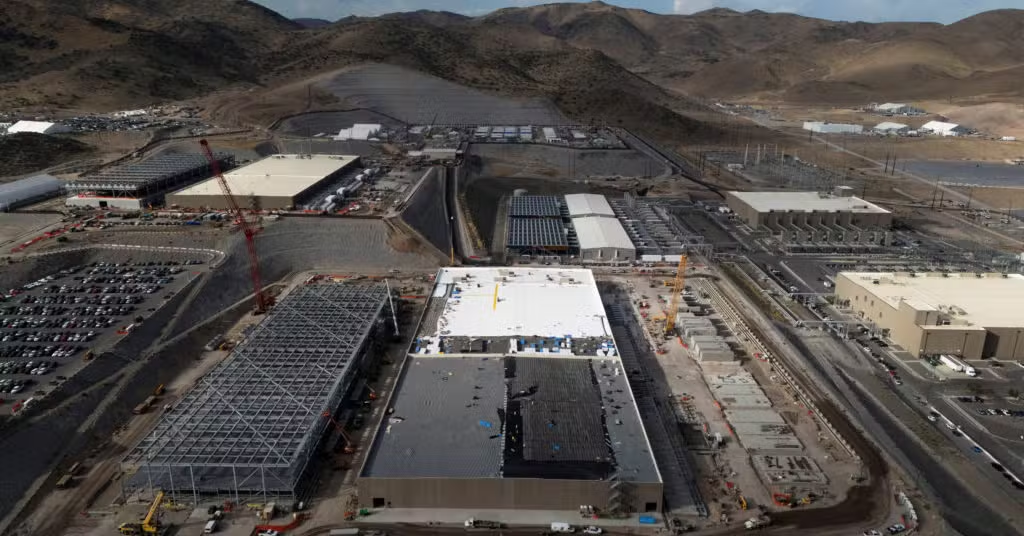
Largest US data centers emit more carbon dioxide than Denmark, Harvard study finds
Study reveals energy demands and emissions of America's data centers
pbs.org· 4d
400 largest U.S. data centers produced more carbon dioxide in a year than Denmark, study finds
Harvard study estimates magnitude of U.S. data center pollution as climate talks unveil clean AI pledge
nbcnews.com· 5d
- Environmental_Footprint_of_U_S__Data_Centers.pdf
harvard.edu· 5d
U.S. data centres now emit more carbon than an entire country | CBC
cbc.ca· 5d
US data centers now burn more electricity than a midsized country
theverge.com· 5d
Study estimates magnitude of US data center pollution as climate talks unveil clean AI pledge
apnews.com· 5d
Carbon Emissions of Biggest U.S. Data Centers Already Rival Entire Countries, Study Reveals
nytimes.com· 5d
Just 400 US Data Centers Use More Electricity Than Michigan
wired.com· 5d
Largest data centers take up about 2 percent of U.S. electricity use, study says
washingtonpost.com· 5d
A Harvard-led study published November 16, 2026 in Nature Sustainability estimates the largest US data centers emit more carbon dioxide in a year than Denmark.
The study examined 403 hyperscale data centers from May 2024 to April 2025, finding they used about 82 terawatt-hours, roughly 2% of US electricity.
More than half their power came from fossil fuels, and the emissions estimate is two to three times the last assessment in 2018.
Data centers in Virginia, Oregon, Ohio, and Iowa used more than half the electricity, and Virginia alone accounted for over a quarter of emissions.
The researchers say the figures likely undercount, emissions are probably higher now, and plans for 2,000 more data centers make the trend worrisome.
Hyperscale data centers are massive facilities built largely to support generative AI, and no public list of them exists.
Francesca Dominici said the findings raise the question of whether the United States is on the right trajectory in terms of data center development.
Jon Koomey called behind-the-meter power a "wild card" in accurately assessing total data center power use.
Gianluca Guidi said the federal government should require operators of large data centers to publicly disclose their electricity use and emissions.
Gianluca Guidi said communities should not need a team of Harvard researchers analyzing satellite images to understand their environmental impact.
Eric Masanet, who researches emerging environmental technologies at the University of California, Santa Barbara, said the study resets understanding of how much power large data centers already use and how much they emit.
Michael Thomas, who runs the energy data company Cleanview, said about a half dozen senators have contacted him asking how many data centers there are because they are trying to write a bill.
Gianluca Guidi said in an email that people treat AI's environmental footprint as a fixed property of the technology when the same infrastructure can have dramatically different consequences depending on the electricity system supporting it, which he finds encouraging because the impacts are not inevitable.
The paper's authors called for hyperscale data centers to be recognized as a relevant sector of the economy.
The paper's authors warned that the surge in data center proliferation driven by artificial intelligence will significantly increase computational demands and electricity consumption.
The paper's authors argued that data-driven decision-making should inform policies aimed at mitigating the environmental impact of data centers.
A Harvard-led team published in Nature Sustainability on November 16, 2026 the first peer-reviewed estimate of United States data center emissions since the AI boom began.
The study estimated the 403 largest US data centers produced about 28.3 million tons, 25.7 million metric tons, of carbon dioxide in a year, more than the entire nation of Denmark.
The study estimated the 403 hyperscale data centers consumed about 82 terawatt-hours of electricity between May 2024 and April 2025, enough to power nearly 7 million homes for a year.
The 403 facilities used almost 2 percent of United States electricity, more than New York City and Los Angeles combined, and accounted for about 0.5 percent of US carbon dioxide emissions.
Across the 403 facilities, 54 percent of the electricity came from burning fossil fuels, mostly natural gas and coal.
Data centers in Virginia, Oregon, Ohio, and Iowa were responsible for more than 50 percent of the electricity use in the study.
Data centers in Virginia, Iowa, and Ohio accounted for about half the estimated emissions, with Virginia alone responsible for more than a quarter.
The study found emissions were two to three times higher than the last assessment of data center emissions in 2018.
The researchers used satellite imagery to identify the 403 data centers and Environmental Protection Agency data to estimate each facility's carbon pollution on its local grid.
With no public list of data centers, the researchers pieced together locations from commercial datasets, building footprints, and satellite imagery.
The study's figures likely undercount total US data center emissions because they exclude facilities the researchers could not verify and centers that bypass the grid with on-site generators.
Cleanview data showed at least 250 more data centers came online after the study period ended on May 1, 2025.
The researchers noted data center construction has only expanded since the study period, so the industry's emissions are probably even higher now.
The published paper identified 3,318 power plants supplying the 403 data centers, with natural gas the largest single source at 40.6 percent of their electricity.
The paper found the data centers' average carbon intensity was 564 grams of CO2 per kilowatt hour, 52 percent above the United States national average.
The paper estimated Virginia had the most hyperscale data centers, 142, and the highest electricity consumption, 24.46 terawatt hours over the study period.
The paper excluded cryptocurrency mining data centers from its analysis and described its consumption estimate as a conservative lower bound.
Senior author Francesca Dominici said, "We are going backwards toward the goal of controlling CO2 emissions."
Francesca Dominici said, "It is the equivalent to the CO2 emission of an entire state like Michigan or a small European country."
Lead author Gianluca Guidi said in a press release, "What we're seeing is already striking, but it's only a snapshot of a rapidly expanding industry."
Cornell University energy systems scientist Fengqi You, who was not part of the study, said, "We cannot manage environmental impacts effectively without reliable measurements and disclosure."
Fengqi You said, "Ultimately, the environmental footprint of AI is not fixed. It depends on where we build data centres, how efficiently they operate, and how we supply their electricity."
Francesca Dominici said plans for 2,000 more data centers make that quantity of emissions more worrisome for the future.

