TSMC halts some China chip orders under new US AI chip export rules
US chip curbs won't impact Malaysia's China ties, PM says
reuters.com· 3d
Trump’s AI Chip Crackdown Inflicts Collateral Damage Across Asia
bloomberg.com· 4d
New US Chip Rules Threaten Pain for Southeast Asia
Treasury secretary says no further restrictions are needed for Nvidia chip exports to China
apnews.com· 6d
TSMC Is Halting Some China Chip Orders as a New U.S. Rule Kicks In
247wallst.com· 7d
US AI chip curbs hit China tech stocks, spur self-sufficiency push
Chip supply chain warns of broader disruption from new US export controls
nikkei.com· 7d
'All Chinese players' will rely on domestic chips eventually: Tencent
Southeast Asia’s data center boom leaned on Chinese demand. New U.S. rules put that pipeline at risk
cnbc.com· 9d
Taiwan Semiconductor Falls 4% as U.S. Tightens AI Chip Curbs on China; Intel Drops 3%, AMD Slides 2%
Singapore defends status as a ‘trusted business hub’ after the U.S. proposes extending AI chip controls to Southeast Asia | Fortune
fortune.com· 10d
Singapore, Malaysia grapple with US chip curbs targeting Southeast Asia
Clampdown on China Chip Loophole Puts Billions in Loans at Risk
Chips down, knives out
politico.com· 10d
Bessent pushed new AI chips rule over Commerce objections
US moves to block China’s remote access to AI chips amid Nvidia scandal
aljazeera.com· 10d
Trump sees ‘both sides’ as Nvidia scandal fuels feud between top aides
washingtonpost.com· 10d
Asia’s Data Center Hotbed Hit by US Chip Curbs as Trump Visits
Trump closes an AI loophole
vox.com· 10d
Trump administration tightens restrictions on flow of AI chips ahead of China trip | CNN Politics
cnn.com· 10d
Commerce closes China’s backdoor to Nvidia chips after White House steps in
Commerce Department Moves to Crack Down on Chip Exports
wsj.com· 10d
Trump administration orders Commerce to close chip loophole at heart of Nvidia scandal
Trump Administration Moves to Close A.I. Chip Loophole Ahead of China Trip
nytimes.com· 11d
Nvidia fallout: Commerce cracks down on third-country loophole that allowed China to use computing power
US Moves to Limit Remote Access to Advanced AI Chips
Lutnick Pushed to Weaken Chip Rules That Overlap With His Family Business
Bessent blames Lutnick's Commerce Department for not restricting Nvidia chips to China
pbs.org· 13d
The United States has imposed new export controls cutting China's access to advanced AI chips, and Taiwan Semiconductor Manufacturing has suspended some previously permitted advanced chip orders from Chinese customers in response to the new licensing requirements.
The Commerce Department's Bureau of Industry and Security issued the interim final rule on November 16, closing the loophole that let Chinese companies lease Nvidia computing power from data centers in other countries, the first US policy response to the Nvidia scandal. The rule restricts overseas data centers supplying significant computing power to firms headquartered in high-risk countries including China, Russia and Iran, and requires a license to export advanced chips to companies based in Indonesia, Malaysia, Singapore, Thailand or Brazil. Chinese AI developers such as ByteDance and Alibaba have used remote access to Nvidia chips in Southeast Asian data centers to train their models. The rule, written at the direction of the Treasury Department and the National Security Council, rescinds the Biden-era AI Diffusion Rule the Trump administration had let lapse, though Commerce Secretary Howard Lutnick had pushed for a less stringent version while Treasury Secretary Scott Bessent, Secretary of State Marco Rubio and Trade Representative Jamieson Greer pushed for tighter controls.
The rule took effect on November 19. Markets reacted quickly: Taiwan Semiconductor Manufacturing shares fell 4 percent in Asian trading on November 17, with Intel down 3 percent and AMD 2 percent. Southeast Asia is exposed, with Malaysia seen as standing to lose the most given the capacity being built in Johor, and October estimates by the Institute for Progress put about 75 percent of China's overseas AI compute in the region by the end of 2026. Facilities already serving large Chinese customers have 90 days to apply for a license.
The impact reaches beyond AI. Industry executives said the controls are hitting chips used in everyday mobile and consumer applications and affecting developers outside China, while shares in Chinese AI firms Z.AI and MiniMax fell 22 and 34 percent over two weeks. Until November 19, some Chinese AI chip designers could still order 7nm chips from TSMC, when the cutoff moved to 16nm and more advanced processes. TSMC told affected Chinese customers to stop ordering at those nodes unless they hold US export licenses, and is screening orders placed through middlemen in Taiwan, the US, Europe, Japan and Southeast Asia. Affected customers will generally be limited to 28nm and 40nm nodes as long as their chips avoid high-bandwidth memory and advanced packaging, with advanced chips now presumed controlled. TSMC and Samsung Electronics have held back some shipments to Chinese customers while licenses are pending.
Treasury Secretary Scott Bessent said on CNBC that his department, along with the State Department, the Defense Department and the US Trade Representative, had favored adding Megaspeed International to an export control list for months but that the Commerce Department was in charge of the matter.
Bessent said President Trump made it very clear that China should not receive any Nvidia chips above the H100.
Bessent said he was frustrated with the Commerce Department's delay in implementing controls over the export of certain Nvidia chips to China.
Commerce Secretary Howard Lutnick has been advocating a less stringent version of the chip controls under consideration, which would give the US government more oversight of chip sales to international data centers.
Lutnick has been seen as a force slowing rules that would clamp down on the sale of Nvidia chips to data centers outside China that provide AI computing power to Chinese firms.
The US Commerce Department issued an interim rule to limit remote access to advanced AI chips and servers from certain countries.
The Commerce Department said the rule is designed to ensure that existing restrictions on access to sensitive American technology cannot be circumvented through remote computing arrangements involving data centers in third countries.
The Commerce Department's Bureau of Industry and Security issued an interim final rule closing the loophole that allowed Chinese companies to lease Nvidia computing power from data centers in other countries, the first US policy response to the Nvidia scandal.
The Commerce Department said the interim final rule was written by and at the direction of the Treasury Department and the National Security Council.
The new rule restricts overseas data centers that supply significant volumes of computing power to firms headquartered in high-risk countries including China, Russia and Iran, and requires them to perform due diligence on their customers, with the provision taking effect in 90 days.
The rule requires a license to export advanced chips to companies headquartered in Indonesia, Malaysia, Singapore, Thailand or Brazil, which the administration says face a higher than normal risk of smuggling.
The proposed rule allows exceptions for US tech companies.
The rule bars companies in restricted countries from renting advanced AI computing power from data centers abroad.
Chinese AI developers including ByteDance and Alibaba have used remote access to advanced Nvidia semiconductors in Southeast Asian data centers to train their models.
Public comments on the interim final rule are due 60 days after its publication in the Federal Register.
Craig Singleton, a former national security official, said 'the fact that Treasury and the National Security Council wrote and directed the rule suggests the White House felt it had to step in and get it done' and that 'on one of the most consequential export-control decisions this year, the initiative came from outside the agency charged with enforcing it.'
Sam Bresnick of Georgetown University's Center for Security and Emerging Technology said the impact of the rule 'is going to be pretty immediate because you're going to have companies outside of China violating laws if they allow Chinese companies to access the chips.'
The new rule replaces a Biden-era export control rule that the Trump administration let lapse the year before.
According to administration sources, the Commerce Department resisted the rule while Treasury Secretary Scott Bessent, Secretary of State Marco Rubio and US Trade Representative Jamieson Greer pushed for it.
Chris McGuire of the Council on Foreign Relations called the rule 'the first good-faith effort to actually close loopholes in export controls in a year and a half.'
President Trump downplayed the dispute, said Scott Bessent and Howard Lutnick 'have two different views' and 'They're fine. One wants to be friendly with China, and one wants to have a blow up with China,' and said he has no plans to fire Lutnick.
Trump defended the delayed decision on labeling Megaspeed a national security threat, saying acting without a delay could have produced a blow-up with China.
Chinese foreign ministry spokesperson Guo Jiakun called the restrictions 'a typical case of economic coercion and long-arm jurisdiction' and said Beijing 'will take necessary measures to resolutely safeguard its legitimate rights and interests.'
The Bureau of Industry and Security called the change a 'logical extension' of existing license requirements and said the United States 'is the global leader in advanced computing and super intelligence technology' and is committed to promoting American technology for legitimate commercial purposes while ensuring sensitive technologies are not exploited in ways that threaten US national security.
Singapore's Ministry of Energy, Trade and Industry and Ministry of Digital Development and Information said Singapore was 'studying the details of this new measure carefully', was engaging affected companies and US authorities on the measure's scope and implementation, and does not condone companies using Singapore to circumvent the laws of other countries.
The new rule takes effect on November 19, 2026.
Chris McGuire said the Commerce Department's statement crediting Treasury and the National Security Council showed the administration is deeply divided over China policy, that Commerce does not want to enforce the rule, and forecast that the loopholes will continue to be exploited.
Christopher Padilla, a former Commerce official, said he could not recall another agency publicly distancing itself from a rule issued under its own authority and warned the statement opens an opportunity for China or others to seek workarounds.
Trump indicated he does not intend to raise the Nvidia controversy with Xi Jinping.
Banks and private credit funds that lent billions of dollars for Southeast Asian data centers and AI chip purchases face the loss of critical Chinese customers under the new licensing rule.
The rule also requires large data centers anywhere in the world to obtain a license to offer computing power to companies based in China.
Indonesia said it was reviewing the US rule and seeking industry input on its potential impact on operations and investment, including in the data center sector.
Thailand's vice minister for commerce, Kirida Bhaopichitr, said Thailand was 'prepared' for the new rule and said, 'We don't want to be a hub for transshipment of these goods from the U.S. to China, so we'll more closely scrutinize these companies, especially data centers.'
Digital Realty's Asia Pacific executives said they remain positive the new export rule will not dampen demand for AI compute in Southeast Asia.
Taiwan Semiconductor Manufacturing shares fell 4 percent in Asian trading on November 17, 2026, after the United States tightened restrictions on China's access to advanced AI chips, while Intel fell 3 percent and AMD 2 percent.
David Moadel wrote that Taiwan Semiconductor Manufacturing feels the new foundry checks most directly, since stricter reviews of chips made for Chinese fabless designers could raise compliance costs and delay orders.
David Moadel wrote that any slowdown in approvals for Chinese fabless orders could show up first in Taiwan Semiconductor Manufacturing's monthly revenue reports, keeping uncertainty high for the stock.
Facilities in Southeast Asia already serving large Chinese customers have 90 days to apply for a license or face future export restrictions.
About 75 percent of China's overseas AI compute was estimated to sit in Southeast Asia by the end of 2026, according to October estimates by the Institute for Progress.
More than half of Malaysia's data center capacity is in colocation facilities, with Chinese firms accounting for a sizeable share of the workloads, and analysts say Malaysia stands to lose the most from the restrictions given the scale of capacity being built in Johor.
Thailand, with more than 60 data centers operating and about 30 under construction, is bracing for tighter scrutiny.
Jessica Brandt of the Council on Foreign Relations forecast the restrictions will make building and operating the data centers 'slower and costlier' and could undercut the business model of neoclouds in Southeast Asia.
Leah Fahy of Capital Economics forecast the rules would weaken the commercial case for further expansion and could knock 0.2 percentage points off Malaysia's GDP growth forecasts through 2028.
Reema Bhattacharya of Verisk Maplecroft said Southeast Asian data center operators are likely to face more rigorous regulatory and national security requirements.
Kirida Bhaopichitr said Thailand would 'crack down' on data centers that re-export high-end chips to third countries and that new projects failing to secure US approval may 'not be able to complete construction.'
Malaysia's investment, trade and industry minister, Johari Abdul Ghani, said companies that want to be in the game have to follow US regulations.
Chris McGuire said there is a significant risk Chinese companies pivot from renting compute in Southeast Asia to renting compute from data centers in Virginia and urged Washington to close that loophole before it is exploited.
Tencent President Martin Lau said the latest US curbs on China's access to advanced AI chips will only accelerate the development of Chinese chipmakers and that all Chinese tech companies will ultimately rely on domestic chips and supply chains.
Taiwan Semiconductor Manufacturing suspended some shipments amid the new US export controls.
Industry executives said the new export controls are having a far broader impact on the global semiconductor supply chain than initially expected, reaching beyond advanced AI chips to chips used in everyday mobile and consumer applications and affecting developers beyond China.
Shares in Z.AI fell 22 percent and MiniMax 34 percent over two weeks as the US curbs pummelled Chinese technology stocks.
A US proposal could require American companies to disclose their use of Chinese AI models.
Taiwan's TSMC suspended some previously permitted advanced chip manufacturing orders from Chinese customers following the new licensing requirements.
Alibaba CEO Eddie Wu said the new US rule will affect the company's products and services next year, that cloud revenue growth will likely slow to 30 to 45 percent from 53 percent in the latest quarter, and that the rule could force Alibaba to lower its long-term target of building 20 gigawatts of computing capacity.
Tencent said its cloud business will be largely unaffected because its AI services rely mainly on inference workloads that can run on domestic chips, though President Martin Lau said the restrictions will slow the development of its next-generation AI model in the near term.
Neil Shah of Counterpoint Research said closing the leading-edge gap before 2030 looks difficult for China's AI industry, that the impact would be 'far more prominent' in frontier model training than in inference, and that startups such as Moonshot AI, Z.AI, MiniMax and DeepSeek are likely to be hit harder than hyperscalers such as Alibaba and Tencent.
Analyst Liu Xingliang said if AI training cycles become longer or the deployment of additional computing capacity slows, product iteration and commercialization could be delayed.
Iluvatar CoreX, which supplies chips to ByteDance, said it has built close ties with domestic semiconductor supply-chain partners to safeguard supplies.
Until November 19, 2026, some Chinese AI chip designers could still order 7nm chips from Taiwan Semiconductor Manufacturing, when the cutoff moved to 16nm and more advanced processes.
Taiwan Semiconductor Manufacturing told affected Chinese customers to stop placing orders at 16nm and more advanced nodes unless they hold US export licenses, and has been screening orders placed through middlemen in Taiwan, the US, Europe, Japan and Southeast Asia, including customers' parent companies, major shareholders and shipping routes.
The Commerce Department rule, 'Addressing Remote Access to Advanced Semiconductors,' rescinds the Biden-era AI Diffusion Rule.
Under the rule, affected Chinese customers of Taiwan Semiconductor Manufacturing will generally be limited to 28nm and 40nm nodes as long as their chips avoid high-bandwidth memory and advanced packaging, and advanced chips are now presumed controlled, putting the burden of proof on the customer.
Taiwan Semiconductor Manufacturing and Samsung Electronics have held back some shipments to Chinese customers while licenses are pending.
Treasury Secretary Scott Bessent said no further restrictions on the sale of Nvidia chips to China are needed, that the proper restrictions are in place, and that remote access to the semiconductors has been curtailed.
Claire Jiao wrote that the chip restrictions set off shockwaves not only in Beijing, their intended target, but also among Southeast Asian neighbors that had made a lucrative business out of serving mainland China's fast-growing demand.
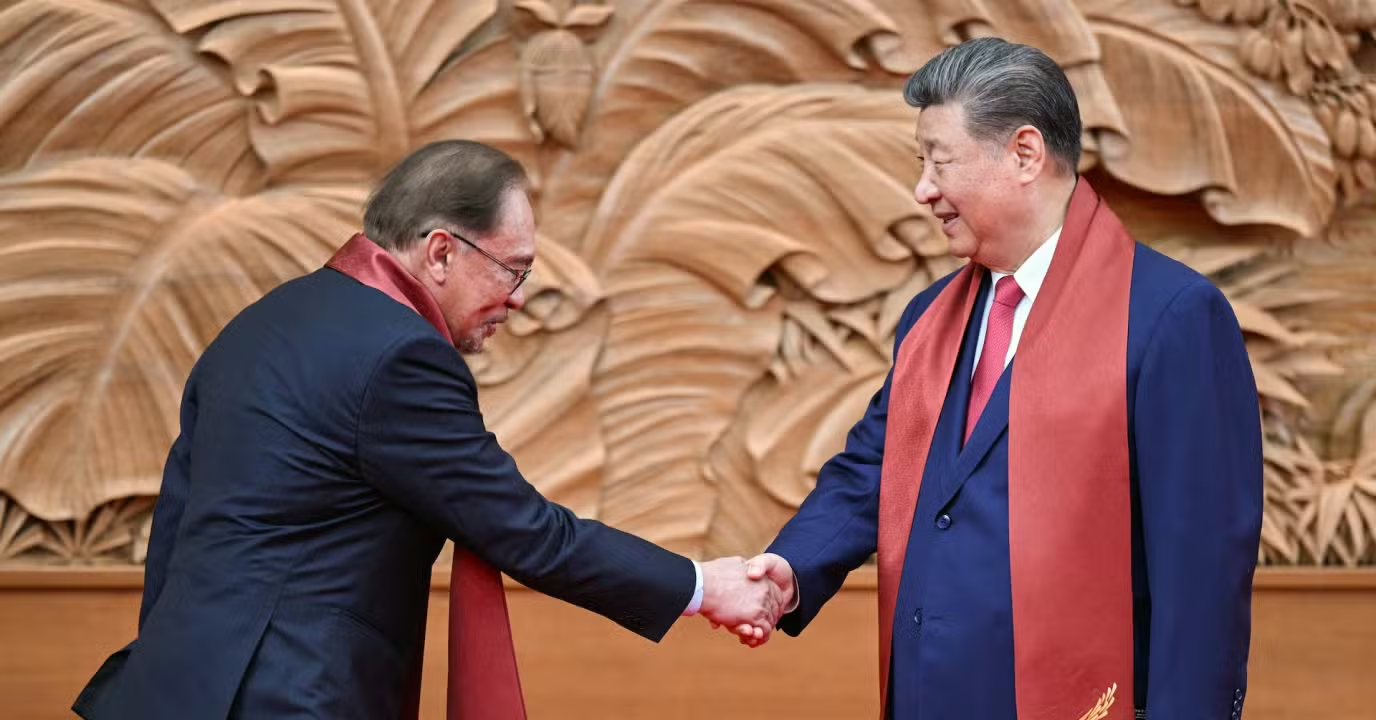
Malaysian Prime Minister Anwar Ibrahim said the US export curbs on advanced AI chips will not deter Malaysia from working with Beijing and Chinese firms, saying, 'Having excellent relations with China does not preclude us from continuing to engage with the United States. And the Chinese seem to understand.'
Anwar Ibrahim rejected suggestions of a tilt toward China, saying, 'People tend to suggest that I'm tilting a bit towards China. It's not true,' and that Malaysia is not leaning to either China or the United States.
Anwar Ibrahim said China has not raised any concerns over Malaysia's relationship with the United States or its technology arrangements with Washington.
Anwar Ibrahim said Malaysia will monitor whether any US-linked companies ship chips to China, just as it would monitor Chinese firms required to operate under rules set by Beijing.

