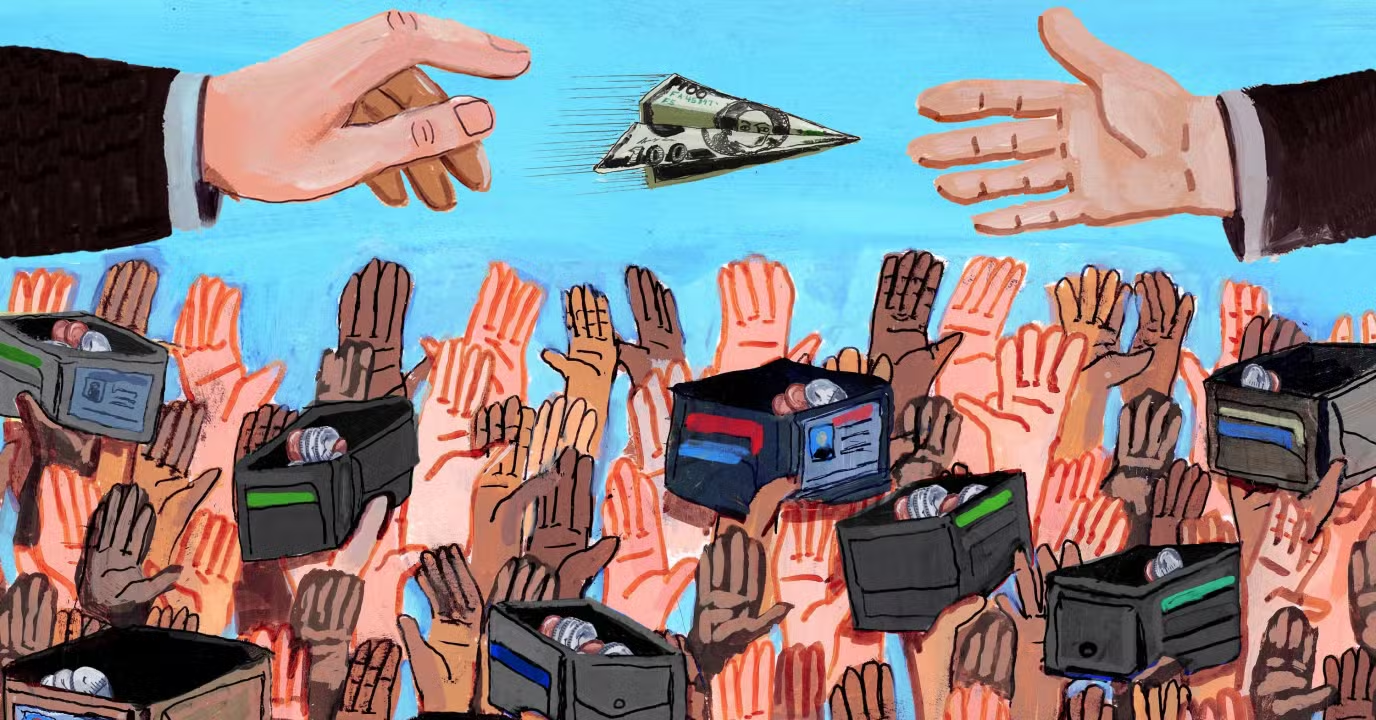
ProPublica Publishes Database of $28.5 Billion in Tariff Refunds
See How Much Companies Are Getting in Tariff Refunds — ProPublica
propublica.org· 2d
We’re Publishing the Tariff Refunds the Government Has Refused to Disclose
Tariff Refunds Are Going To Executive Bonuses At These Companies, Report Says
forbes.com· 5d
Several companies are using Trump tariff refunds for corporate bonuses
theguardian.com· 5d
Companies Use Tariff Refunds For Executive Bonuses - Joe.My.God.
joemygod.com· 5d
These Companies Are Using Trump’s Tariff Refunds for Executive Bonuses
When President Donald Trump's tariffs hit in 2025, Stanley Black & Decker raised its prices repeatedly, telling consumers the increases were needed because of the import fees. After the Supreme Court struck down Trump's most sweeping tariffs in 2026, the company began receiving at least $298 million in tariff refunds, and is using the money for executive bonuses rather than customer reimbursements. It has not responded to a lawsuit brought by a Wisconsin resident and has not answered questions about who is getting its bonuses or whether customers will be reimbursed.
Stanley Black & Decker is not alone: a ProPublica analysis of thousands of securities filings and earnings calls found at least nine publicly traded companies that have disclosed using tariff refunds for bonuses instead of repaying consumers. TJX, the parent of TJ Maxx and Marshalls, received $331 million and accrued $112 million for year-end incentive compensation and discretionary bonuses. Acushnet, the owner of Titleist, will spend $12 million of its $45 million refund on bonuses, and American Eagle plans to use $18 million of its $196 million refund for the same purpose. None of the companies using refund money for bonuses has ever said it planned to refund customers. Almost all firms that publicly pledged to pass refunds along sell to other businesses rather than consumers, and some are repaying business customers that kept itemized receipts of the tariff markups.
The Trump administration has refunded at least $100 billion in tariffs since August 2025 but has not specified which companies are receiving the money, and it denied ProPublica's public records requests for the refund information, prompting the outlet to rely on securities filings and earnings call transcripts. ProPublica is appealing the US Customs and Border Protection denial.
On November 19, ProPublica published 'Cash Back', a database of refunds for tariffs paid under the International Emergency Economic Powers Act covering 343 public companies. Its tally found $28.5 billion in refunds disclosed or expected, against $166 billion in tariffs to be refunded plus interest. The largest disclosed refunds include FedEx at $3.3 billion, Walmart at $2.9 billion, Apple at $2.2 billion, and Ford at $1.3 billion, while UPS and FedEx are itemizing how much customers paid in tariffs and reimbursing them through online portals.
Stanley Black & Decker raised prices repeatedly after being hit with President Donald Trump's tariffs in 2025, telling consumers the increases were needed because of the import fees.
After the Supreme Court struck down Trump's most sweeping tariffs in 2026, Stanley Black & Decker is receiving at least $298 million in tariff refunds and is using the money for executive bonuses rather than customer reimbursements.
A ProPublica analysis of thousands of securities filings and earnings calls found at least nine publicly traded companies that have disclosed using their tariff refunds for bonuses instead of repaying consumers.
Companies directing refund money to bonuses include TJX, the parent of TJ Maxx and Marshalls, and Acushnet, the owner of the golf equipment brand Titleist.
TJX said it received $331 million in tariff refunds and accrued $112 million for year-end incentive compensation and discretionary bonuses for eligible employees.
Acushnet disclosed an incentive compensation expense of about $12 million from its tariff refund.
Dozens of other firms have said little about their refund plans beyond describing the windfall as earnings used to determine executive bonuses.
Almost all companies that publicly pledged to pass refunds to their customers sell to other businesses rather than consumers, leaving consumer refunds largely out of reach.
Some companies are paying refunds back to business customers that kept itemized receipts detailing the tariff markups.
None of the companies using refund money for bonuses has ever said it planned to refund customers.
Stanley Black & Decker has not responded to a lawsuit brought by a Wisconsin resident and did not answer questions about who is receiving its bonuses or whether customers will be reimbursed.
TJX said it has not disclosed a breakout of the bonus accrual because the refunds are an accrual and its current fiscal year has not ended.
TJX said the rest of its refund will be used to support its future growth.
Securities experts who reviewed the disclosures said the refund windfall appeared to boost Stanley Black & Decker's profits, which factor into formulas that help determine bonus pay.
The Trump administration has refunded at least $100 billion in tariffs since August 2025 but has not specified which companies are receiving the money.
President Trump signaled he would 'remember' which companies sought reimbursements.
Acushnet will spend $12 million of its $45 million tariff refund on bonuses.
The Trump administration denied ProPublica's public records requests on the tariff refunds, prompting it to rely on securities filings and earnings call transcripts.
American Eagle disclosed in a September 2026 Securities and Exchange Commission filing that it plans to use $18 million of its $196 million tariff refund for bonuses.
Gregory Germain, a corporate law professor at Syracuse University, said, "Executive bonuses are probably the least just way to use this money because it wasn't anything the executives did that they should be rewarded for. It was a government mistake that resulted in a refund."
On November 19, ProPublica published 'Cash Back', a database of figures on refunds for tariffs paid under the International Emergency Economic Powers Act.
The database covers 343 public companies with mentions of refunds, amounting to more than $28 billion recovered or expected.
The Trump administration has not publicly detailed which companies are getting roughly $170 billion in tariff refunds or how much they have requested.
ProPublica is appealing the US Customs and Border Protection denial of its requests for the refund information.
UPS and FedEx are itemizing how much customers paid in tariffs and reimbursing them through online portals for tracking refunds.
ProPublica says it will periodically update the 'Cash Back' database by pulling information from newer filings and correcting or adding information when companies reach out.
ProPublica's tally found $28.5 billion in tariff refunds across 343 public companies, against $166 billion in tariffs to be refunded plus interest.
The largest disclosed refunds include FedEx at $3.3 billion, Walmart at $2.9 billion, Apple at $2.2 billion, and Ford at $1.3 billion.
Other large disclosed refunds include Target at $994 million, Nike at $986 million, Home Depot at $730 million, Amazon at $640 million, Gap at $517 million, and Medline at $507 million.

