Democrats' midterm sweep delivers 56 Senate seats and control of statehouses nationwide
See How Much Democrats Gained, From Congress to State Races
nytimes.com· 3h
Ben Shapiro says Republicans need a ‘complete rebuild’ before 2028
newsnationnow.com· 12h
Trump shares inaccurate ranking of presidents' midterm losses
newsweek.com· 19h
US midterms 2026: What happens before the new Congress takes office?
aljazeera.com· 21h
Trapped GOP chair admits grim truth after massive midterm wipeout
rawstory.com· 24h
‘Grandfather’ or ‘godfather’? Republicans know they’re stuck with Trump
politico.com· 25h
Democrats Have 56 Senate Seats. Is That Enough? - Newsweek
Sotomayor suggests Supreme Court colleagues may applaud midterm results as safeguard
thehill.com· 37h
Black voters swung the South. Their message to Democrats: Don't squander this
motherjones.com· 38h
After winning historic trifecta, Arizona Democrats could enact sweeping pro-voting agenda
democracydocket.com· 41h
“Weird Little Echo”: Natalie Harp’s Eerie New Way of Hyping Up Trump
newrepublic.com· 46h
From Beto to ‘Blexas’: how Democrats flipped Texas during the midterm elections
theguardian.com· 2d
Gen Z is getting nostalgic for the Obama era — with an asterisk
vox.com· 2d
Tarrant County GOP is soul-searching, finger-pointing
texastribune.org· 2d
Instant frontliners: North Carolina’s surprise delegation knows they’re running on borrowed time
White House's 'little echo' has insiders worried Trump is done for: biographer
Keisha Lance Bottoms says Democrats better spend big on the South
Elie Mystal: Accountability for Elon is coming from Democrats in Congress & new Texas Democratic AG
youtube.com· 2d
The midterms were the largest win for either party in 50 years
npr.org· 2d
The midterms were bad for Republicans. The closest races show how it was nearly even worse.
nbcnews.com· 2d
AG Blanche OUTFLANKED by 30 Dem Attorney Generals led by California and Now TEXAS!!!
'Narcissistic injury': Doctors flag 'major toll' on Trump's brain from midterm battering
Voters Rejected Washington’s Foreign Policy; Congress Must Listen | Common Dreams
commondreams.org· 3d
Democrats won big. Now they’re arguing about why.
Odessa Republican sees path to bipartisanship in the Texas House
The Man Who Broke the Texas Democratic Party to Save It
rollingstone.com· 3d
Democrats flipped 9 US Senate seats — the most in almost 70 years
apnews.com· 4d
2 in 5 Americans will live in states with Democratic women governors
19thnews.org· 5d
Donald Trump's midterm election charts leave out key details
‘The American people said SCREW YOU!’: Nicolle and Maddow on how ‘weirdo’ Trump’s reign is ENDING
Newly empowered Democrats ready to overhaul gun laws in red states
dailykos.com· 5d
Democrats bullish on South after historic midterms gains
The Reward for Black Women’s Work in Georgia: Leaders Who Look Like Them
Midterm voters ended the long-running GOP dominance in state legislatures
Will Trump’s lame duck presidency push him further beyond constraints of the law?
Rep. Lauren Boebert of Colorado loses House seat to Democrat Eileen Laubacher
How Texas’ Blue Takeover Could Soon Begin Impacting Texans’ Lives
time.com· 8d
Democrats Flip Two More Governor’s Offices in Massive Win
Josh Shapiro’s blowout victory is his strongest case for 2028. How do other potential presidential contenders compare?
inquirer.com· 9d
Democrats have reached a détente in their internal war. Will it last?
These two voter turnout trends explain what happened across the South in the election
How badly did Republican gerrymandering fail?
economist.com
We’re All Worth Fighting For
medium.com· 9d
Black Turnout Rose in Georgia, Powered by Younger Voters
A Democratic Ground Game Reshaped the Political Map of the South
bloomberg.com· 9d
‘Too big to rig’: Democrats’ midterm landslide divides election deniers
The Democratic tsunami Is a “sea change” for reproductive rights
Trump’s Midterm blow: The Conversation
House Democrats’ majority approaches a modern record
washingtonpost.com· 11d
MAGA Fury Erupts as Trump Blurts Out Damning Admission about GOP Loss
AOC Brilliantly Explains How Congress Really Works After Democrats’ Historic Midterm Sweep
540-Plus Seats Flipped, 6 New Trifectas: Dem Wins At The State Level Keep Piling Up
huffpost.com· 12d
Mike Johnson slams voters for making ‘wrong choice,’ predicts ‘circus’ after GOP’s midterm drubbing
nypost.com· 12d
The Democratic Party gained power across the country in the midterms. Now what?
Black Women Carried Democrats to Victory—Again - The American Prospect
prospect.org· 12d
Trump’s End Could Come Sooner Than Anyone Thinks (w/ Mark Blumberg) | Psycho Politics
'Beaten and Disinterested' Trump Makes 'Flaccid' Claim That Midterms Were Rigged | Common Dreams
Everyone Thought Bill Kristol Was Crazy. Then Election Night Happened. | Bulwark Daily
Trump Blurts Out Surprise Admission About Losses, Wrecking MAGA’s Spin
Trump casts doubt on Democrats’ historic midterm wins
Trump Finally Emerges From Election Loss Stupor to Cry Fraud
Real Men Are Thrilled About All the Women Elected Last Week
substack.com· 12d
Dems storm Deep South as GOP’s ‘safe’ red states start to crack amid ‘paradigm shift’
Congress returns to a changed Washington after GOP's election wipeout
‘A complete repudiation’: public health won big in US midterm elections
Democrats won big on issues like immigration. But ICE still has the money
Democrats won big. Can they lower your grocery bill?
Maintaining calm while GOP panics.
Read the full transcript of Ross Douthat's interview with President Trump
cbsnews.com· 13d
Democrats’ Victory Will Be Wasted Without New Leadership
currentaffairs.org· 13d
BREAKING: Trump Lashes Out After Midterm WIPEOUT
Our Wins Of The Week
Trump enters the anger stage over the GOP's catastrophic loss
For Trump and America, a Clear Election Verdict but a Murky Future
Video: Keisha Lance Bottoms on What Democrats Can Do to Make Their Victory Last
Here are the midterm races to watch that are still too close to call
Will this week's blue wave election usher in a Democratic president in 2028?
cnbc.com· 14d
‘Swaggering assholery’ REJECTED: Voters threw ‘toxic chuds’ out on their butts, says Hayes
The economy propelled Democrats to victory. What can they actually do about it?
Trump Has Made A Noticeable Change In How He Acts Since The Election. Therapists Have A Theory Why.
Democrats want RFK Jr’s ‘head on a platter’ after midterms triumph
independent.co.uk· 15d
Big Tech lost big in the 2026 election | The Vergecast
Gina Hinojosa Will Be Texas’s First Democratic Governor in Decades. Republicans Won’t Make It Easy.
Mary Trump: 'Investigate ALL OF THEM' After Trump's Midterm Wipeout | 6 Questions | Steven Beschloss
US elections 2026 live: Democrats hold nearly 100 more House seats than Republicans as blue wave continues to grow
"This Was An Extinction Level Event For Republicans," Ron DeSantis Says Midterm Voters Rebuked Trump
AIPAC’s dwindling allies in Congress
Exclusive: Democrats flock to Mississippi amid Senate vote tally
semafor.com· 16d
A NIGHT TO REMEMBER
Democrats' victory was clear. The party's future is not
JD ABANDONS SHIP: IRAN WAR Was Political Disaster
America isn’t the only nation celebrating the blue tsunami
Trump’s Heart Breaks As Canada Sings Saddest Song After Loss | Lego, Bill Clinton & Slow English
Here’s What Happens When Trump’s Star Implodes
thebulwark.com· 16d
Elon Musk Deletes Smug Election Posts After They Backfire and His Businesses Tank by $120 Billion
futurism.com· 16d
Didn’t Take Long: Dems Are Already Hiring the Lawyers Who Will Bury Trump And His Friends
Was Elon Musk the US midterms' biggest loser? – Stateside with Kai and Carter
Progressives hail ‘blue wave’ victories in US midterm elections as top Democrats push for unity
How Trump's Corruption Helped Democrats Create A Blue Wave
What a blue Texas means for Elon Musk’s future
Does the blue wave mean lower gasoline and diesel prices soon? Don't hold your breath
The South flexes political power in midterms, sets regional influence in 2028 election
November 4, 2026
- The MeidasTouch Podcast - Podcast - Apple Podcasts
apple.com· 17d
How Trump Lost the Midterms
wsj.com· 17d
Inside Team Trump’s Historic Collapse in the 2026 Midterm Elections
BREAKING: Blue Tsunami CRUSHES Republicans as Trump Folds
Democrats won Congress. But can they deliver on their promises?
Voters Just Changed the Trajectory of the Supreme Court
Trump Wrestles With New Reality: A Lame Duck With Two Years Left to Fight
Republicans quickly turn against Pete Hegseth after midterms rout
yahoo.com· 17d
A MAGA media civil war erupts over who’s to blame for the GOP’s thrashing
2026 midterm election results live: Democrats sweep Congress. What’s next for Trump?
ms.now· 17d
Schumer, Jeffries say cutting costs is job No. 1 for Democratic majority
spectrumlocalnews.com· 17d
Trump, MAGA SELF IMPLODE After MASSIVE LOSS
Vance blames Republicans’ midterm losses on Iran war, cost of living
Midterms: how the blue wave took Congress in three minutes – video
'This is a disaster': Angry Republicans blame Trump for midterms defeat
bbc.com· 17d
6 takeaways from Democrats' big wave on election night
Election 2026 live updates: Democrats take Congress as Trump distances himself from historic losses
2026 Midterm Elections Live Updates: Democrats Vow to Check Trump After Winning Congress
Angry Voters Usher in Beginning of the End to the Trump Era
Everything you need to know from the US midterm elections
Democrats capture full control of Congress, NBC News projects, fueled by victories in deeply Republican states
Voters pummel GOP out of power
【米中間選挙2026】 民主党、上下両院で主導権を奪う見通し トランプ政権を有権者が否定 - BBCニュース
Democrats poised to sweep Florida congressional districts redrawn by Republicans
Republicans Forced to Reckon With How They Destroyed Their Own Party
Trump Says There’s No Way Democrats Are Going to Impeach Him
Trump Rages Wildly Over Losses—and Accidentally Reveals How MAGA Dies
Democrats Win Enough Seats Nationwide to End Electoral College
Midterm elections live updates: First polls begin to close with control of Congress at stake
2026 Senate midterm election results as Democrats win control, Schumer vows "legislative razor wire" against Trump
Midterms aux États-Unis : la nuit électorale en direct
mediapart.fr· 18d
Trump faces midterm verdict with control of Congress at stake
reuters.com· 19d
Democrats won the November 3, 2026 midterms in a historic sweep, taking both chambers of Congress and governorships nationwide. Senate control, uncertain going into election night, was settled within hours: Democrats flipped seven seats, three in states Republicans had held for decades, including Texas, where James Talarico beat Ken Paxton by 12 points despite more than $413 million in Republican spending. Keisha Lance Bottoms became the first Black woman governor in US history in Georgia.
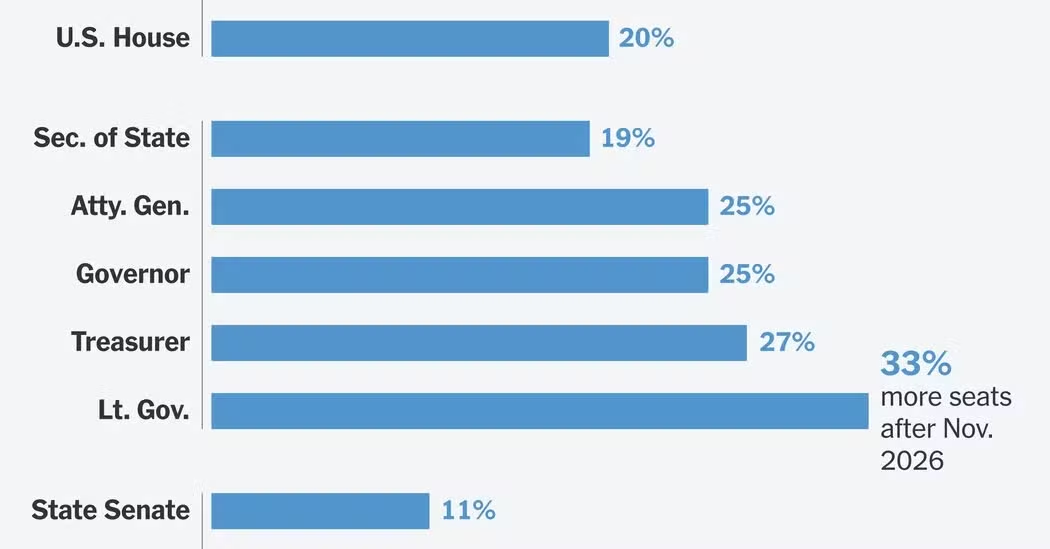
The House was a wave: Democrats flipped at least 43 Republican-held seats and finished with their largest delegation since 1990. They also flipped 549 state legislative seats and took 12 chambers, while the Texas map drawn to add five Republican seats instead elected one more Democrat.
Exit polls found 43 percent of voters cited opposition to Trump as a reason for their vote. Republicans tried to pin the losses on Defense Secretary Pete Hegseth and the Iran war, but his impeachment failed and Jim Jordan became minority leader. Trump blamed Fox News, claimed the results were tainted by fraud, and replaced chief of staff Susie Wiles with Stephen Miller.
Scott Colom unseated Cindy Hyde-Smith in Mississippi, its first Black senator since the early 1880s, and on November 18 Mary Peltola defeated Dan Sullivan in Alaska, giving Democrats a 56-44 Senate majority, their largest in 16 years. Final counts put Democratic gains at nine Senate seats, 47 House seats flipped for a net gain of 44, six governorships and 28 statewide offices, nearly all in the South and Great Plains, and three-quarters of Americans will be represented by a Democratic governor.
Polls and nonpartisan analysts favored Democrats to win the US House of Representatives, while control of the Senate remained uncertain before the November 3, 2026 midterms.
All 435 House seats and 35 of 100 Senate seats were up for election, and Democrats needed to flip at least three House seats and four Senate seats to win majorities.
Democrats had to defend every Senate seat while winning at least two of seven states Donald Trump carried by double digits in 2024: Alaska, Iowa, Kansas, Nebraska, Ohio, South Carolina and Texas.
Trump's approval rating hovered near his all-time lows amid voter frustration over the war with Iran and the resulting rise in fuel prices.
Trump's Justice Department opened a criminal probe into Alaska Senate recruitment allegations, sued to block ballots in California and deployed 1,000 Election Day monitors.
The Supreme Court declined to halt the Justice Department's suit to block California ballots.
Democrat Haley Stevens endorsed Republican Mike Rogers over Abdul El-Sayed in Michigan's Senate race days before the election.
Mary Peltola's campaign was reported to have helped recruit a third candidate sharing the name of her Alaska opponent Dan Sullivan, which she denied.
Elon Musk spent hundreds of millions of dollars boosting Republicans, including a nine-figure investment benefiting Ken Paxton in Texas.
Democrats warned Trump might challenge the midterm results if Republicans lost.
Democrats won the 218 seats needed for a House majority, giving them control of the full Congress along with the Senate.
Democrats took control of the Senate with 51 seats confirmed, flipping seats in North Carolina, South Carolina, Texas, Kansas, Ohio and Iowa.
James Talarico defeated Ken Paxton in Texas's Senate race, 58 percent to 40 percent.
Annie Andrews, a pediatrician, defeated Darline Graham Nordone in South Carolina's Senate race.
Adam Hamilton won Kansas's Senate race and Josh Turek won Iowa's.
Roy Cooper won North Carolina's Senate race.
Susan Collins conceded Maine's Senate race to Troy Jackson while trailing by more than five points.
Keisha Lance Bottoms won the Georgia governorship, defeating billionaire Rick Jackson to become the first Black woman governor in US history.
Rob Sand won the Iowa governorship with more than 56 percent of the vote.
Jon Ossoff won reelection to the Senate in Georgia.
Gina Hinojosa was elected governor of Texas.
Denise Powell won Nebraska's 2nd congressional district by 17 points.
Elon Musk spent nearly half a billion dollars on the midterms, including more than $180 million supporting Ken Paxton in Texas.
Nearly 60 million Americans voted early, about 10 million more than in 2022.
CBS projected Democrats won control of the Senate with at least 54 seats after upsets in Texas, South Carolina and Kansas.
CBS projected Senate flips in Maine, Iowa, Ohio and North Carolina, and Democratic holds in Georgia, New Hampshire and Michigan.
CBS projected Abdul El-Sayed defeated Mike Rogers in Michigan, which would make him the nation's first Muslim senator.
Alaska and Mississippi remained unresolved, with Scott Colom and Cindy Hyde-Smith separated by a hair-thin margin and Mississippi officials saying several thousand ballots still needed counting.
Ken Paxton conceded the Texas Senate race to James Talarico on election night.
CBS projected Republican wins for Pete Ricketts in Nebraska, Kurt Alme in Montana, Mike Rounds in South Dakota, Julia Letlow in Louisiana, Bill Hagerty in Tennessee and Barry Moore in Alabama.
CBS projected Peggy Flanagan won Minnesota's Senate seat.
Montana's Republican win followed Senator Steve Daines's surprise retirement and quick endorsement of Kurt Alme before the filing deadline.
The first polls closed in parts of Indiana and Kentucky on November 3, with competitive House races in Indiana's 5th and Kentucky's 6th districts on the early ballots.
Some Chicago polling places ran out of paper ballots, and election officials printed more, saying everyone in line by closing would be able to vote.
Chester County, Pennsylvania extended voting 30 minutes in three precincts after machine set-up problems delayed opening.
North Carolina extended hours at five polling sites after computer problems, with the longest extension 45 minutes in Columbus County.
The Associated Press compiled tallies and declared winners in nearly 7,000 races nationwide.
Democrats took control of state legislatures and governorships in Pennsylvania, Michigan, Arizona, Wisconsin and Nevada, states that had not joined the National Popular Vote Interstate Compact.
If those five states joined the compact, electoral votes assigned to the national popular vote winner would rise to 283, above the 270 needed to win the presidency.
The compact's 19 existing member states hold 222 electoral votes, and Democrats lack a filibuster-proof 60-vote Senate majority.
Trump blamed Fox News, Republican candidates and his own consultants for the losses that flipped the Senate and House.
Democrats flipped at least five Senate seats in states Trump carried by double digits, a number that could rise to seven.
Trump's 2024 gains among Latino and young voters evaporated, with exit polls showing Democrats winning both groups by lopsided margins and nearly reaching parity among non-college voters.
Democrats increased their share among working-class whites by 14 points over 2024 and won white women, reversing Trump's 2024 victory among them.
Democrats recaptured Mahoning County, Ohio, the archetypal Obama-Trump county, and flipped House districts in Iowa, Wisconsin and Appalachian North Carolina.
Trump privately raged at his own advisers, accusing them of giving him bad information about polling before the election.
Trump's first public remarks after the defeat came at the construction site of his White House ballroom, alongside Interior Secretary Doug Burgum.
Florida Governor Ron DeSantis blamed Republican lawmakers for bad votes, including opposing a stock-trading ban, and for the botched release of the Jeffrey Epstein files.
Republicans lost four of the five supposedly GOP-friendly House seats they had created in Texas, plus two more of their own.
Alabama voters rejected the state GOP's gerrymander, reelecting Democratic Representative Shomari Figures.
Democrat Ben McAdams won Utah's redrawn 1st congressional district by 47 points.
Democrats gained two more House seats in Ohio, possibly a third, and elected Amy Acton governor and Sherrod Brown senator.
Missouri voters rejected the new congressional map, and Democrats gained a House seat in the state.
Republicans redrew districts in several states, but voters in Florida, North Carolina, Ohio, Texas, Alabama and Utah largely chose Democrats anyway.
Marsha Blackburn won Tennessee's race for governor.
In Florida, Representatives Jared Moskowitz, Kathy Castor and Debbie Wasserman Schultz held their seats, first-time candidate Pia Dandiya won, and Darren Soto led in the 9th District.
CBS projected Democrats winning at least 239 House seats to at least 161 for Republicans.
CBS projected a Democratic Senate majority of 52 seats to 41 Republican, with seven seats undecided.
CBS changed its rating of the Kansas Senate race to leans Democratic during counting.
CBS projected Sherrod Brown winning Ohio's Senate seat.
CBS projected Chris Pappas winning New Hampshire's Senate seat, set to become the first openly gay man in the Senate.
Final results in some House districts would take several days as mail ballots were counted.
By 11:30 p.m. on election night Democrats had flipped eight Republican House seats, enough for a majority.
Texas voters elected at least two Democrats statewide, flipping the Senate seat and the governor's mansion.
County-level data showed Democrats running on average more than 8 points ahead of Kamala Harris's 2024 performance, with nearly every state, district and county moving toward them.
Trump's political operation spent more than $380 million to retain control of Congress.
Roy Cooper was on track to win North Carolina's Senate race by as many as 20 points.
Democrats flipped Kentucky's 6th District, which Trump won by 15 points in 2024.
Annie Andrews won South Carolina, a state Trump carried by nearly 18 points in 2024.
NBC projected Democrats captured full control of Congress with their largest House majority in nearly two decades.
Not since 2006 had the minority party flipped both chambers of Congress on a single night.
Exit polls found 43 percent of midterm voters cited opposition to Trump as a reason for their vote.
Democrats will gain the power to issue subpoenas and schedule oversight hearings when the new Congress convenes in January 2027.
Hakeem Jeffries needs 218 votes to win the speaker's gavel on January 3, 2027, which would make him second in the line of presidential succession.
Representatives Robert Garcia and Jamie Raskin are positioned to lead House investigations of Trump, with Garcia focusing on what he calls 'Trump family corruption.'
Republicans may pass a reconciliation bill and a debt ceiling increase during the lame-duck session before relinquishing House control.
Gina Hinojosa was elected Texas governor, its first Latina governor and its first Democratic governor in decades.
Republican Byron Donalds won the Florida governor's race, becoming Florida's first Black governor.
Melat Kiros won a House seat in Colorado, becoming the first Gen Z woman elected to Congress.
Trump invoked 9/11 and called Abdul El-Sayed a 'jihadist' without evidence, drawing a backlash and accusations of Islamophobia.
Estimates put the Democratic margin in the national House vote at about 13 points, the largest for either party in a congressional election since at least 1976.
Trump implored voters 47 times during the fall campaign to pretend he was on the ballot.
Trump delivered his final pre-election address at the Lincoln Memorial Reflecting Pool, talking about renovation details rather than cost-of-living worries.
Control of the Senate was determined within hours, with 33 of 35 contests called on election night.
The Democratic surge netted at least 330 state legislative seats, full control of 22 state governments, and majority status in a dozen statehouse chambers.
Voters across every major demographic group swung left, with Hispanic voters moving nearly 30 points toward Democrats and sizable gains among non-college whites and older voters.
Representative Richard Hudson conceded his North Carolina seat while trailing by about 2 points with the race still uncalled.
If Democrats exceed 257 House seats, it would be the largest majority for either party since 1992.
Democrats won a majority of governorships for the first time in 16 years and regained governing power in four new states.
Trump had personally convinced Darline Graham to run for a full Senate term in South Carolina, where she lost to Annie Andrews by more than four points.
Two Senate races and more than 60 House races remained uncalled as of early Wednesday morning.
Alaska's vote counting will continue for the next two weeks.
Iran's parliament speaker Mohammad Bagher Ghalibaf said the Republican loss of Congress showed voters had rejected Trump's war in Iran.
Voter polling found 62 percent disapproved of Trump's job performance, two-thirds said his policies made economic conditions worse, and 62 percent said he prioritizes his own interests over the country's.
James Talarico won Texas's Senate race by roughly 12 points, or 1.1 million votes, the first Democrat sent to the Senate from Texas since 1988.
Gina Hinojosa won the Texas governor's race by 7 points, almost 700,000 votes.
Texas Democrats flipped two congressional districts Trump won by at least 14 points in 2024 and won lieutenant governor, attorney general and railroad commissioner.
Republicans spent more than $413 million on the Texas Senate race and lost.
Trump posted an image of a red hat reading 'VETO' just before midnight on election night.
Trump was silent for much of election night before posting on Truth Social after both chambers were called for Democrats.
Trump often seemed disinterested in the midterms over the summer, consumed by the Iran war abroad and his construction overhaul of Washington at home.
Several Republicans said events like a UFC match at the White House on Trump's 80th birthday in June fed the impression he was more interested in feting himself than winning the midterms.
Trump told Politico he does not want to just be vetoing things and wants to work with Democrats, and said maybe when asked whether he would work on an immigration bill.
Trump said he does not think there will be any cabinet changes as a result of the election.
Democrats flipped seven Senate seats, three in states Republicans had held for decades: Texas, Kansas and South Carolina.
Democrats held 229 House seats to 139 for Republicans, with 67 races still to be called.
House Majority Leader Steve Scalise and House Judiciary Chair Jim Jordan both planned to run for House Republican minority leader.
Mary Peltola led Dan Sullivan by 626 votes in Alaska's Senate race with more than 70 percent counted and roughly 70,000 ballots potentially outstanding.
Alaska will begin counting late-arriving ballots on November 10 and has until November 18 to process absentee ballots, using ranked-choice tabulation if no candidate wins a majority.
Scott Colom led Cindy Hyde-Smith by 65 votes in Mississippi with thousands of provisional ballots outstanding, in the only state without a recount provision.
Voters backed abortion rights in three of four states with abortion-related ballot measures: Virginia, Nevada and Missouri.
Democrats won control of the Texas state House for the first time in more than two decades, with 76 seats called to 61 Republican.
Eric Armstrong won an Iowa state House seat by roughly 10 points despite having dropped out of the race.
Nancy Lacore led in South Carolina's 1st congressional district after her Republican opponent Jenny Costa Honeycutt conceded.
Republicans moved swiftly to pin the midterm losses on Defense Secretary Pete Hegseth, arguing he played a chief role in convincing Trump to attack Iran with no exit strategy.
Representative Thomas Massie planned to trigger a vote to impeach Hegseth when Congress returned, with multiple Republicans expecting it to pass, possibly as soon as that week.
White House aides including Stephen Miller, budget director Russell Vought and legislative affairs staff had prepared a menu of options for Trump to govern through executive power alone.
House Democrats planned to scrutinize top immigration officials including Stephen Miller, border czar Tom Homan and Homeland Security Secretary Markwayne Mullin.
Trump's election-night watch party in the East Room turned morose, with attendees quietly discussing possible cabinet changes and Chief of Staff Susie Wiles's future.
Trump told podcaster Dan Bongino on Election Day that he has 'many, many things in the hopper' without elaborating.
An ally described Trump as dazed after the Democratic rout.
Under Ohio law Sherrod Brown will replace Senator John Husted in the Senate on December 15, 2026, shrinking the Republican majority before new senators are sworn in.
Matt Ford argued that a 51-vote Democratic majority would have raised concerns that Pennsylvania Senator John Fetterman, who has sided with Trump, might defect, while the larger margin removes that risk.
Marc Elias's law firm was retained by Scott Colom's Mississippi Senate campaign, disclosed on November 4, with lawyers on the ground observing the count.
Colom led Cindy Hyde-Smith by 1,138 votes as of early evening November 4, a margin the Associated Press confirmed.
Mary Peltola led the Alaska Senate race by 625 votes with 74 percent of the vote counted.
North Carolina's entire congressional delegation flipped to Democrats.
Democrats picked up four seats on the Texas Supreme Court, and won more governorships than at any time since 1993, including Jocelyn Benson in Michigan, Aaron Ford in Nevada and Katie Hobbs in Arizona.
Democrats took control of at least one legislative chamber in Texas, Georgia and North Carolina.
Six days before the election, more than two dozen of Trump's top strategists held a grim private video call filled with gallows humor about funeral arrangements, prison food and fleeing the country.
A slide deck by Trump aide James Blair tied Republican polling to the Iran war timeline, warning that a 10-point Democratic edge would likely cost the Senate.
Trump asked advisers before the polls closed what would have happened in the midterms if the United States had never gone into Iran.
A string of investigative reports into Trump family self-dealing, including $2.2 billion in personal profits, made corruption voters' top concern by October, an early Fox News poll found.
Chuck Schumer wooed Roy Cooper for months and made at least three trips to Ohio to coax Sherrod Brown back into running; both won their Senate races.
Trump's allies threatened Senators Joni Ernst and Thom Tillis into retirement, creating vulnerable open Republican seats.
Trump endorsed Ken Paxton over incumbent Senator John Cornyn, and Republicans spent close to $300 million in Texas before Paxton lost by 12 points.
House Democratic recruiters sought candidates with distinctive biographies in districts Trump carried by 10 or more points, betting early that the president would overreach.
The mid-decade gerrymandering push begun in Texas carved out five new Republican-favoring House seats, which Democrats largely swept anyway.
California voters approved five new Democratic-favoring House seats and Virginia voters approved four, though the Supreme Court later struck down the Virginia map.
Federal agents shot and killed two protesters, including Alex Pretti, during a January 2026 immigration enforcement surge in Minneapolis, after which Democratic internal polls showed the party taking the edge on immigration for the first time.
Trump's four-to-six-week timeline for the Iran war stretched into months, closing the Strait of Hormuz, pushing gas past $4 a gallon and depleting American weaponry.
JD Vance negotiated a memorandum of understanding with Iran in June 2026, but the deal fell apart after Iran hawks including Ted Cruz pressed Trump to keep pressure on Tehran.
Elon Musk sent $75 million to the Senate Leadership Fund during the Dallas convention and would spend more than $450 million overall, much of it trying to save Paxton.
Counties that were 80 percent or more Hispanic favored Democrats by 40 percentage points, and Democrats won the Senate races in all four such states.
The White House closed off press access after the election and Trump went roughly 11 hours without a public post.
Election scholar Michael McDonald estimated turnout at about 124.3 million voters, just under half those eligible and just under the 2018 midterm rate.
Deb Haaland was elected governor of New Mexico, becoming the nation's first Native American woman governor.
Voters placed their 'I VOTED' stickers on shrines to Renee Good and Alex Pretti, killed by federal agents during immigration enforcement raids.
Black voter turnout surged in Louisiana, Georgia and South Carolina, where voting set a record for a gubernatorial election year.
Justin Pearson lost Tennessee's redrawn 9th District by one point after national Democrats made his race a priority only in October.
Shomari Figures won reelection by nearly 8 points in the Alabama district Republicans redrew to unseat him, and Republicans carried only one of the nine targeted House seats.
Jamie Davis lost Louisiana's Senate race by less than two points in a state Trump won by more than 15 points in 2024.
Democrats swept every Georgia statewide office and gained control of the state utility regulator.
Republican supermajorities ended in Florida and South Carolina.
Democrats won both Texas attorney general and land commissioner offices, with Nathan Johnson succeeding Ken Paxton as attorney general and Benjamin Flores defeating Dawn Buckingham for land commissioner.
Republicans retained the Texas state Senate 19-12, setting up the state's first divided government in nearly three decades.
Republicans weighed rule changes to curb the powers of Democratic Lieutenant Governor-elect Vikki Goodwin, who will preside over the state Senate.
Christina Bohannan won Iowa's 1st congressional district by nine points after campaigning on a congressional stock-trading ban and other anti-corruption pledges.
Paige Cognetti defeated Representative Rob Bresnahan in Pennsylvania, making corruption and ethics the centerpiece of her campaign against one of the Capitol's most frequent stock traders.
Exit polls found 90 percent of voters called corruption a crucial or major factor in their vote, favoring Democrats 57 to 41.
Leading progressive groups called on senators to oppose Chuck Schumer's ascension to Senate majority leader.
Elon Musk poured $446 million into Republican-aligned groups since 2025, and Democrats won every one of the five Senate races where his America Pac spent the most.
Within 24 hours of the results, the House Judiciary Committee's Democratic staff posted a job listing for oversight counsel and professional staff for the 120th Congress.
Jamie Raskin said his staff had been reviewing investigative opportunities for months, and Robert Garcia said his team had been preparing quietly.
Senior Democrats circulated a 181-page dossier identifying hundreds of executives and companies worth a closer look.
Oversight Democrats said companies that did business with Trump family members collected more than $725 million in federal loans, grants and awards since the inauguration.
Natural Resources Committee Democrats sent demands to more than 20 companies, including defense contractors, tech firms and the UFC, that sponsored America 250 anniversary celebrations.
Tesla shares fell 3.3 percent and SpaceX shares 3.8 percent after the sweep, and by one estimate the drops wiped out more than $120 billion, leaving Musk some $30 billion poorer.
Elon Musk deleted his election-day 'Vote red today!' tweet and his pinned tweet urging followers to vote for Republican senators.
Democrat Zach Dembo won Kentucky's 6th congressional district by more than nine points.
Ontario Premier Doug Ford said he was doing cartwheels and jumping up and down as the results came in, calling the outcome a victory for the United States, the world and Canada.
California elected Xavier Becerra as its first Latino governor.
Mexican President Claudia Sheinbaum praised Becerra's win at a press conference.
Spanish Prime Minister Pedro Sánchez said the far-right is 'crumbling' after the results.
Russian state media warned that after the Republicans' defeat, Trump's wrath would fall on Europe.
The AP Voter Poll found moderates made up about half of Democratic House voters, up from roughly four in ten in recent elections, while about a third of Democratic voters identified as democratic socialists, including nearly half of those aged 18 to 29.
Progressive House candidates Will Lawrence of Michigan and Randy Villegas of California won battleground seats after winning tough primaries.
David Crowley won Wisconsin's governorship by about 8 points over Tom Tiffany, and Jocelyn Benson won Michigan's by nearly 11.
Scott Colom's lead over Cindy Hyde-Smith increased to 1,724 votes as counting continued in Mississippi.
The National Republican Senatorial Committee sent letters to county clerks and election commissioners asking them to preserve and set aside provisional ballots.
Senate Majority PAC spent $2.2 million on Colom's race on top of at least $500,000 from the Democratic Senatorial Campaign Committee.
Senator Catherine Cortez Masto said every time votes come in in Mississippi, Colom gets more and more votes, so she feels confident.
Cindy Hyde-Smith's campaign vowed that outstanding votes from Republican counties will 'reinforce her path to victory.'
More than 30 AIPAC-preferred candidates lost, including Representatives Mike Lawler, Brian Fitzpatrick and Max Miller, and AIPAC said in a memo it would stop directly endorsing candidates while supporting them through its United Democracy Project super PAC.
J Street spent $3 million through its action fund to help defeat five Republican candidates, and all five lost.
AIPAC said in a statement it congratulates the 'hundreds of pro-Israel Democrats and Republicans who won their elections.'
AIPAC spokesperson Deryn Sousa said, 'Our community will work with returning and newly elected members of both parties to advance America's interests by strengthening the U.S.-Israel relationship.'
Ilan Goldenberg of J Street called the results 'an earthquake for the influence of AIPAC, the influence of J Street, and where we stand inside the Democratic Party.'
Brian Romick, president of Democratic Majority for Israel, said, 'There's plenty of pro-Israel candidates who won tough races too. You had a D by your name, you won.'
Ron DeSantis said Florida saw a 10-to-12-point swing against Republicans compared with roughly 20 in Texas, and credited a property tax initiative with turning out voters.
DeSantis said Republicans held every Florida statewide race and kept 26 of 40 state Senate seats despite the wave, while Texas was swept from governor to the state supreme court.
DeSantis called Texas a potential extinction event for Republicans, said the party is not viable nationally if it cannot win Texas, Kansas or Iowa, called the midterm a rebuke of the president and Congress by Democrats, independents and crossover Republicans, and said the fault lies on both sides of Pennsylvania Avenue.
Anton Daniels said the outcome is an extinction level event that was really a rebuke of Trump, and forecast it will hurt for a long time, especially for the middle class.
Cait Conley defeated Mike Lawler to flip New York's 17th congressional district in the Hudson Valley.
Democrats flipped six more House seats, including JoAnna Mendoza over Juan Ciscomani in Arizona, Jessica Killin over Jeff Crank in Colorado, Richard Ojeda over Richard Hudson in North Carolina and Kristina Knickerbocker over Mike Turner in Ohio, for a 253-155 lead.
Matt Dunlap conceded Maine's 2nd congressional district to Republican Paul LePage.
Mary Peltola's campaign said her 637-vote Alaska lead was large enough to prevent Dan Sullivan from overtaking her once all ballots were counted.
Ted Cruz said Republicans were handed an 'ass-kicking,' that it was 'not simply a bad 2006 midterm election, it was a Watergate-level repudiation,' and that food, gas, diesel and insurance are too expensive while 'Too many Republican politicians seem like they didn't understand or they didn't care.'
Newt Gingrich called the midterms 'a failed performance election.'
Volodymyr Zelensky expressed hope that the midterm results will bring more support for Ukraine.
Chuck Schumer told a gathering at the Center for American Progress that millions voted for Democrats out of frustration with Trump rather than love for the party, and warned against the 'false choice' that 'Populism and moderation are not mutually exclusive.'
Analysis forecast certification of new members in January looks likely to go smoothly.
Steven Beschloss put the national margin at 56 to 43 for Democrats, with at least 250 House seats and between 54 and 56 Senate seats.
Mary Trump called the result seismic and a mandate the likes of which she had never seen, and urged wide-ranging investigations, saying 'basically investigate all of them,' including Elon Musk.
Mary Trump said Trump's acceptance of the results was strategic because the numbers against him are too vast, and that he probably wants to get ahead of the investigations coming his way.
Mary Trump said Elon Musk effectively set $500 million on fire in the midterms, spending that bought nothing.
Steven Beschloss called the result a full-throated repudiation, and raised the notion of narcissistic collapse.
Gina Hinojosa pledged a $1,500 refund check to every Texas household from the rainy day fund, abolishing the school voucher program, regulating data centers, and firing Texas Education Agency head Mike Morath on her first day.
Democrats unseated Greg Abbott, Ken Paxton and Dan Patrick, taking control of the Texas House after Republican domination since 2003.
Houston Democrat Senfronia Thompson emerged as the early front-runner for Texas House speaker.
Texas Senate Republicans weighed gutting the lieutenant governor's powers before Democrats officially take over.
Hinojosa said at her first post-election news conference, 'We will have a bipartisan transition, and we will have a bipartisan administration.'
State Senator Bryan Hughes, author of the state's abortion ban, promised Republicans will work with Democrats but said, 'Make no mistake: We will be the firewall against bad and destructive policy.'
House Republican Caucus chair Tom Oliverson said his job is to keep Republicans together and preserve three decades of conservative lawmaking.
Former Abbott adviser John Colyandro said conservative senators could cause gridlock and it will be tough for Hinojosa to get appointees confirmed unless she compromises.
Representative Gene Wu said the transition will look for thousands of people to 'replace Abbott's cronies and sycophants.'
State Senator Carol Alvarado said Democrats will look for an issue to deliver on quickly with Republicans, like regulating data centers.
Of 41 data-center ballot measures in 10 states, all but one, in Harwood, North Dakota, went against data centers.
Jon Ossoff said in his victory speech that the titans of Silicon Valley dig bunkers for themselves and warn the artificial intelligence they are creating risks human extinction, while politics has been too long mired in small and selfish politics bought by big money.
MAHA-aligned groups lost at least 64 of the 97 candidates they endorsed across federal and state races.
Democrats planned investigations, impeachment calls and resignation demands targeting Health and Human Services Secretary Robert F. Kennedy Jr.
Senator Angela Alsobrooks posted on X, 'The time is now. RFK Jr must resign or be fired. End of discussion.'
Erik Polyak, executive director of 314 Action, said, 'We're going to see RFK Jr's head on a platter.'
Florida Surgeon General Joseph Ladapo said of Kennedy, 'The honeymoon period came to an end some time ago,' adding that the partial fracture between MAHA and MAGA may in some ways be a good thing.
Kennedy ally Robert Malone said Kennedy is unlikely to resign because he 'is not a quitter and will stick it out.'
HHS press secretary Emily Hilliard said Kennedy will 'continue delivering President Trump's Make America Healthy Again agenda.'
Trump reacted to the loss with an unusually calm public demeanor, focusing on White House glamour projects including making the Oval Office a national monument, while reminding people of his veto power.
Clinical psychologist Denise Dudley called the calmness 'impression management,' a power move meant to minimize the significance of the setback and signal that Trump is confident, in control and still president.
Therapist Shenikka Moore-Clarke said she does not know whether Trump's calm appearance reflects his internal state and does not trust it either way.
Hakeem Jeffries said Democrats will fight to make the country affordable for every single American, called the election a change election, and said House Democrats need to deliver dramatic change.
Trump announced that Susie Wiles was out as White House chief of staff and that Stephen Miller would run his agenda for the next two years.
Vivek Ramaswamy lost Ohio's governor's race by eight points, and his concession call to Amy Acton went to voicemail.
Max Miller lost his Ohio House seat by almost 10 points.
Pete Hegseth posted congratulations to Stephen Miller within minutes of the appointment, followed by 'Patriots in control' and a photo captioned 'stand, fight, defend the republic'.
Harmeet Dhillon resigned after the election.
Chris Hayes said voters rejected 'the swaggering assholery of the MAGA Republican Party' and threw out its most toxic figures, and that Trump's response is to get into a bunker with two of MAGA's most hated characters.
Chris Hayes forecast that the two remaining years of Trump's presidency will still be incredibly dangerous, all the more so with Stephen Miller as chief of staff and Hegseth at the Pentagon.
In clips the show played, Trump called Democrats 'a party of freaks, weirdos, losers, and crazies' and praised Stephen Miller as great, saying sometimes in life you have to make moves.
Democrats flipped at least 43 Republican-held House seats with an estimated net gain of at least 41, ranking the result among the top ten wave elections and the biggest House loss for the party holding the White House since 2018.
Four days after the election, 19 House races and two Senate races remained uncalled.
Scott Colom's Mississippi lead stood at 2,574 votes as of Friday evening.
Lauren Boebert trailed Eileen Laubacher by more than 3,000 votes in Colorado's 4th District.
Virginia Foxx was locked in a surprisingly close race with Chuck Hubbard in North Carolina's 5th District.
Keisha Lance Bottoms said Democrats flipped the Georgia House, took every constitutional office and reelected Jon Ossoff, becoming the first Democrat to win the governor's race in more than 25 years despite being massively outspent.
Seven other Black women won statewide races in Georgia, including Penny Brown Reynolds as secretary of state and Tanya Miller as attorney general.
Bottoms said Medicaid expansion, eliminating the grocery tax, funding schools and expanding mental health services will be priorities.
In her victory speech Bottoms said, 'Georgia, this win is for all of us,' 'There was a big wave, a seismic shift,' and 'If we don't listen and if we don't deliver, then shame on all of us.'
Penny Brown Reynolds said the Black women elected in Georgia were not selected because they were Black women but because they bring something the state desperately needs, and that 'there is a turning in America.'
Bottoms said she will have to work across the aisle and find common ground where she can, and that she will immediately begin preparing state agencies for Medicaid expansion.
Andrew Young said in a local interview, 'This is the America they taught me about,' saying he felt they saw the results of their labors.
In the days after the defeat Trump signed a steel beam for his ballroom and flew to Florida to give a speech on the space program.
The White House posted an online message reading 'TRUMP IS STILL YOUR PRESIDENT.'
Hillary Scholten said people are conveying joy and relief but also 'Get to work, Congress': they do not want political theater, drama or infighting.
Daniel M. Price said the spell is broken and the veil of invincibility has been pierced.
Peter Baker wrote that Trump has sounded like a man in denial and seems flat, maybe a little dazed, and that the country faces an interregnum between the time Americans decided they were done with Trump and the time he is actually done.
Trump reposted posts alleging the Democratic wins were fraudulent, including one falsely claiming Democrats materialized 20 million new votes.
Trump demanded a Justice Department investigation into alleged Democratic threats against Republican donors and party members.
Trump claimed the stock market, which he called a 'ROCKETSHIP,' took a one-day loss of $3 trillion after the election.
Trump offered the press secretary job to UFC chief Dana White, who declined.
Trump said on a ballroom tour that it is largely true the Iran war hurt Republicans because it drove gasoline prices up in the short term, but that he would do it again because the United States cannot let Iran have a nuclear weapon.
Trump wrote that the economy would suffer without him but 'have no fear, we will be back, BIGGER AND STRONGER THAN EVER BEFORE!'
Commentary read the flurry of posts as Trump trying out responses to see what might stick, and judged he had moved from denial into anger.
Steve Rattner said Democrats won more votes than any party in midterm history, 66 million and counting.
An aggregate account noted Democrats won the combined Senate popular vote across ten former Confederate states, 20,782,908 votes to 17,888,197, a margin of nearly 2.9 million.
Owen Winter said the Democratic popular vote margin was the largest of any party's since 1976.
Trump posted on Truth Social promoting claims that the Democratic wins, including James Talarico's victory in Texas, cannot be real.
Trump ordered Attorney General Todd Blanche to investigate Democrats he called 'EXTORTIONISTS.'
Todd Blanche said on CNN that 'there could be' investigations into Democratic lawmakers who carry out oversight.
Troy Jackson and Adam Hamilton said they will not support Chuck Schumer for Senate majority leader, and James Talarico declined to commit to him.
Chuck Schumer told the New York Times he expects no challenge for majority leader, saying 'No,' because 'everyone's very happy with what we all did.'
Trump said the stock market lost almost 2,000 points, about $3 trillion, on election day, while the next day's job numbers beat expectations by more than 125,000.
Trump said he does not disagree with JD Vance's analysis that the war caused the loss, except that if he had it to do again he would attack Iran in an emphatic yes.
Trump said gasoline in Iowa was $1.85 a gallon at its low under him and rose to $3.50 or $4, that the war and gas prices were the primary reasons for the losses, and that 'there seems to be a great dislike for Israel among voters.'
Trump said he endorsed Darline Graham in honor of his friend Lindsey Graham, and that the Florida candidates he endorsed would not have won without his endorsement because there was a wave.
Trump said the economic numbers are phenomenal and historically good and the problem was bad messaging, and that Republican voters did not vote against him but in some cases did not like the candidates.
The positions of House speaker and Senate majority leader will not be filled until January 3, 2027, when members hold leadership elections as their first order of business.
Robert B. Hubbell told readers to ignore the pundits warning Democrats about the wave, saying the hard part was the work that went into the wave election.
At least 28 states will have Democratic governors beginning in 2027, and ten state legislative chambers flipped to Democrats.
Incoming Democrats planned to cut grocery bills by rolling back Trump's tariffs, defending food assistance and blocking food industry mergers.
Lael Brainard said Americans are expecting relief from Washington, and quickly.
James Talarico said he would push back against 'attacks' on the federal food assistance programs WIC and SNAP.
Adam Hamilton announced his support for a national ban on 'dynamic pricing' in grocery stores.
Counties along the U.S.-Mexico border flipped to Democrats after supporting Trump in 2024.
Homeland Security Secretary Markwayne Mullin posted a three-word tweet the day after the election: 'Deportations will continue.'
Trump said he would welcome the nickname 'Mr. Veto.'
Artemio Muñiz of the Texas Federation of Hispanic Republicans said the Hispanic community got fed up with anti-immigrant policies and that the only acceptable Republican outreach includes a reasonable solution on immigration.
César Espinosa of FIEL said ending Texas's partnership with ICE is something that can happen on day one.
Robert Garcia promised to look into several issues, including ICE accountability.
Virginia passed a constitutional amendment enshrining marriage equality and reproductive rights.
Anti-trans initiatives in Washington and Colorado appeared to pass, and Democratic leaders in both states began questioning whether they are constitutional.
Emergency doctor Amish Shah flipped a House seat in Arizona and surgeon Adam Hamawy won a New Jersey House seat campaigning partly on affordable healthcare.
Julie Scofield of Defend Public Health called the outcome a complete repudiation of Trump's policies and said the anti-trans ads backfired.
Scientist Mallory Harris said scientists and physicians were getting elected in record numbers and that after the election things suddenly became a lot less scary.
Jon Ossoff concluded his victory speech by guaranteeing healthcare for every single American.
Congress returned on November 9 for a six-week lame-duck session before Republican majorities end on January 3, 2027, as newly elected members arrived for orientation.
Representative-elect Daniel Biss said the country sent a clear message that voters have had enough of Trump and MAGA and are ready to transform who holds power.
Representative-elect Chris Stigall said the party must understand the economy is not where it needs to be, and that 'six-dollar diesel' is a tough pill to swallow for farmers in his district.
Angie Nixon came within three points of Senator Ashley Moody in Florida's Senate race.
Justin Pearson said there is a paradigm shift and no way to House or Senate majorities without the South, urging the party to invest there.
Raphael Warnock recalled that donors laughed when he urged them to pay attention to the Mississippi Senate race, and said Mississippi 'got the last laugh.'
DNC Chair Ken Martin vowed the party will continue investing in the South heading into 2028.
Georgia Democratic chair Charlie Bailey predicted national groups will start pouring money into other Southern states.
Twelve Democratic women won governorships, and a record 115 Democratic women will serve in the House of Representatives.
Peggy Flanagan became the first Native woman elected to the US Senate.
John Fugelsang said Jocelyn Benson has spoken about how her miscarriage shaped her understanding of health care.
Nearly a week after saying he would accept the results, Trump claimed on Truth Social that the election was tainted by voting machine fraud.
Trump wrote, 'Does anybody really believe that this Election was honest. How could the Polls be so wrong?'
Trump wrote that some early voting 'dumps' were so large that it was impossible to win, no matter how many people went to vote.
Trump wrote, 'It's all about the machines, which are far more important than the voter!'
Commentary suggested Trump's expectations may have been manipulated by sycophantic staff, and called the fraud claims a return to his old tricks.
Trump singled out states where the Democratic Senate candidates, including in Georgia, North Carolina and Texas, would have won on early and mail ballots alone, casting the totals as suspicious.
In a 60 Minutes interview, days after installing Stephen Miller as chief of staff, Trump admitted his immigration agenda both helped and hurt Republicans, conceding that deporting long-settled immigrants with jobs may have been 'too tough.'
Trump said of immigration's effect on the midterms, 'I think it both helped and hurt.'
Trump said sealing the border was a political positive but that it hurt that he deported 'people with good jobs' who had committed only the 'one violation' of entering illegally, acknowledging 'a large group' of Americans think such immigrants 'should be allowed to stay.'
Commentary argued the admission undercuts the immigration explanation MAGA figures are offering and JD Vance's interpretation of the outcome.
Republicans lost 11 state legislative chambers, a breadth Bill Kristol likened to the 1994 wave.
Bill Kristol forecast the Senate would reach 56 Democratic seats once Mississippi and Alaska were decided.
Tim Miller recounted watching people celebrate James Talarico's win in tears and telling a group of women at his victory party that Gina Hinojosa had won and Greg Abbott had conceded.
Bill Kristol called the election an overwhelming defeat, said people should enjoy the moment, and said Democrats are now the majority party at every level of government except the executive branch and the Supreme Court.
Unfounded fraud claims spread on social media alongside posts promoting a January 3 'Million Crusader Cross March' on the Capitol headlined by Jake Lang.
Mike Rothschild wrote that Trump's denial is 'a pale shadow of 2020 denialism. He sounds beaten and disinterested.'
Isaac Saul wrote that Trump's denial 'feels pretty flaccid,' that nobody actually thinks the results are nefarious, and that even Trump seems to offer it as an afterthought.
Andrew Weinstein said, 'Losing isn't proof of fraud. It's proof you lost.'
Alyssa Farah Griffin wrote, 'Lather, rinse, repeat.'
Megyn Kelly wrote, 'Just stop.'
In a Wall Street Journal interview Trump said, 'I've done the right thing.'
Psycho Politics host George said the cult is breaking, with Republicans turning on Trump and on each other, and called talk that Trump had turned conciliatory foolish.
Exit polls found 93 percent of Black women voted Democratic, and more than 560,000 Black women in Georgia voted early, up 31 percent from 2022.
Keisha Lance Bottoms won Georgia's governorship 54 to 45 percent.
Nadia Brown of Georgetown University said Black voters turned out in larger numbers while Republicans stayed home, defying gerrymandering designed to choose constituents for them.
Christine Slaughter of Boston University said the investments Black women have made to support democracy have been pivotal and 'sometimes just pays off elections later.'
DNC Chair Ken Martin called the cycle the biggest in the party's history and said Democrats would start the 2028 race competitive in places like Florida and Texas and as favorites to win the White House.
Ken Martin said the midterms were a massive repudiation of Trump, MAGA and the Republican Party, that the South is the frontline for whether Democratic power holds, and that Texas is no longer a red state but a blue state.
Raphael Warnock called the victories proof of concept that the South is central to American politics, said a multiracial coalition offered a silent rebuke of where the country is, and said Democrats must now build an economy that works for working families.
Outgoing House Speaker Mike Johnson said voters made the 'wrong choice,' predicting the next two years under Democratic control will be 'a bit of a circus' and 'chaos,' which he called 'a great tragedy.'
Johnson dismissed suggestions Trump should change course, called the first two years of the second administration 'incredible,' and said he will not tell Trump how to do his job.
Johnson called moves toward impeaching Pete Hegseth a terrible look.
Democrats flipped 549 state legislative seats from Republican to Democrat, took 12 chambers and broke 13 Republican supermajorities.
Democrats created at least six new trifectas and now outnumber Republican trifectas nationally 22 to 19, and will control a majority of state legislative chambers for the first time in a generation.
The States Project spent $100 million across 21 states, and Texas Democrats recruited 104 candidates to run in every seat for the first time since at least 1972.
Wisconsin's legislature flipped to Democratic control for the first time since 2010, giving the state a Democratic trifecta and the ability to redraw its congressional maps.
Will Rusche of the Democratic Legislative Campaign Committee said Democrats won an immense amount of governing power built over years of groundwork.
Edith Jorge-Tuñón of the Republican State Leadership Committee said Democrats invested unprecedented resources in state legislative races because they understand the power state legislatures hold.
Mandara Meyers of The States Project said the group essentially had a clean sweep across its states.
Leslie Martes of Forward Majority said trifectas give Democrats power they cannot have at the federal level, calling Wisconsin's new trifecta a huge deal.
Kendall Scudder said the Texas win is a consequence of people on the ground, county chairs and candidates who ran in every office.
Katherine Fischer of Texas Majority PAC said Democrats did it without much national support and that no one can argue Texas is now on the map.
Alexandria Ocasio-Cortez said the election was a big shift and that given time and effort further progressive change is certainly possible, explaining that new House members are not sworn in until January 3.
In the CBS interview Trump called undocumented immigrants good workers and said Americans think immigration is good for the country.
House Democrats reached at least 254 seats, with an estimated final majority near 260, the largest for either party since the early 1990s.
Hakeem Jeffries wrote on X, 'This is the largest majority that any party has had this century. News of our demise was greatly exaggerated.'
Mike Johnson told reporters, 'The results were not what we hoped for and worked for.'
Marjorie Taylor Greene blamed Trump squarely for the losses and said the results reflect the need for a wider Republican reckoning.
Incoming Texas Attorney General Nathan Johnson announced he would stop suing out-of-state abortion providers and was expected to pull Texas out of federal lawsuits over the abortion drug mifepristone.
Kansas elected Chris Mann attorney general over Kris Kobach, likely ending the state's participation in the federal mifepristone lawsuit.
Abortion historian Mary Ziegler said Democrats have an opportunity to make abortion and reproductive health a breakthrough issue in a way they have not been able to before.
Mini Timmaraju of Reproductive Freedom for All said voters delivered an unmistakable mandate and called the shift in the Texas attorney general's office a huge sea change.
Nourbese Flint of All* Above All called the election a bold-change election and warned that officials who go back to business as usual set a dangerous precedent.
Monica Simpson of SisterSong said she realized she was coming home to a different Georgia and called the moment a chance to be more visionary.
Former Stop the Steal organizer Ali Alexander declared the midterm wipeout legitimate and said there would be no protest, while Michael Flynn published an open letter urging Trump to accept defeat.
Kari Lake, Mike Lindell, Joe Hoft and Joe Oltmann continued spreading claims the midterms were stolen, and Cleta Mitchell's Election Integrity Network laid out goals including strict voter ID and harder certification.
Michael Flynn wrote in his open letter, 'Stop shifting blame or masking the reality of what happened; digest the failure directly so you can use it as fuel to move out smartly into the future.'
Ali Alexander announced on Telegram, 'STOP THE STEAL SAYS MIDTERM WIPEOUT WAS LEGITIMATE; WILL NOT PROTEST.'
Kari Lake wrote, 'Let's audit this election to make sure the results are honest before we hand over the Hawkeye state and America to Communists' and 'Do not certify until you VERIFY the vote.'
Mike Lindell said his cybersecurity expert found Ken Paxton received 292,000 fewer votes than the average Republican statewide candidate, calling that 'IMPOSSIBLE' and saying 'These numbers demand answers!'
Joe Hoft wrote, 'We are told that the results of the 2026 elections are legitimate despite reports of machines adding ballots to the counts.'
Megyn Kelly suggested the results were 'too big to rig,' asking on her radio show, 'Like, we're going to do that again? We don't trust the vote?'
Cleta Mitchell said 'the governed withdrew their consent for a number of things.'
Scott Colom unseated Cindy Hyde-Smith to become Mississippi's first Black US senator since the early 1880s, after visiting all 82 counties.
Jackson State University organizer Jakari Holland arranged shuttles so students could reach a circuit clerk's office and validate affidavit ballots after the election.
Turnout rose 13.9 percentage points on average in Mississippi counties that were at least half Black, versus 9.8 points elsewhere, and more than 503,000 Black voters cast ballots in South Carolina, up 29 percent from 2022's nonwhite total.
Georgia Democrats knocked on 575,000 doors, up from 230,000 in 2022, with 100 staffers canvassing from 30 field offices since May.
Jakari Holland predicted the turning tide in Mississippi will be young people and how they showed up, and that national Democrats will now invest there.
Charlie Bailey said ending 24 years of Republican rule is not the story of just one thing or one person, and that the thing most responsible for Bottoms's win is Bottoms herself.
Lauren Groh-Wargo said rural southerners are reeling with tariffs and gas prices, which is part of why Colom is where he is.
Amir Badat said years of voter organization and Fair Fight's court work laid the foundation for Colom's victory, and that it is not an aberration.
Black voters made up about 32 percent of Georgia's electorate, the highest share since 2012, and voters under 30 swung toward Democrats by more than twice the overall margin, with young Black turnout outpacing young white turnout.
The Associated Press called Mississippi's Senate race for Scott Colom on November 11 with a 4,669-vote lead out of 962,237 counted, and Cindy Hyde-Smith conceded the same day.
Marsha Blackburn won Tennessee's governor's race by 2.6 points, about 54,183 votes, in a state Trump carried by nearly 30 points in 2024.
David Jolly lost Florida's governor's race by 1.3 points.
Victoria Broderick led 16-year incumbent Scott DesJarlais by 280 votes in Tennessee's 4th District, uncalled, without airing a single TV ad.
Scott Colom said, 'Mississippi was never a lost cause. We were a betrayed cause.'
Representative Bennie Thompson said engagement 'can't come two weeks or less before the general election' and that Colom 'could've benefitted from early recognition from Senate Majority PAC and others.'
Ayanna Pressley criticized the DSCC for not making 'equitable investment in progressive and diverse candidates.'
Senate Majority PAC said it was 'focused on making strategic decisions that will build a Senate majority' with 'limited resources.'
Chris Kromm said the Southern shift 'would have been even bigger' without 'the extreme gerrymandering' and 'the extreme voter restrictions that have been seen throughout the South.'
The mid-decade gerrymanders gained Republicans only about two seats on net, with North Carolina's new map on track to elect 11 Democrats to three Republicans.
Texas's map meant to add five Republican seats instead sent one more Democrat to Congress, with Leticia Gutierrez winning a Houston-area district by 15 points.
Only the refusal of Indiana and South Carolina legislatures to redraw kept Republicans on the positive side of the ledger; had they complied, Democrats might have won 14 of those 16 seats.
Analysis judged the gerrymandering gains minuscule, and forecast the maps will not face a real test until an election close enough for boundaries to matter, possibly in 2028.
In six southern states, turnout fell 26 percent in Trump-won counties against 19 percent in Harris-won counties, and the swing toward Democrats averaged 22 points, larger than the national swing of about 14.5.
Michael Whatley earned 1.25 million fewer votes than Trump's 2024 total in North Carolina, a roughly 43 percent drop in Republican support.
Majority-Black counties turned out at about 85 percent, and 16 of them, 12 in Mississippi, cast more Democratic votes than in 2024.
Every one of Georgia's 159 counties shifted toward Democrats as Jon Ossoff won by 14 points, and Greenville County, South Carolina flipped to Annie Andrews by about two points.
A poll conducted November 7 to 10 found two-thirds of Democratic midterm voters believed progressives make the party stronger, up from 41 percent before the election, with moderates' agreement rising from 33 to 59 percent.
Among Democratic midterm voters, 47 percent prefer an agenda of major systemic reforms over 39 percent who prefer pragmatic targeted solutions, a split expected to spill into the 2028 campaign.
Elissa Slotkin said Democrats who spend more time going after other Democrats instead of figuring out how to work together may not have the right priorities.
Veteran strategist Pete Giangreco said the big-tent party coming into Congress is what people want and they do not want ideological divisions.
Josh Shapiro won reelection in Pennsylvania in a blowout and said a presidential run would be a 'personal decision' as he prepared to join potential rivals at a gathering in Denver.
Shapiro said running for president will be a 'personal decision.'
Democrats won the Kansas governor's race with Cindy Holscher, 50.3 to 49.7 percent, and flipped Alaska's governorship with Jonathan Kreiss-Tompkins, who had 50.2 percent in a crowded field.
With those wins, more than 75 percent of Americans will live in states with Democratic governors.
Commentary forecast that with the Kansas and Alaska wins, more than 75 percent of Americans will live in states with Democratic governors.
Democrats won four of nine Texas Supreme Court seats and three of nine Court of Criminal Appeals seats, breaking Republican streaks dating to 1994, and claimed a railroad commissioner seat for the first time since 1990.
Eileen Laubacher defeated three-term Republican Lauren Boebert in Colorado's 4th congressional district.
Lauren Boebert said of the losses, 'We collectively failed,' and, 'It's very clear. The American people let us know we have failed in this governing experience for this Congress.'
Republicans on Capitol Hill effectively killed the attempt to impeach Pete Hegseth and elected Jim Jordan, an ally of Trump, as their minority leader for the next Congress.
Hillary Clinton wrote that 'Trump is about to get even weirder and, sadly, more dangerous,' predicting he will deflect blame, become more unhinged, demand even greater loyalty and potentially launch fresh attacks on Iran.
White House spokeswoman Olivia Wales said Trump will continue to enact his commonsense, America First agenda.
Democrats took a 24-22 lead in state legislative chambers, with Pennsylvania electing a Democratic state Senate majority for the first time since the Carter administration.
A North Carolina state Senate recount will determine whether Republicans hold a one-seat majority or the chamber is tied, in which case the Democratic lieutenant governor would break ties.
The Republican State Legislative Committee's president, Edith Jorge-Tuñón, wrote, 'Ultimately, the results of this cycle underscore both the challenges Republicans face and the importance of maintaining a strong, sustained presence in the states.'
The Democratic Legislative Campaign Committee's president, Heather Williams, said the wins 'proved what is possible when you put statehouses at the center of a national strategy.'
Josh Shapiro pledged to work with the new legislature to raise the minimum wage to $15 an hour, strengthen abortion rights and increase affordable housing.
Georgia's governor, attorney general, secretary of state and insurance commissioner will all be Black women, with only one of the state's top eight offices not held by a Black woman.
Tanya Miller, Georgia's attorney general-elect, said the goal is not just to be first but to create a pathway for others to follow.
Mary-Pat Hector said the work ahead is to protect against a backlash by urging patience and holding the new officials accountable without unfair standards.
The 2026 midterms were the most expensive on record.
Kentucky Governor Andy Beshear wrote on X that Southern Democrats have long been overlooked and 'looked down upon' but are 'on the rise.'
Angie Nixon criticized her party for being 'gun-shy' about backing Democrats in the South, particularly Black women, calling her race a 'missed opportunity.'
South Carolina strategist Antjuan Seawright described 'a tectonic plate shift all across the South.'
Strategist Douglas Wilson said Georgia electing a Black woman governor shows Black voters understood the assignment and decided to act upon it.
Less than a week after the election, Texas Democrats filed several gun bills, including a repeal of the state's ban on red flag laws, assault weapon regulations, storage requirements and a repeal of the firearms preemption law.
Texas Gun Rights president Chris McNutt said the bill would implement a statewide red flag law 'taking guns without any crime, without a conviction, and before a court hearing,' and said Republicans in the Texas Senate should look for no common ground on confiscation.
Nicole Golden expects the Democratic Texas House to hold hearings on gun safety legislation and wants safe storage laws and age restrictions for semiautomatic rifles.
LaTonya Johnson said Wisconsin Democrats are prepared to pass universal background checks, a red flag law and a ghost gun ban in the next session.
Chris Larson said Wisconsin legislators will look at policies from other states and wants to overturn the state's firearm preemption law.
Rachel Maddow said the midterm turnout was the second highest in a century, that the defeat of denialism was people-powered rather than led by institutions, and that it makes the moment a come-to-Jesus moment for the Democrats.
Maddow said she feels the election denialism stuff is dead, that the public passed a clear verdict on the treatment of immigrants, and predicted most states will now be governed by Democratic governors.
Trump posted charts comparing Republican midterm losses with past administrations that combined different election cycles for Obama's losses and omitted the 2018 midterms entirely.
Approached about the data, the White House said to 'refer to the TRUTH.'
By January 2027 there will be 15 Democratic women governors, meaning two in five Americans will live in states led by Democratic women chief executives.
The Democratic Governors Association's Women Governors Fund has invested $120 million in races with Democratic women candidates over eight years, and Democrats are on track to hold 30 governorships in 2027, half of them women.
Massachusetts Governor Maura Healey said the election was a vote for trusting women as governors and stewards of the economy, called the investment in women candidates a tremendous return, and said the sisterhood of women governors past and present is really great and going to matter.
Mary Peltola defeated Dan Sullivan in Alaska's Senate race, flipping a ninth Republican-held seat and giving Democrats their biggest midterm Senate gain in nearly 70 years.
Democrats will hold a 56-44 Senate majority, their largest advantage in 16 years.
Texas Democratic Party chair Kendall Scudder moved the party's headquarters to Dallas, cleared its debt and recruited candidates for every race, a first in the party's modern history.
A dozen Texas Challengers candidates won their 2026 races after the Abbott camp dismissed the program as a gimmick.
The Texas Democratic Party built its first coordinated campaign, pulling together more than $40 million in contributions statewide.
Bernie Sanders said as Texas goes politically, so goes America, and that what happened on November 3 is extraordinarily important for Texas and America, crediting Scudder with demanding candidates in every race and building a grassroots movement.
Jim Hightower said Scudder was willing to fight the people holding back the Texas Democratic Party.
Scudder said he must protect the flipped seats, is going after the Texas Senate next cycle, and wants Gina Hinojosa to govern as a Democrat.
Texas Representative Brooks Landgraf said he sees bipartisan opportunities ahead of the 2027 session, supporting a higher per-student basic allotment and scrapping the STAAR test.
Landgraf called on Texas Republicans to step away from 'ragebait' issues and return to 'kitchen table' matters after the party lost ground with rural voters.
Landgraf forecast that proposals to use the Rainy Day Fund for $1,500 checks, a Hinojosa pledge, are unlikely to clear the required supermajority, and recommended reinvesting part of the fund in rural water and electricity infrastructure.
Andrew Prokop forecast that Democratic leaders will have to decide whether the moderates' or progressives' case is more persuasive as they shape the party's governing agenda.
The new Congress will seat 109 incoming lawmakers, the largest freshman class since 1933.
Stephen Semler of the Center for International Policy said the Iran war has quickly become the most unpopular war in US history.
Days after the election Trump lashed out at a reporter who asked about his renovation focus during nationwide airline outages.
Anahita Dua said the midterm loss is undoubtedly taking a major physiological toll on Trump, and that his boastful behaviors may indicate cognitive decline.
Neuropsychologist Sanam Hafeez said Trump is surely quietly raging at losing Congress, that 'narcissistic injury' basically means you're butthurt, and that his presidency has hit a huge wall.
Geriatrician Liz Landsverk said Trump tells the same stories over and over, falls asleep during the day, and his filters seem to be failing him.
Mary Trump wrote on her Substack that the losses could be 'catastrophic' for her uncle.
Democrats flipped attorneys general offices in Georgia, Iowa, Kansas, Ohio and Texas, taking their total from 24 to 29, after the Democratic Attorneys General Association spent $35 million, with Alaska possibly bringing the total to 30.
Rob Bonta said voters rebuked the lawlessness, trampling of the Constitution and disregard for checks and balances of the last two years, and that Democratic attorneys general will focus on antitrust, consumer protection and corporate lawbreaking that drives up prices.
Bonta joked that losing Texas takes the Republicans' best player off their home field and puts him on the Democratic team, calling it a blockbuster trade in attorney general world.
Michael Popok said Democratic tabletop exercises had covered doomsday scenarios from martial law to seizing ballots, none of which came true, and called JD Vance's comment the most honest thing anyone on the Republican side said.
Republicans lost nine Senate seats and at least 42 House seats, with Representative Anna Paulina Luna surviving re-election by less than one point.
Democrats won the national House vote 56 to 42 percent, a 14-point spread and the biggest win for either party in 50 years, and have flipped 46 Republican-held seats, the second-most this century.
Analysis forecast that if Democrats win all races where they lead, they will have 260 House seats, the most since the early 1990s, possibly rising to 49 flips.
Robert Garcia sent out a batch of oversight letters, with Jamie Raskin and other committee members doing the same.
Elie Mystal said the win gives Democrats oversight of the most corrupt administration in American history, that accountability rather than lawmaking is the biggest thing, and that state attorneys general could act if Trump pardons his people out of federal trouble.
Dean Obeidallah said young men who voted for Trump in 2024 and many Latino voters came back in huge numbers, and predicted the Democratic investigations will be remarkable.
Rick Jackson spent nearly $200 million of his own money on his losing Georgia governor's race.
Keisha Lance Bottoms said the numbers to flip the Mississippi Senate seat have been there for a while but the investment has not, and that in two years Democrats should not have to beg and borrow to run successful campaigns in the South.
Biographer Michael Wolff reported White House insiders fear Trump cannot process the midterm loss, with people around him using words like PTSD and trauma.
Wolff said Trump kept saying on election night that 'this is not so bad' and that 'they said it was going to be much worse,' focusing entirely on Florida, and that aide Natalie Harp repeated 'so much better than they said we would do' like 'a sort of weird little echo.'
North Carolina's delegation will shift from a 10-4 Republican advantage to a likely 11-3 Democratic edge, with LaKesha Womack defeating Tim Moore and Republicans admitting their backfired redistricting became a top example of 'dummymandering.'
Chuck Hubbard, leading Virginia Foxx in an uncalled North Carolina race, said everyone knew a blue wave was coming but the intensity was all up to chance.
Tarrant County Republicans lost all 17 contested countywide races, ending a 40-year hold on the county judge's seat, with every statewide Republican losing the county by more than 11 points.
Moderate Republicans published an open letter on November 11 blaming county party leaders for alienating voters, and 76 leaders and volunteers answered two days later in the leaders' defense.
Matt Krause called the election a wake-up call for his party, said Ken Paxton losing Tarrant by 20 points told him it would be a short night, and forecast that party unity will be crucial in 2028.
An open letter signed by 18 Republicans, including former Fort Worth Mayor Betsy Price, read, 'We need to get back to restoring a culture of service, civility, and principled conservative leadership.'
Former Southlake Mayor John Huffman said the county party's leaders, not its volunteers and workers, let Republicans down, and that the rejection should have sparked accountability but did not.
Alexandria Ocasio-Cortez wrote on Instagram the day after the election that millennials have been chasing the feeling of their first vote since 2008, saying, 'Imagine all the seats we flipped last night, that feeling, plus on top of it, electing the first Black president ever. And on top of that, you did it the first time you ever voted? That hits generationally.'
Olivia Julianna said millennial optimism exists because Barack Obama won elections so decisively that millennials had time to hit the club afterward.
A coordinated campaign called Texas Together united the Texas Democratic Party, Texas Majority PAC and Powered By People, sharing more than 30,000 volunteers, voter data and ad discounts.
Democrats recruited 104 candidates through 40 recruitment rallies and 1,385 interviews, 90 percent of them first-time office seekers, and Texas Democrats flipped 20 state House seats, all four Texas supreme court seats and both appellate courts up for election.
Wendy Davis likened the groundswell to drinking out of a firehose, asking 'Who knew that winning was such hard work?'
Aimee Prudhomme of Powered By People said, 'A lot of us have not known a world where that was possible,' and 'it's very apparent what's possible when we can truly coordinate together.'
David Villalobos of the Texas Organizing Project said, 'I was helping [voters] connect the dots, and man, they were connecting the dots with us, or for us, too.'
Arizona Democrats will control the governor's office and both legislative chambers in 2027 for the first time in six decades, winning 37 of 60 House seats and 20 of 30 Senate seats, with Katie Hobbs and Secretary of State Adrian Fontes reelected.
Democrats planned to revive the Voters First Act and the Arizona State Voting Rights Act, though voter-approved rules like Proposition 200 cannot simply be repealed.
Alex Gulotta of All Voting Is Local said vote centers give voters flexibility and that expanding registration would require modernizing Arizona's voter registration infrastructure.
Adrian Fontes signaled Democrats should use their majority to dismantle Republican voting restrictions.
Exit polling showed democracy ranked behind only the economy among voter concerns in Georgia, South Carolina, Mississippi and Florida, where Democrats made significant gains.
Senate Majority PAC gave Sherrod Brown $150 million while Scott Colom received $2.2 million, Annie Andrews $750,000, and the Florida and Louisiana Senate candidates apparently no direct funding at all.
Stacey Abrams said in her keynote at the Facing Race conference that Black voters 'were never going to let' discrimination stop them, and called on attendees to hold their newly elected officials to account.
Stacey Abrams wrote in her newsletter that Republicans still control the executive and judicial branches despite Democrats' new majorities.
Scott Colom said on Meet the Press, 'In the South, we had to do more with less. In Mississippi, we got it out the mud,' and that the party 'can't continue to allow that lack of investment.'
Angie Nixon said weeks before the midterms, 'People are being very hesitant in terms of funding Black women, especially in the South,' calling Florida 'an underinvested state,' and suggested she will run again in 2028.
Tamela Glover said people cannot just celebrate the wins because the real work begins with holding everybody accountable.
Tressie McMillan Cottom said Democrats neglected the South, naming Florida as a prime example of a lost opportunity.
Supreme Court Justice Sonia Sotomayor said her colleagues may applaud the midterm results because they counted on elections as an institutional safeguard when they granted presidents broad criminal immunity.
Sotomayor replied 'absolutely' when asked whether her colleagues were counting on elections as a check, and said she hopes the immunity decision will ultimately be overturned.
Sotomayor said her colleagues missed the concept that no man in the United States was above the law, and that she does not believe the remaining institutional controls are enough.
Democrats' 56-seat Senate majority ends the leverage of pivotal senators like John Fetterman, who could no longer determine outcomes alone, though the party still needs Republican votes to break filibusters and override vetoes.
NBC estimated Democrats will finish with 259 House seats to 176 Republican, their largest House delegation since 1990.
Philip Wallach of the American Enterprise Institute said Trump is now 'at sort of his weakest point of either of his two terms' and may not be able to push Congress around as he has been used to.
Adrienne Ramsay called the result 'a strong defensive hand against an Executive Branch agenda, and a modest offensive one.'
Casey Burgat called confirmations 'the number one thing that is unilaterally in Democrats' control' and said the majority's most immediate effect will be investigations.
Sarah Binder said the red-state victories created a broad caucus with competing electoral interests, and is skeptical Democrats would abolish the filibuster.
Michael Thorning forecast Democrats will use the Congressional Review Act to force votes on Trump administration regulations affecting energy, health care, Medicaid and food assistance, and expects 'none or close to no' Trump nominees considered.
Trump endorsed Republican National Committee Chair Joe Gruters for another term and ordered his super PAC to continue fundraising ahead of 2028.
Some state Republican chairs backed KC Crosbie's challenge to Gruters, and a post-election poll found 56 percent of Trump's 2024 voters believe the party needs to distance itself from him.
Republican National Committee spokesperson Natalie Baldassare said Trump remains the unequivocal leader of the party and that Republicans will harness his ability to energize voters to win in 2028.
Arkansas GOP chair Joseph Wood said Trump is going to be part of the party whether Republicans want that or not.
Kansas GOP chair Danedri Herbert said she hopes Trump becomes 'the mentor grandfather' and not 'the godfather' of the Republican Party.
Oklahoma GOP chair Charity Linch said Republicans should embrace a new standard-bearer and let the Trump era be gone by 2028.
Kentucky GOP chair Robert Benvenuti said Trump should not take a back seat and will not, calling him a tremendous leader for the country.
Vermont GOP chair Paul Dame said he does not know how much Trump really has to offer.
Trump shared a Truth Social graphic ranking the biggest presidential midterm losses that miscounted several entries and omitted larger historical defeats, including Grover Cleveland's loss of 125 House seats in 1894.
A news agency characterized a White House briefing featuring Marco Rubio as a public audition for Trump's successors, though Trump has declined to endorse one.
Ben Shapiro said the Republican coalition broke in 2026 and the party's 2028 effort will have to be 'almost a complete rebuild' rather than a copy-and-paste of Trump's movement.
Shapiro questioned whether the timing is right for Marco Rubio and suggested 2032 'might not be a terrible idea,' citing Rubio's relative youth.
Shapiro recommended that whoever steps in next must build something new rather than offer a copy of the current movement.
Final counts put Democratic gains at nine Senate seats, 47 House seats flipped for a net gain of 44, six governorships, five attorneys general and 28 statewide offices, nearly all in the South and Great Plains.
Three-quarters of Americans will be represented by a Democratic governor, up from 57 percent before the election, and almost half of US states will have Democratic trifectas.
Ron DeSantis said a day after the election, 'To call it a wave, I don't think would be fully accurate. It's the political equivalent of a meteor strike that went all around the United States.'