Lean and Mathlib communities verify Anthropic mathematician's claimed Riemann hypothesis proof
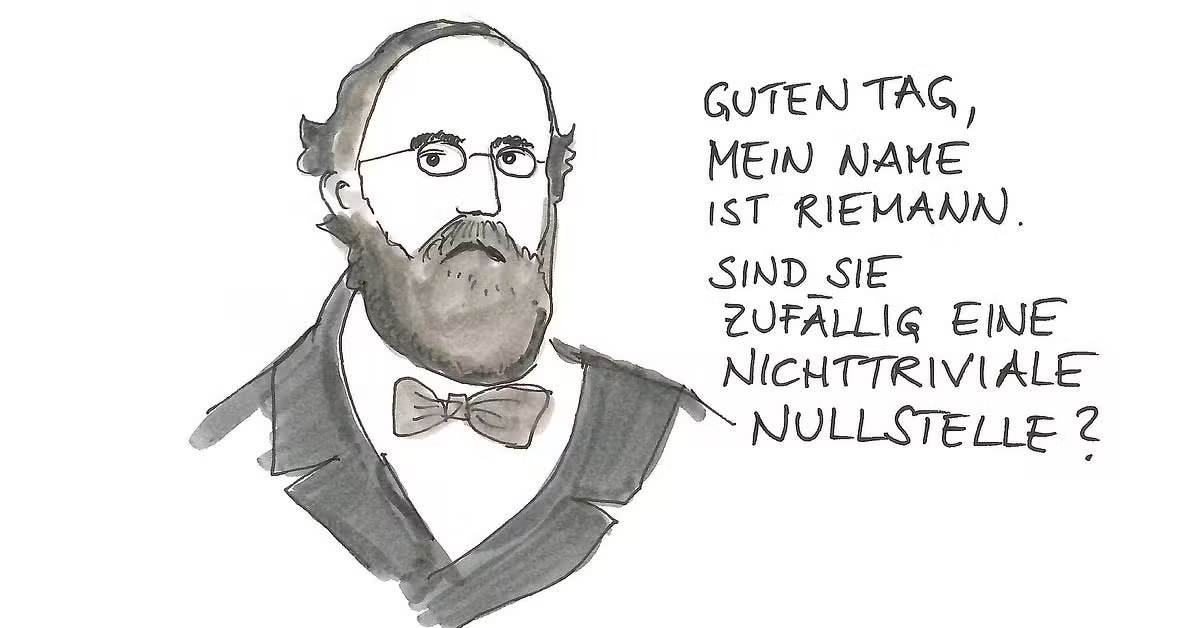
Riemann und die Maschine
substack.com· 8h
- remark.pdf
alpo.ge· 10h
Anthropic mathematician says AI helped solve famous math problem
usatoday.com· 11h
Anthropic employee claims to have proven the most famous math problem using Claude - Engadget
engadget.com· 13h
Anthropic mathematician claims he used Claude to prove 19th-century Riemann hypothesis
theguardian.com· 16h
250,000-Page Math Slop: Why Anthropic Didn’t Solve the Riemann Hypothesis – Emerald Book
emeraldbook.org· 17h
Anthropic worker claims to have solved a Holy Grail of math problems with the help of AI | CNN Business
cnn.com· 18h
Lean verification of the Riemann Hypothesis
github.io· 19h
Riemann hypothesis: Has the world’s most famous maths problem been cracked?
aljazeera.com· 20h
Anthropic worker claims to have solved a Holy Grail of math problems with the help of AI
apnews.com· 28h
Claude JUST solved the Riemann Hypothesis...
youtube.com· 31h
Mathematician says he and AI solved Riemann hypothesis — the field’s biggest outstanding challenge
nature.com· 33h
The race to prove math's most famous problem just became a human-versus-AI showdown
businessinsider.com· 33h
Anthropic Mathematician Claims to Have Solved Math’s Most Famous Problem
nytimes.com· 35h
The AI Riemann hypothesis proof is almost certainly true, independent mathematicians attest
scientificamerican.com· 36h
AI claimed a solution to the 167 year-old Riemann Hypothesis — and a human did, too | TechCrunch
techcrunch.com· 37h
Anthropic mathematician says Claude helped solve the 'biggest problem in math'
Anthropic staffer claims solution to mathematics’ Riemann hypothesis
ft.com· 39h
Riemann-Vermutung: Mathematiker behauptet, mit KI einen Beweis für den »heiligen Gral« der Mathematik gefunden zu haben
spiegel.de· 40h
Anthropic Mathematician Says AI Has Solved the Most Famous Problem in Math
wsj.com· 40h
Anthropic mathematician claims to have solved prestigious Millennium Prize problem with Claude
theverge.com· 40h
Re: Riemann
borretti.me· 44h
On November 20, 2026, Levent Alpöge, a mathematician at Anthropic, announced that he believes he has, working with Anthropic's AI Claude, discovered a proof of the Riemann Hypothesis. He posted a four-page note on his personal website linking not to a traditional paper but to computer code written in Lean, which turns mathematical statements into a verifiable form. He said the arguments had been formalized without assumptions, that the method easily extends to the Generalized Riemann Hypothesis, and that he does not yet fully understand the purported proof himself and cannot yet describe it comprehensibly.
The timing drew notice of its own: Alpöge texted Anthropic CEO Dario Amodei late Sunday night beginning "Hypothetically, if I were to have . . .", and suggested he held off publication until after Anthropic's initial public offering on November 19, 2026, later calling the precise timing of his announcement horrible. Anthropic did not respond to an email requesting comment, and the Clay Mathematics Institute, which has offered $1 million for a solution since 2000, had not yet publicly accepted the work, which remained listed as unsolved on its website.
Hours after the announcement, Alessandro Masullo, a postdoctoral researcher at Stanford, announced he had also solved the Riemann Hypothesis without using AI, saying 12 years of work had been blindsided; he posted a paper warning it may contain errors because it was rushed. As of the afternoon of November 20, neither solution had been formally proven, and mathematicians were racing to scrutinize both, with number theorists weighing in on Zulip and independent mathematicians attesting that Alpöge's AI-created proof is almost certainly true.
The work behind it was vast: the proof was finalized on the 42nd day of Alpöge and Claude's sprint, on Sunday, November 15, and released as roughly 17 million lines of Lean code spanning a quarter million pages, drawing on Stepanov's method, automorphic forms, and theta series, with Alpöge also crediting OpenAI's October 2026 math team. On November 21, the Lean and Mathlib communities announced they had verified the proof: dozens of people compiled the library without errors, two independent comparison tools confirmed the theorem proved is exactly Mathlib's vetted statement of the Riemann Hypothesis, and the exported raw proof was checked by Lean's official kernel and several independent checkers, satisfying all four criteria in the Xena Project's post of November 12, 2026.
Anthropic mathematician Levent Alpöge announced that he believes he has, working with Anthropic's AI Claude, discovered a proof of the Riemann Hypothesis.
Alpöge said the method easily extends to resolve the Generalized Riemann Hypothesis, and that he expects it to resolve the Extended Riemann Hypothesis with more time.
Alpöge said he and Claude have also formalized the arguments without assumptions.
A correspondent's Discord message quoted in the post read 'they proved riemann :/'.
Alpöge wrote that what he saw during the course of progress so amazed him that he believes it is one dawn across science of something far greater.
Alpöge wrote that it was his secret in his student days that his plans were for this problem in decades, and that he then tried to become familiar with all the tools he could.
Alpöge wrote that he and Claude have had a great time together in recent months, but that this time Claude far outpaced him near the finish line, flying, dancing, and sparkling.
Alpöge wrote that his line was to combine two quite different ideas present in a toy setting, one of which was already new and shocking, simplifying one of the shadows of Riemann.
Alpöge wrote that he guided the work to the right situation analogous to that toy setting, and then Claude began to leave him in awe.
Alpöge's solution had not been verified independently, and Anthropic had not commented on or involved itself in the announcement.
Alpöge said he texted Anthropic CEO Dario Amodei about the solution late Sunday night and suggested he held off publication until after Anthropic's initial public offering on November 19, 2026.
The solution is presented in Lean code and was published only on Alpöge's website, and the Clay Mathematics Institute had not yet publicly accepted it.
Alpöge said he does not yet fully understand the purported proof himself and cannot yet describe it comprehensibly.
Alpöge said the proof is currently incredibly long, that its formalization is complete, and that he has taken only a first step.
Alpöge wrote that he intends to do his best to understand the proof and its simplifications, make it comprehensible, speak about it, and write it up properly.
An editorial argued that it remains to be seen whether Alpöge has really managed a proof of the Riemann Hypothesis with Anthropic's Claude.
Leading mathematics scholars said the claimed solution, should it stand, would be the biggest breakthrough in math yet.
Cornell mathematics professor Steven Strogatz said the solution has been verified by a computer-based system that sometimes makes mistakes and has not yet been independently verified, and that if it holds up it is an extremely big deal, calling the Riemann Hypothesis the 'Moby Dick' of Mathematics.
Caltech mathematics professor Sergei Gukov called the claim a 'HUGE deal', saying 'This is not a small potato' and that the Riemann Hypothesis was the biggest problem in math.
Number theorists, including Chris Birbeck of the University of East Anglia, began posting thoughts on the claimed proof in a chat on Zulip.
Alpöge wrote that the precise timing of his announcement was horrible and that he messaged Dario Amodei on the Sunday night before to ask how to announce the finding.
Chris Birbeck wrote in the Zulip chat that the cohomology bound is proved by what looks like an automorphy-lifting argument using Galois representations, base change, Jacquet-Shalika, Clozel's purity, and Deligne-Ribet.
Tim Fernholz reported that most mathematicians following the proof appear confident the formalized Lean result will hold, and forecast it will be a while before the community has a handle on the proof.
Tim Fernholz forecast that the AI work will not mean anything until humans are able to understand the result and explain it to each other.
Alpöge wrote that his obsession with the problem since childhood made him feel he 'could not live' if he waited to release the finding, and he committed to pursuing an explanation of the result that humans can understand.
Independent mathematicians attested that the AI-created proof of the Riemann hypothesis is almost certainly true.
As of November 20, 2026, researchers were near completing their verification of the claimed solution.
Alpöge posted a four-page note on his personal website saying he had completed a proof of the Riemann hypothesis by collaborating with Claude, linking to computer code written in Lean rather than a traditional mathematical paper.
Other researchers were checking Alpöge's Lean code, which turns mathematical statements into a verifiable form; if Lean code compiles, that indicates the logic of the proof is solid.
Alpöge did not reply to a request for comment about his proof.
James Maynard of the University of Oxford said he thought the proof was likely to be correct and that he would be 98 or 99 percent certain, while cautioning that one must ensure a Lean verification is proving the thing it is meant to prove.
James Maynard said the new proof 'will give us great understanding, and so it's something to be celebrated.'
Steven Strogatz said it seemed clear Alpöge played a central role in telling Claude which mathematical ideas to explore, called the claimed proof 'the Mount Olympus,' and compared the work to a skillful jockey riding a really fast horse.
Brian Conrad said it was 'frankly completely outrageous' of Alpöge to release a proof he did not fully understand.
Alex Kontorovich said he was still flabbergasted on Friday: 'I'm absolutely, absolutely shocked.'
Hours after Alpöge's announcement, Alessandro Masullo, a postdoctoral researcher at Stanford, announced that he had also solved the Riemann Hypothesis without using AI.
Masullo said he worked on the problem for 12 years and was about a year from releasing his results when Alpöge's announcement blindsided him.
Masullo posted a paper online warning it may contain errors because it was rushed, and his solution is far shorter than Alpöge's.
Neither Masullo's nor Alpöge's solution had been formally proven as of the afternoon of November 20, 2026, and mathematicians were racing to scrutinize both with their own brains and with AI.
Masullo, his partner at Stanford Brian Conrad, and Alpöge did not respond to requests for comment on November 20, 2026.
In his posted paper, Masullo wrote, 'In light of the current climate I am being advised to release the current version as it is.'
Masullo wrote, 'If any message at all this work is meant to send to the mathematician who feels discouraged by the pace and tone of the current climate, it is this: we are still here. We are very much alive. We are not going anywhere.'
Steven Strogatz wrote on X on November 20, 2026, 'The plot thickens!'
Sergei Gukov said, 'Now it's getting more complicated.'
James Maynard said, 'If this fully checks out, it is clearly a historic milestone in mathematics.'
Andrew Granville of the University of Montreal said Alpöge should have taken the time to prepare a clearer write-up before making the announcement, saying of the document, 'What he released is garbled.'
Andrew Granville said the downturn in Anthropic's stock value was the reason for the timing of the proof's release.
Alpöge wrote in the document, 'There is an obvious cynical view, to do with the timing, but it is false.'
Alpöge and Claude finalized their proof on the 42nd day of their sprint, finishing the work on Sunday, November 15.
The Lean proof sits in footnote one of the announcement, split across 14 downloads totaling about 18 million lines and a quarter million pages, and people on the Lean proof forum were combing through the data posted that morning.
The proof's building blocks included the function-field Riemann conjecture, a method from Stepanov, automorphic forms, and theta series, and Alpöge also credited OpenAI's October 2026 math team.
Alpöge's own idea was to lock one side of an equation to a fixed positive or negative sign so rogue zeros cannot hide, taking an earlier concept to a new level.
Alpöge said he was not an expert in this material and did not really understand it.
Terence Tao posted hours before the video that previous releases of AI-assisted proofs had more time for human experts to digest them, and that this latest one is the least digested.
Wes Roth said the smart money is on the proof being true, noting that as far as he knew not one of the many mathematicians commenting was saying it is not true.
Wes Roth likened the work to an industrial revolution in which humans made the little parts and the machine takes them into production, making Claude the math factory.
Wes Roth wondered whether 'Claude flew and danced and sparkled near the finish line' will become one of those little quotes that gets stuck in history, like 'I am become death, the destroyer of worlds'.
Abhishek Saha said that like most mathematicians he believed the Riemann Hypothesis was completely out of reach at present even with the best AI tools, comparing the proof to an incredibly complicated tour through infrastructure built for hundreds of other mineral reserves that somehow creates a wormhole to the destination.
Abhishek Saha said this is not theory building in the usual sense but something much weirder and more alien, beyond what any human brain on its own could create.
Eliezer Yudkowsky said this should be the obvious coal-mine canary for dangerously advanced AI, comparing it to producing enriched uranium, though maybe not 90 percent enriched weapons-grade uranium.
Wes Roth said AI became superhuman at coding and at math, but that he is not personally feeling it just got that much more lethal because it was able to solve this.
Hours after the announcement, the Riemann Hypothesis remained listed as unsolved on the Clay Mathematics Institute's website, which has offered $1 million for a solution since 2000.
Alpöge released his and Claude's proof of the Riemann Hypothesis within 17 million lines of Lean code and said more than 250,000 pages came out of the work.
Anthropic did not respond to an email requesting comment on Alpöge's claim.
Rutgers mathematician Alex Kontorovich said Claude followed the Lean code and found the proof to be true, though he does not yet understand the proof himself, noting the computer checker is extraordinarily pickier than he is.
Alex Kontorovich said traditionally the findings buried in such code would be published in a formal paper read line by line to reach deep understanding, and described an out-of-body experience trying to comprehend the words that the Riemann Hypothesis has been solved.
Clay Mathematics Institute president Martin Bridson called the announcement 'of historic significance', saying it holds the promise of a dramatic transformation in the perception of what is possible in extending human understanding of mathematics.
Martin Bridson said the journey from the announcement to a place of real understanding will be long and difficult, and that assessing whether the problem has actually been solved takes time.
Alpöge said he is 'presenting the world with a complete argument before having mastered a massive neighbourhood around its mathematics.'
Kevin Buzzard of Imperial College London said nobody yet understands what the claimed proof actually shows, describing it as millions of lines of gobbledygook in a strange programming language that people all over the world are translating back into English.
Kevin Buzzard forecast that the situation will change in a matter of weeks, since experience shows humans given Lean code understand it much better within a week or two.
Abhishek Saha said his own intuition was that a proof of the Riemann hypothesis was still several years away and that the claimed proof, if correct, shatters his model of reality.
Abhishek Saha said the credit should go to Alpöge, who should get a Fields Medal if the proof holds up, noting that others with similar access to frontier AI models and computing resources were not able to come up with a proof.
The Lean and Mathlib communities announced they had verified Alpöge's proof of the Riemann Hypothesis, released on November 20, 2026 as a 17-million-line Lean library depending only on Mathlib.
Dozens of people compiled the library without errors or build failures, and two independent comparison tools confirmed the theorem proved is exactly Mathlib's vetted statement of the Riemann Hypothesis.
The exported raw proof was checked by Lean's official kernel and several independent checkers in other programming languages, which come with formal proofs, relative to set theory, that they cannot accept a false proof.
The checks ran on an inert export of the proof, out of reach of hypothetical malicious code in the Lean sources, and the communities said all four criteria in the Xena Project's post of November 12, 2026 are satisfied.
The Lean and Mathlib communities stated they have full confidence that Alpöge's proof of the Riemann Hypothesis is correct and certified both the statement and the proof correct.
The Lean and Mathlib communities congratulated Alpöge on his proof and said they look forward to community activity that will help explain the new ideas in it.
Alpöge said Claude helped develop the proof of the Riemann hypothesis over the course of about six weeks.
Mathematicians began working to determine whether the claimed proof could be confirmed.
Alpöge said in his announcement, 'This problem has been the sacred object in mathematics for me since my childhood.'
Hector Pasten of the Pontifical Catholic University of Chile said the work could connect areas of mathematics that researchers have only partially linked, comparing the potential discovery to the Rosetta Stone.
Alpöge's posted PDF, remark.pdf, describes the proof as a descendant of Stepanov's method over function fields, using simple Fourier-analytic ideas and chained theta lifts to mimic multiplicity over the integers.
The remark's timeline records milestones including a Stepanov determinant on October 6, 2026, iterated theta lifts between totally definite unitary groups on November 15, 2026, and the Generalized Riemann Hypothesis on November 16, 2026.
Alpöge wrote that after the breakthrough, which came late Sunday night, he messaged Dario Amodei beginning 'Hypothetically, if I were to have . . .' and the two figured things out, with a constraint to respect.
Alpöge wrote that he decided to present only Lean because a draft write-up of the argument would have been a massive unreadable travesty of 'slop' running past 250,000 pages.
Alpöge wrote that he has little personal mastery of the automorphic forms involved and may have baked many strange suboptimal choices into the argument.
Alpöge wrote that the argument implies a significant weakening of Vandiver, implying vanishing of a number of K-groups of the integers and maybe cyclicity up to around 100.
Alpöge forecast that the argument will be massively simplified, likely immediately, and that short arguments will follow fairly quickly.

