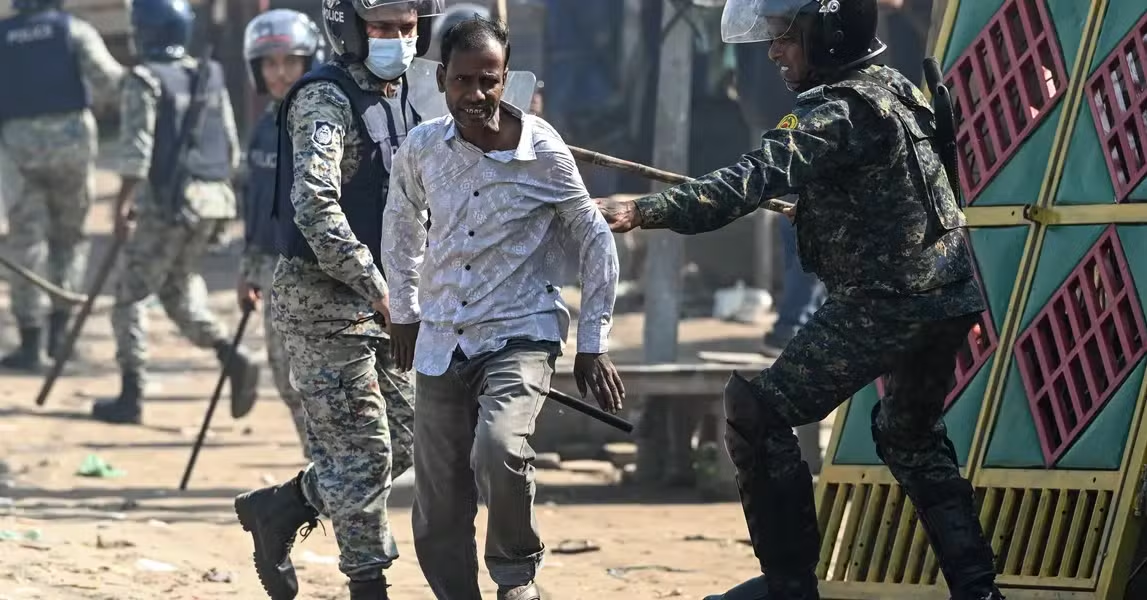
Bangladesh garment workers reject 36% pay rise, keep protesting despite crackdown
'Not Asking for Luxury': Bangladeshi Garment Workers Continue Protests Despite Police Crackdown | Common Dreams
commondreams.org· 12h
Police use tear gas to disperse fresh Bangladesh garment worker protests
reuters.com· 26h
Bangladesh garment workers clash with police as pay protests shut factories
Garment workers in Bangladesh have been protesting over pay since early November 2026, triggering repeated factory shutdowns and clashes with police. They demand the monthly minimum wage more than double to 30,000 taka ($241) from 12,500 taka, citing soaring food, housing and transport costs. The government-appointed wage board held talks on a new minimum wage on November 24, a day after factory owners submitted their proposal. That day, workers in Gazipur blocked a major highway and set fires after rumours spread that a worker had died, and police fired tear gas and sound grenades to disperse them.
The Bangladesh Garment Manufacturers and Exporters Association estimated that 18 days of disruptions cost 317 factories about $428 million in lost production, while buyers shifted roughly $254 million in orders to competing countries. On November 25, the six-member wage board approved a 36% increase in the minimum wage, raising it from Tk12,500 to Tk17,000, or about $100 to $138. Protests broke out within hours of the announcement.
Workers rejected the increase, saying it did not meet the soaring cost of living, and continued protesting in Gazipur into November 27. On November 26, police fired tear gas and used so-called less-lethal weapons to break up demonstrators who blocked the Dhaka-Tangail Highway, where protesters set fire to a police motorcycle; police said peace had since been restored after the protest. The government of Prime Minister Tarique Rahman has responded in part by arresting and intimidating labor organizers, detaining Green Bangla Garment Workers Federation president Sultana Begum and other union figures, including Bangladesh Garments Trade Union Federation vice president Mostafa Kamal.
Garment workers in Bangladesh have been protesting over pay since early November 2026, triggering repeated factory shutdowns and clashes with police.
Workers demand the monthly minimum wage more than double to 30,000 taka ($241) from 12,500 taka, citing soaring food, housing and transport costs.
The government-appointed wage board held talks on a new minimum wage on November 24, a day after factory owners submitted their proposal.
On November 24 workers in Gazipur blocked a major highway and set fires after rumours spread that a worker had died, and police fired tear gas and sound grenades to disperse them.
Authorities later shut nearby shops and deployed paramilitary personnel along the Gazipur route, which suffered severe traffic congestion.
The Bangladesh Garment Manufacturers and Exporters Association estimated that 18 days of disruptions cost 317 factories about $428 million in lost production, while buyers shifted roughly $254 million in orders to competing countries.
Gazipur Industrial Police Superintendent Mohammad Amjad Hossain said, 'No worker died.'
Wage board chairman Syed Azad Subhani said talks were ongoing and expressed hope for a final decision on November 24.
Industry leaders said a wage increase of more than 15% would be unsustainable, citing rising costs and weak global demand.
A six-member government-appointed wage board approved a 36% increase in the garment workers' minimum wage on November 25, but protests broke out within hours of the announcement.
On November 26 police fired tear gas and used sound grenades to disperse garment workers who tried to block a major highway in Gazipur, where protesters set fire to a police motorcycle.
Police said peace had since been restored after the protest.
Gazipur Industrial Police Superintendent Mohammad Amjad Hossain said, 'The situation is now calm, but we remain on alert.'
Garment workers rejected the approved increase, which raised the monthly minimum wage from Tk12,500 to Tk17,000, or about $100 to $138, saying it did not meet the soaring cost of living, and continued protesting in Gazipur on November 27.
Police used so-called less-lethal weapons to break up the demonstrations after protesters blocked the Dhaka-Tangail Highway.
The government of Prime Minister Tarique Rahman has responded to the protests in part by arresting and intimidating labor organizers.
Green Bangla Garment Workers Federation president Sultana Begum and the federation's general secretary Md Ilias were apprehended after taking part in an international webinar on workers' wage demands.
Other detained union figures included Bangladesh Garments Trade Union Federation vice president Mostafa Kamal and organizer Rozina Akter Sumi.
Sultana Begum said, 'Garment workers are not asking for luxury; they are demanding the right to live with dignity.'
Garment worker Nazul Islam said, 'Our factory declared a holiday. After that, everyone was returning home along the highway,' and, 'Several people armed with sticks attacked us. We then took up positions on the highway and blocked it.'
Garment worker Kabir Hossain said supporting his family on the previous Tk12,500 minimum wage had become increasingly difficult, leaving virtually nothing after rent, food and other expenses, and he forecast he would keep protesting until the demand for higher wages was met.
Garment worker Shariful Islam said prices had risen while workers' incomes remained inadequate.
Amnesty International South Asia said the crackdown 'raises concerns about the targeting of workers for exercising their rights to freedom of peaceful assembly, freedom of association, and collective bargaining.'
Amnesty International South Asia said the government of Bangladesh 'must immediately stop the arrest, intimidation, and harassment of workers and trade union representatives for participating in peaceful protests or organizing to demand better wages.'
Amnesty International South Asia said that where violence occurs, 'law enforcement authorities must distinguish between peaceful protesters and individuals engaging in violence' and that 'any use of force must comply with international human rights standards.'
Amnesty International South Asia said the government must ensure the minimum wage is fair, nondiscriminatory and based on the actual cost of living, protect workers' rights to organize and bargain collectively, and ensure accountability for human rights violations.

