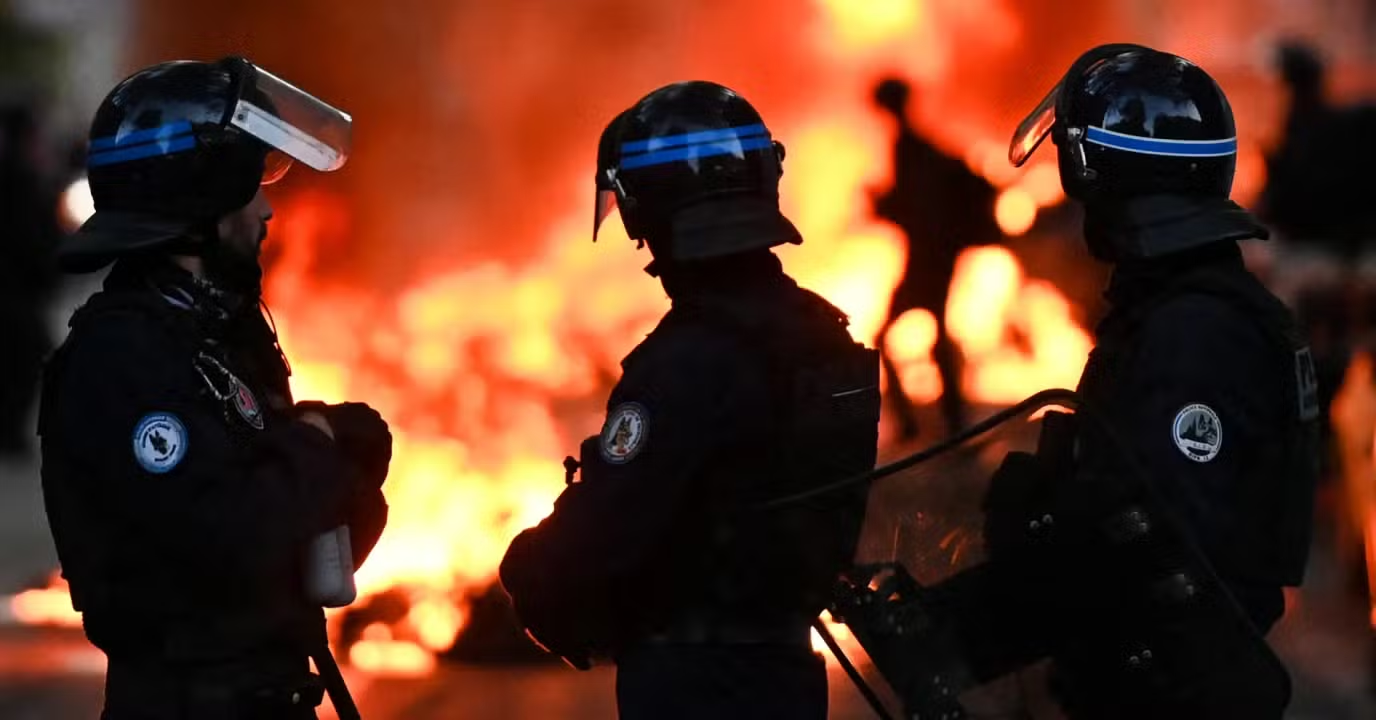
Turnout falls as French protest movement holds sixth weekend of demonstrations
Photos: People rally across France over living costs, public services
aljazeera.com· 16m
Polizeigewalt in Frankreich: Sie wollen die Abschreckung, sie bereiten Le Pen den Weg
zeit.de· 21h
Mobilisation lycéenne : les introuvables preuves des accusations de « complicité » de violences portées par Matignon à l’encontre d’enseignants
lemonde.fr· 28h
"Comment on se reconstruit ?" : dans les plaies des manifestants gravement blessés
tv5monde.com· 29h
Mouvement lycéen : l’impossible débat sur le « maintien de l’ordre à la française »
Mobilisation lycéenne : 3 000 conseils de discipline entre septembre et le 1er novembre, selon le ministre de l’éducation nationale, Edouard Geffray
Young French students who see ‘no change’ keep up protests in Paris suburbs
Dans les lycées, le personnel éducatif éprouvé après deux mois de mobilisation
france24.com· 5d
‘We need to get back to class’: some teachers lose patience as France enters its eighth week of student protests
theguardian.com· 7d
Mapping how France’s protest wave spread across Europe
🔴 Sortie de notre programme, mobilisations sociales : Manuel Bompard, invité de France info !
youtube.com· 16d
フランスのデモに57万人「若者が目覚めさせた」 世代超え最大規模:朝日新聞
asahi.com· 16d
A protest movement over school conditions, wages and living costs began in France in mid-September 2026 with high school students and grew as labor unions joined. The weekly demonstrations, which began on 17 October, descended that month into the worst rioting seen in years, with hundreds of shops looted and buildings set on fire.
At least 31 people have been seriously injured by law enforcement, 16 of them maimed, according to a count based on testimonies, victims' lawyers and NGO censuses, while the authorities have provided no official tally.
Hundreds of high schools have been barricaded or shut, and at least 50 principals asked to quit their posts, saying they are struggling to cope.
The government argued that its offer to cut some class sizes and review the university application platform meant the movement was ending, but the still-mobilized Union syndicale lycéenne counts 350 high schools at a standstill.
On 18 November, Education Minister Edouard Geffray said about 3,000 disciplinary councils had taken place over violence during the movement, and about fifteen students in Paris had been permanently expelled. Prime Minister Sébastien Lecornu warned that staff complicit in the violence would also be prosecuted.
Unions including the CGT demanded an immediate minimum wage increase of between 5 and 10 percent. The protests also spread to 30 other European countries.
On 22 November, tens of thousands marched for the sixth consecutive weekend, with organisers reporting 150,000, down from 200,000 a week earlier and 800,000 at the first demonstration, while the Interior Ministry counted 82,500. Unions and activists called for further protests.
Large demonstrations took place across France on 5 November 2026 demanding improved education conditions, an end to teacher shortages, bigger education budgets, measures against high prices and wage increases.
France's Interior Ministry said 575,000 people took part in the demonstrations across the country.
The movement began in mid-September 2026 when high school students started protesting over school conditions, and grew as labor unions and working people anxious about wages and living costs joined.
A demonstration on 17 October 2026 drew 550,000 participants, with further protests held on 24 and 31 October 2026.
The 5 November demonstration was called by major labor unions and joined by civil servants, private-sector employees, high school students, university students and retirees.
Wary of a repeat of the riots that followed the 17 October demonstration, the authorities deployed about 70,000 police officers and gendarmes across France.
Students again blockaded their leaking, overcrowded high school in the Paris suburbs on 5 November 2026.
The French government announced on 5 November that it would meet labor unions and employer organizations on 9 November to discuss purchasing power and wages.
A 50-year-old Paris demonstrator, Joanna Roger, said young people woke her up and that the high school students' protests since September encouraged her to take to the streets.
A 15-year-old high school student in the Paris suburbs, who says her school leaks rain and its classrooms overflow, asked the government to listen to the protesters' voices.
The same student said she is proud that the protest movement is supported across a wide range of generations.
The Interior Ministry counted 475,000 demonstrators on 5 November while union organizers gave a higher figure.
Prime Minister Sébastien Lecornu called a social conference at Matignon to bring unions and employers together on the Monday after 6 November, and met employers' representatives, including the employers' association president, on the day itself.
Trade unions including the CGT demanded an immediate minimum wage increase of between 5 and 10 percent.
Youth organizations planned ten measures, including massive investment, the end of Parcoursup, and additional places in higher education and research.
The yellow vests coordination called a demonstration for the day after the interview, the fourth in four weeks, and its websites suggested going to the Place de la Concorde in Paris, a route forbidden by the authorities.
Demonstrations were banned in a number of French cities, and in Toulouse tens of thousands of people were blocked for two hours.
Manuel Bompard said the government could raise the minimum wage by only 0.5 percent, about 7 or 8 euros a month.
Manuel Bompard said the mobilization is extremely powerful and produced the most numerous demonstrations in France since the movement against retirement at 64, showing the exasperation of people who can no longer make ends meet.
Manuel Bompard said he does not lead the mobilization but totally supports the unions if they keep calling people to mobilize, and forecast there will be a before and after 5 November.
Manuel Bompard said the government must bring rapid, immediate responses, and that it has levers of its own in raising the minimum wage and revalorizing civil servants' index point.
Manuel Bompard called on Sébastien Lecornu to propose a genuine boost to the minimum wage at the close of the social conference, along with wage increases, saying salaries should be indexed to inflation and civil servants' pay revalorized.
Manuel Bompard said an increase of 0.5 percent would be totally beside the point as a response to the country's social exasperation, calling the demands absolutely just.
Manuel Bompard urged the government to stop challenging the right to demonstrate and to answer the demands instead of preventing people from protesting by repression.
Manuel Bompard forecast further mobilization dates that La France Insoumise would support, saying that if the government refuses to answer the demands the mobilizations will continue.
The Interior Ministry said 146,000 people rallied across France on the Saturday before 8 November, including 46,000 in Paris, while unions put the figures at 250,000 and 75,000, with turnout down from previous weeks.
Police used tear gas and batons on protesters in Paris and fired tear gas canisters at hundreds of people blocking a road in central Lyon.
An analysis of ACLED data found more than 1,200 protests and riots of 100 or more people took place across France between 15 September and 30 October 2026 over education, public services and the cost of living.
ACLED chief executive Clionadh Raleigh said the rate of demonstrations had jumped to almost 66 a day, more than three times the usual, and that 24.2 percent of events were riots against a median of 1.9 percent in previous cycles.
On 28 October 2026, four United Nations experts mandated by the Human Rights Council expressed alarm at the excessive use of force by French authorities and said the arrests of several thousand people, mainly minors, appeared disproportionate.
A teenager lost a hand when a grenade exploded as school protesters clashed with police in Lille.
Demonstrations over living costs, low wages and public services broke out in 30 other European countries, with more than 1,700 protests and riots of 100 or more people across Europe between 15 September and 30 October 2026.
Professor Alberto Alemanno of HEC Paris said France is the epicentre of the movement and there are signs the discontent is spreading beyond France.
Students, teachers and education staff marched in Paris on 10 November 2026 during a national day of protests for better school conditions, with several thousand taking part between the Panthéon and Place d'Italie.
France entered the eighth week of an unprecedented schools crisis, with hundreds of high schools barricaded with wheelie bins or shut amid security fears.
More than 360 schoolchildren and 245 staff have been injured since the protests started.
At least 50 French high school principals asked to quit their posts, saying they are struggling to cope with the confusion and chaos, and held their own demonstrations.
Thousands of children in baccalauréat exam years have missed up to 150 hours of teaching at schools barricaded daily or closed for security reasons since the end of September 2026.
The government first responded to the protests with a security crackdown, mobilising riot police outside schools amid clashes that caused injuries from police weaponry, including children who lost a hand or an eye.
Over the two weeks before the article, the government argued that its offer to decrease some class sizes and review the university application platform meant the protest movement was coming to an end.
Fireworks have been fired outside schools and inside classrooms, a local councillor outside Paris was hit in the chest by a bottle of gasoline while mediating, and a school principal bought a bulletproof vest.
Police are increasingly stationed outside schools, sometimes hitting students' hands with truncheons to make them loosen their grip on bins, as happened in central Paris in November 2026.
A 16-year-old school student lost the use of his eye on the pavement outside Lycée Balzac in Tours after he was allegedly struck by a police rubber bullet.
At Lycée Balzac, ten staff including the principal and deputy principal are on sick leave, and teachers' unions accuse the government of letting the protests fester into a dangerous mood of violence.
Julien Roy, a history and geography teacher at Lycée Balzac in Tours, said the administration is imposing a smokescreen of wishful thinking and that France needs a de-escalation of violence and a path back to education.
Julien Roy said teachers and pupils will have to sit down and talk honestly and calmly to restore trust, and forecast the crisis will create future adults who feel bitter and broken.
Alex, a 16-year-old who rises at 4am to build bin blockades at his high school in Vincennes, said the students cannot stop blockading because it is the only way the government will listen.
A teacher who demonstrated outside a central Paris police station after one of her pupils was arrested said there is absolute uncertainty over how to return to proper teaching and no end in sight.
An English teacher at a high school in the Créteil area said she feels proud of her students' peaceful protests, which ask for the same resources and dignity teachers have wanted for years, and forecast it is difficult to imagine the protests stopping with the presidential election in spring 2027.
Teacher unions took part in a new day of mobilization in France on 17 November 2026.
The lycée Jean-Jacques Rousseau in Sarcelles, which reopened in early November, introduced timetables announced one or two days in advance to limit how many pupils are present at once, and a teacher said the school has had no normal classes since 24 September.
At the lycée René Cassin in Gonesse, officers of the Compagnie départementale d'intervention have been present daily since the return from the Toussaint holidays to prevent gatherings on the forecourt and to search bags, and about ten pupils have been arrested since the start of the mobilization.
On 3 November 2026, school-life staff at the lycée Jean-Jacques Rousseau exercised their right of withdrawal after an education assistant and a principal education adviser were jostled when they found a firework mortar in the toilets.
On 12 November 2026, Prime Minister Sébastien Lecornu said that in certain high schools a logistics plan to deliver firework mortars is being set up, with people engaging in complicity inside the lycées themselves.
Gaël Bonneau-Blescel, a teacher at the lycée Jean-Jacques Rousseau, said he is appalled by the management's day-to-day handling, that consultation with staff is almost nonexistent, and recommended half-capacity operation of classes as used after Covid-19.
An education assistant at the Sarcelles school, Thomas, said staff feel taken for human shields, carrying out untrained missions from crowd management to putting out bin fires, and that the predominant feeling is anger.
The general-education teacher at the lycée René Cassin said many pupils have come out of arrest devastated, traumatized or humiliated, and that she judges the pupils have become politicized and are realizing the republican promise of equal opportunity does not work for them.
Sophie Vénétitay of Snes-FSU and Bruno Bobkiewicz of SPDEN-Unsa denounced Sébastien Lecornu's declarations, asking what the point is of throwing the staff to public opinion if not a strategy of hardening the response and letting the situation fester.
Staff at the lycée René Cassin, failing to agree on a collective position before the mobilization day, agreed on one point: there is no possible return to normal.
Students and teachers met outside the locked gates of the Paul Eluard high school in Saint-Denis in early November 2026, and four days after returning from a mid-term break joined the national strike of 5 November.
Students at the Bartholdi trade school in Saint-Denis blockaded their gates over rats in the courtyard and restrooms, dirty facilities, cockroaches and too little running water.
The size of the student protests peaked in early October 2026, but many young people, especially in the suburbs, are refusing to return to the classroom until some of their demands are met.
The head teacher of Paul Eluard stepped down as a safety precaution after teachers accused him of letting police arrest a student.
President Emmanuel Macron said in a statement in early October 2026 that the government planned to respond to the students' demands in the most concrete way possible, and that he understands the anxieties and anger of French youth.
Louis Boyard of France Unbowed, a party accused of weaponising the student movement, insisted the movement was organic and that the party is always on the side of those who fight, saying people have gone too far to back down and the students are justified.
Nohlan, a 17-year-old Bartholdi student, said the November blockade came in response to the lack of solutions, saying there is still no change and students are waiting for it.
Lucie Sabze, an English teacher at Paul Eluard, said she is impressed by the students and their lucid political discourse, and thinks the scale of the movement reflects a growing frustration.
Kamelia, a 17-year-old who wore a dinosaur costume to the protests, said costumes show it is not all about violence, that the movement started in the suburbs before Paris followed, and that hers is a generation that has truly awakened.
Education minister Edouard Geffray said on 18 November that about 3,000 disciplinary councils took place between September and 1 November over violence committed during the high school movement.
Geffray said more than 1,000 criminal complaints had been filed for violence.
In a telegram sent the Friday before, the government asked academy rectors to strengthen and systematize disciplinary sanctions against students and education ministry staff taking part in blockades, covering calls to violence, property damage, blocking access and violence against staff.
Geffray said about fifteen students in Paris were permanently expelled, the highest disciplinary sanction, and re-enrolled in another school in the capital.
Geffray said about fifteen disciplinary procedures were underway against education ministry staff who strayed from the duty of neutrality.
Geffray said the situation regarding high school blockades has become residual, while the still-mobilized Union syndicale lycéenne put forward 350 high schools at a standstill out of 3,700 establishments.
Since the high school movement began in mid-September 2026, dozens of videos have circulated daily denouncing police practices, showing demonstrators with hands torn off by grenade explosions, eyes lost to rubber bullet launchers, and dozens of wounds, fractures or burns.
More than 183 investigations have been opened to date by the General Inspections of the National Police and of the National Gendarmerie.
The Interior Ministry said 2,829 members of the security forces have been injured since the start of the crisis, 1,190 during the high school blockades and 1,639 during the mobilizations between 17 October and 5 November.
The ministry's injury count is criticized for giving no breakdown between units and no detail on the types or severity of injuries.
French security forces point to the violence of certain protesters, listing dozens of shots from firework mortars and throws of projectiles near high schools or at demonstrations.
A count based on testimonies, victims' lawyers and NGO censuses found at least 31 people seriously injured by law enforcement since the start of the movement, 16 of them maimed, while the authorities have provided no official tally.
Lawyer Pierre Brunisso, who defends 17 seriously injured protesters including 8 maimed, said at a press conference in Paris on 6 November that intermediate-force grenades break bones and flesh, amputate children and burst eyes.
Pranny Ouch, a 25-year-old art therapy student, was hit in the leg at the Place de la République in Paris on 17 October 2026 by what she and her lawyer believe was a grenade shard, suffering a double open fracture that required three operations.
Rémi Aubert, a 39-year-old podiatrist, lost eight teeth and suffered a broken nose in what he describes as an outbreak of violence by CRS police in Marseille on 31 October 2026, and an investigation into his injuries has been assigned to the national police inspectorate.
A 21-year-old Marseille protester known as Oliv carries a 6 cm crater in her right leg from a grenade wound suffered on the night of 17 to 18 October 2026, and the hospital report concluded the object was a disencirclement grenade.
Interior Minister Laurent Nuñez said he regrets that there were injured protesters but that police and gendarmes use force only within a legal and regulatory framework, and that intermediate armament is indispensable.
Lawyers defending the maimed protesters plan to take Interior Minister Laurent Nuñez before the Cour de justice de la République for authorizing the use of maiming weapons.
Pranny Ouch says she cannot understand throwing such violent weapons at people expressing an opinion, and that France does not have a political situation that justifies having war wounded at a protest.
Rémi Aubert says what happened to him is a global injustice, not only a personal one, and that he testifies so that police violence stops and to show these are not isolated cases.
Oliv hopes her testimony will help bring about a ban on the grenades, saying France is the only country in Europe that uses them for crowd control.
Prime Minister Sébastien Lecornu warned on 12 November that the accomplices of the violence in a small minority of lycées, whether active or passive, including among the staff of national education, would also be prosecuted.
Several media outlets citing a source within the executive put forward at least 40 recorded cases of suspected staff complicity, while the authorities publicly refused to provide a single supporting example.
The education community reacted to the prime minister's accusations with shock and indignation.
Prime Minister Sébastien Lecornu said: 'We have a small minority of lycées in which there is a planning of violence, notably a logistical planning to deliver firework mortars,' adding that 'with people who sometimes, within these lycées themselves, engage in complicity.'
Interior Minister Laurent Nuñez said on LCI the next morning: 'There are investigations under way (…). We have a number of cases where it was reported to us that there could be the complicity of certain members of the staff.'
On 28 September 2026, a police officer shot 14-year-old Eden with a grenade launcher from close range, shattering nearly all his upper teeth, tearing out several lower teeth and breaking his jaw in two places, after he had demonstrated that morning for better schooling.
On 5 October 2026 in Lens, a police grenade shredded the hand of Evan, a student blockading his school.
Tens of thousands of people marched in cities across France on 22 November for the sixth consecutive weekend to demand better public services and express anger over the rising cost of living and deepening inequality.
Organisers reported 150,000 protesters, down from 200,000 a week earlier and 800,000 at the first of the weekly demonstrations on 17 October, while the Interior Ministry put turnout at 82,500 against 106,000 a week earlier.
The movement has fuelled a nationwide campaign against soaring prices, failing public services and police brutality.
In October 2026, huge rallies descended into the worst rioting seen in years, with hundreds of shops looted and buildings attacked and set on fire.
Unions and activists called for further protests in the weeks after 22 November.

