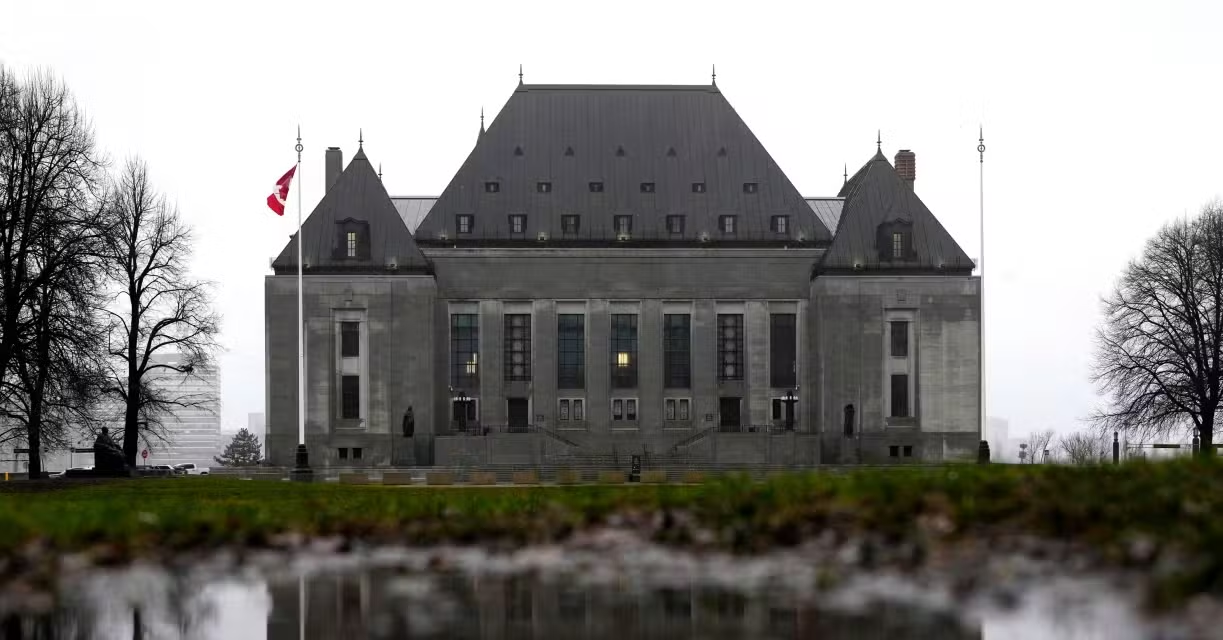
Supreme Court upholds Quebec religious symbols ban, with exemption for legislators
Canada’s Supreme Court Upholds Quebec’s Religious-Symbols Ban
wsj.com· 3h
Canada’s top court upholds Quebec’s religious symbols ban. Bigger battles loom.
politico.com· 6h
Canada’s Top Court Lets Quebec Use Controversial Measure for Secularism Law
nytimes.com· 7h
Canada’s Supreme Court largely upholds a Quebec ban on religious symbols for public servants
apnews.com· 7h
Canada’s top court largely upholds Quebec’s religious symbols ban
aljazeera.com· 8h
Rights groups vow to keep fighting after Supreme Court largely upholds Quebec's controversial secularism law | CBC
cbc.ca· 9h
Canada's top court upholds Quebec religious symbols law in test of unity
reuters.com· 12h
Supreme Court of Canada rules Quebec's secularism law is constitutionally valid | CBC News
The Supreme Court of Canada has upheld almost all of Quebec's secularism law, Bill 21, affirming the province's authority to bar some public-sector workers from wearing religious symbols on the job. The ban cannot apply to members of Quebec's National Assembly, the court ruled, because applying it to elected officials would infringe their democratic rights.
All seven justices who heard the case agreed Bill 21 is constitutional and dismissed the appeals of 51 groups, individuals and interveners. The court also found that Quebec's use of the notwithstanding clause, which overrides the Charter, was correct, and that invoking it pre-emptively is a valid practice in law. Courts in Canada can still issue non-binding declarations on rights overridden by the clause, but the justices voted 4-3 against issuing one in the Bill 21 case at this time.
The bench was not unanimous on everything. In a partial dissent, Justices Andromache Karakatsanis and Michelle O'Bonsawin wrote there was no question that Bill 21 violates freedom of religion, and argued that Section 28 establishes a substantive right in itself. The majority dismissed that Section 28 argument, holding that sex equality is a principle for interpreting the Charter but not a standalone equality guarantee separate from Section 15. It also rejected the FAE's claim that a requirement to count staff wearing religious symbols infringed those employees' fundamental rights.
The case split governments across the country. Alberta, Ontario and Saskatchewan were among 51 intervenors supporting Quebec's use of the notwithstanding clause in one of the court's longest hearings, while Manitoba, British Columbia and the federal government argued the court should retain the power to rule on whether laws violate Canadians' rights. The court made clear its ruling applies only to the Quebec case and does not stop courts from weighing in on the notwithstanding clause in the future. The override must be renewed every five years to keep it in force.
On November 27, 2026, the Supreme Court of Canada upheld almost all of Quebec's secularism law, Bill 21, affirming Quebec's authority to bar some public-sector workers from wearing religious symbols on the job.
The court ruled the ban cannot apply to members of Quebec's National Assembly, because applying it to elected officials would infringe their democratic rights.
All seven justices who heard the case agreed Bill 21 is constitutional and dismissed all appeals by the 51 groups, individual appellants, and interveners, though they differed on many of the questions addressed.
The court ruled that Quebec's use of the notwithstanding clause in the Bill 21 case was correct.
The court ruled that courts in Canada can issue non-binding judicial declarations on rights overridden by the notwithstanding clause, but voted 4-3 against issuing such a declaration in the Bill 21 case at this time.
The court dismissed the Section 28 argument in a 4-3 vote, saying sex equality is a principle for interpreting the Charter but that Section 28 does not establish a standalone equality guarantee separate from Section 15.
Justices Andromache Karakatsanis and Michelle O'Bonsawin dissented, saying Section 28 does establish a substantive right in itself.
Chief Justice Richard Wagner wrote that "Bill 21 is rooted in Quebec's legitimate and historical commitment to ensuring the laicity of the state in a free and democratic society".
In their dissent, Justices Andromache Karakatsanis and Michelle O'Bonsawin wrote that the notwithstanding clause "cannot shield legislation that infringes Section 28 by affecting Charter rights in a manner that undermines substantive equality between men and women".
In her dissent, Justice Sheilah L. Martin said Bill 21 unequally restricts "a woman's right to respect her faith, freely express herself and to be free from discrimination based on religion and sex".
Stephen Brown, chief executive of the National Council of Canadian Muslims, called the decision an unrestricted license for every government in Canada to pass legislation taking away the fundamental freedoms and legal rights of every Canadian.
Emmett Macfarlane, head of political science at the University of Waterloo, called the law "Islamophobia as a state policy".
Kerri Froc, an associate professor at the University of New Brunswick, said the court set a worrying precedent by refusing to limit the powers of provinces that invoke the override, and sent a clear message that it will not step in when the rights of vulnerable minorities are trampled on.
Froc recommended that perhaps the issue of provinces overriding rights needs to move to the political sphere.
Mathieu Levesque, interim leader of the Coalition Avenir Quebec, called the ruling "a victory for the Quebec nation and the CAQ".
Justice Minister Sean Fraser said the government respected the independence of the Supreme Court and is "carefully reviewing its decision".
The court ruled that the pre-emptive invocation of the notwithstanding clause, which overrides the Charter, is a valid practice in law.
The court concluded that a requirement to count staff wearing religious symbols did not infringe the fundamental rights and freedoms of those employees, rejecting that ground of the FAE's appeal.
Joe Ortona, chair of the English Montreal School Board, said he was "very disappointed" with the ruling.
Former senator Serge Joyal, one of the architects of the Charter of Rights and Freedoms, said he was "very happy" with the ruling and called it a historic judgment.
Bloc Québécois Leader Yves-François Blanchet called the ruling an "important victory for the Quebec National Assembly" and said the court recognizes the relevance and legitimacy of Quebec's invocation of the notwithstanding clause.
Blanchet rejected the prospect of the federal government cancelling provincial laws, saying "at some point, the madness has to stop".
Bouchera Chelbi, a Quebec teacher who wears a hijab and advocated against Bill 21 for more than seven years, said she is "really disappointed" and that "if you belong to certain religions, you have no place here".
Howard Sapers, executive director of the Canadian Civil Liberties Association, said "real people" have been denied employment opportunities by Bill 21 and made to feel unwelcome in public life, and that a declaration would not restore lost careers or remove the restrictions still in force.
Stephen Brown called the day of the ruling "a sombre day" for Quebec and Canada, the decision "one of the most significant setbacks in terms of rights guaranteed by the Charter in the history of our country", and said "the floodgates for a full attack on the Charter rights of Canadians" have been opened.
Prime Minister Mark Carney said the government is "closely" studying the decision, and that what matters is that all legislatures, including Parliament, do their utmost to respect the rights and liberties of all Canadians, including those in the minority.
Montreal lawyer Michael Bergman said the ruling confirms the Canadian Charter is "an empty shell" and that governments can, with "a magic wand, make fundamental rights go away".
In a partial dissent, Justices Andromache Karakatsanis and Michelle O'Bonsawin wrote there was no question that Bill 21 violates the right to freedom of religion.
The notwithstanding clause override used for the law must be renewed every five years to keep it in force.
Quebec Premier Paul St-Pierre Plamondon welcomed the ruling as "a victory for secularism" and for Quebec's ability to make different choices from the rest of Canada.
Prime Minister Mark Carney said he respects the ruling, welcomed the court's finding that judges can still declare a law violates constitutional rights even when the override keeps it in force, and pledged his government will not use the constitutional override.
Carney said "Canada is a mosaic" and that constitutional rights are particularly important for minorities and vulnerable people.
Manitoba Premier Wab Kinew called Bill 21 "legislated discrimination" against Muslims, Sikhs and other religious minorities, and pledged his government will never use the constitutional override.
Mehramat Kaur of the World Sikh Organization of Canada said "Quebec is still telling qualified people that they must set aside their faith".
Joe Ortona said the English Montreal School Board is "obviously very disappointed with the decision" and that "the sun comes up tomorrow".
Stephen Brown said the notwithstanding clause "was intended to be an instrument of last resort, and now it has become an ordinary instrument of government".
The governments of Alberta, Ontario and Saskatchewan were among 51 intervenors who supported Quebec's use of the notwithstanding clause in one of the court's longest hearings.
Manitoba and British Columbia joined the federal government in arguing before the court that it should retain the power to rule on whether laws violate Canadians' rights.
The court made clear its ruling applied only to the Quebec case and did not prevent courts from weighing in on the use of the notwithstanding clause in the future.

