Trump urges Putin to end military aggression in Europe as Ukraine peace talks stall
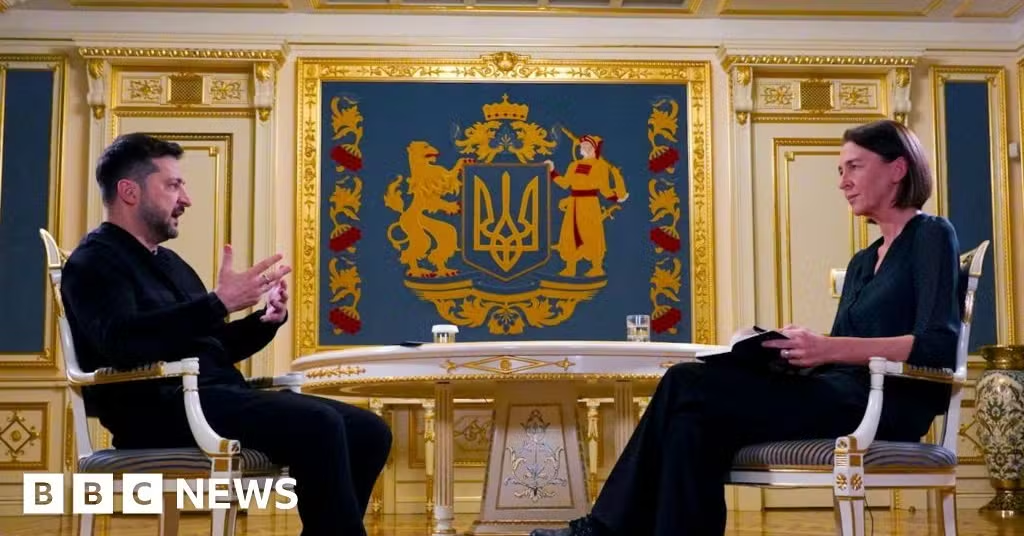
Zelensky tells BBC US too focused on Middle East and not pushing Russia hard enough
bbc.com· 22h
Trump urges Putin to end 'military aggression' in Europe
abc.net.au· 27h
‘They Will Simply Deceive Us’: Zelensky Shuts Down Trump-Putin Deal; Reveals Lesson Learnt In Crimea
youtube.com· 34h
Kushner blames stalled peace talks on alleged Ukrainian attack on Putin’s residence — an attack both U.S. intelligence and Trump say did not happen — Meduza
meduza.io· 36h
Europe is at war with Russia, US envoy Kushner claims, calling Ukraine conflict a "proxy war"
pravda.com.ua· 37h
Kushner Admits Putin Is Uninterested in Ceasefire, Calls Russia’s Invasion of Ukraine a ‘Proxy War’
kyivpost.com· 41h
Kushner: Europe has no convincing plan for peace
telegraph.co.uk· 2d
Kushner: Europe has no convincing plan for peace
This just ‘blew a hole’ in Trump’s claims about Putin — it’s all unravelling now | Charlie Sykes
Exclusive: US rules out troops, military bases in Ukraine under post-war security guarantees, falling short of Kyiv's expectations
kyivindependent.com· 2d
Trump laughs at Zelenskyy's remarks about peace deal by January: "He wants me to do what?"
Zelenskyy Will Seek Aid From New US Congress if Trump Fails to Reach Peace Deal
bloomberg.com· 3d
Zelenskyy Wants Congress to Pressure Putin If Trump Can’t Win Deal
Zelensky Ready for Four-Party Ukraine Peace Talks Tomorrow | World Affairs Digest
blogspot.com· 3d
Zelensky calls for NATO to admit Ukraine at alliance assembly
Von der Leyen and Kushner clash over peace talks sequence
euronews.com· 4d
Zelenskyy Says New Congress Should Force Putin To End Ukraine War If Trump's Peace Push Fails
huffpost.com· 4d
Weekend Update #212: The Clock Is Ticking
substack.com· 5d
Zelensky suggests new round of peace talks could happen during G-20 summit
washingtonpost.com· 6d
Zelensky says Ukraine has yet to see written commitments on NATO-style security guarantees
Donald Trump seeks Ukraine peace deal before January
ft.com· 7d
EN DIRECT, guerre en Ukraine | L’Elysée évoque une adhésion à l’OTAN du pays et réclame une pleine place pour les Européens dans les négociations
lemonde.fr· 7d
Russia Pushes Back Against U.S. Idea of NATO-Style Security Guarantees for Ukraine - The Moscow Times
themoscowtimes.com· 7d
Kushner says Russia 'comfortable' with idea of NATO-like security guarantees for Ukraine
cnbc.com· 7d
Europe ready for talks with Russia on ending war in Ukraine, leaders say
Kushner says Russia is ‘comfortable’ with NATO-like security guarantees for Ukraine to end war
apnews.com· 8d
Trump Says He Wouldn’t Make Deals With Putin Without Ukraine
Exclusive: Trump's envoys warn Russia that time is running out to secure a deal on Ukraine
Ukraine Talks Run Up Against Deep Enmity Between Russia and Europe
nytimes.com· 10d
Finland's Stubb urges Europe to take Russia talks into its own hands after 'irresponsible' US reliance
Ukraine holds peace talks with US, Europe as conflict escalates
aljazeera.com· 10d
Russian demands are 'absurd,' ceasefire must come first, Kallas comments on Ukraine peace talks
Europe will 'closely engage' in peace negotiations between Russia, Ukraine, von der Leyen says
Ukraine war briefing: US proposes Kyiv cede land to Russia for Nato membership, Zelenskyy says
theguardian.com· 12d
EN DIRECT, guerre en Ukraine : Volodymyr Zelensky affirme que les Etats-Unis ont évoqué des concessions territoriales en échange d’une adhésion à l’OTAN
U.S. floated idea of Ukraine ceding Donbas for NATO membership, Zelenskyy says
US proposed Donbas swap for NATO membership - Zelensky
rte.ie· 13d
Europeans decide on thorny question of who will speak for bloc in Ukraine talks
Ukraine war briefing: Europe to join negotiations, says Kushner, as Putin warns against peace keepers
After meeting Putin, U.S. envoys say Europe to join talks on ending Ukraine war
Europe wants a seat at the table with Russia. It can't agree on who gets it
Zelensky Rejects US Pressure to Cede Donbas as Putin Talks Begin
Security guarantees for Ukraine must also be acceptable to Russia, Rubio says
Trump’s ‘big, beautiful’ European security plan isn’t convincing Europe
politico.eu· 21d
President Donald Trump is pressing for a 'big, beautiful agreement' to end Russia's war in Ukraine, but the peace talks have stalled over territory and security guarantees.
US-mediated talks in Abu Dhabi on November 10 and 11 ended with significant differences, and Russia's chief negotiator Vladimir Medinsky ruled out territorial exchanges. President Volodymyr Zelensky rejected pressure to concede Donbas, and said on November 14 the United States had for the first time proposed Ukraine withdraw from Donbas in exchange for joining NATO.
US special envoys Steve Witkoff and Jared Kushner took proposals to Vladimir Putin in Moscow, and Witkoff said Putin agreed to let European officials join the next round, though Moscow later disputed that. On November 17, US, Ukrainian and Russian officials met, agreeing on a prisoner exchange but reaching no breakthrough.
Envoys warned this could be the last realistic chance for a deal before Democrats move closer to controlling Congress, and Moscow agreed to resume trilateral talks. The United States proposed the next round before Christmas, and Trump invited Putin to the G20 summit in Miami without inviting Zelensky.
Kushner said Putin has accepted 'Article 5-like' security guarantees in principle, though US negotiators privately ruled out troops or bases in post-war Ukraine. He blamed the talks' earlier collapse on an alleged Ukrainian attack on Putin's Valdai residence, a claim the CIA contradicted.
On November 26, Trump urged Putin in a Truth Social post to pull back all military aggression against territories throughout Europe, saying a deal could be made quickly.
After meeting Kremlin envoy Kirill Dmitriev, President Donald Trump said he wants a 'big, beautiful agreement' that would involve more than Ukraine and might involve all of Europe.
Envoy Jared Kushner outlined five goals for a European security arrangement: permanent security consultations, reliable crisis communications, greater military transparency, reciprocal de-escalation measures, and an enduring framework for European security.
NATO allies had not been briefed in advance on the American plans, and European capitals were skeptical that the initiative risks sidelining the continent and emboldening Vladimir Putin.
Some allies feared the United States might tie the new initiative to a December review of American troops in Europe.
EU foreign policy chief Kaja Kallas said Europe already has a security architecture through NATO and the EU, that Ukraine must be integrated into it, and that Putin has no veto over European security.
Lithuanian President Gitanas Nausėda said Europe must have a seat at the table in negotiations on peace in Ukraine and the future European security architecture.
A NATO diplomat said any discussion with Russia on the future security architecture would be used by Moscow to legitimize its arguments and would not fly with European allies.
US-mediated peace talks between Ukrainian and Russian representatives were scheduled to take place in Abu Dhabi on November 10 and 11, 2026, and the Kremlin said it would send senior diplomats and military officials.
Secretary of State Marco Rubio said any post-war security guarantees for Ukraine would need to be acceptable to Russia, that no concrete plan had been settled on, and that such guarantees would be critical for Kyiv to accept a peace agreement.
A senior EU diplomat said Europe would be represented at the negotiations by officials from leading national governments, NATO, and the EU.
Rubio said the United States is not a combatant in the war and can only serve as a facilitator, injecting ideas in the hope of a diplomatic solution.
Rubio said Washington will continue its diplomatic efforts despite the lack of a breakthrough.
The two days of US-mediated talks in Abu Dhabi ended with significant differences remaining, and Russia's chief negotiator Vladimir Medinsky ruled out territorial exchanges as part of a settlement.
President Volodymyr Zelensky, at a press conference in Dublin on November 11, rejected US pressure to make territorial concessions in Donbas, saying Kyiv will not surrender sovereign territory to end the war.
US special envoys Steve Witkoff and Jared Kushner arrived in Moscow on November 12 carrying concrete proposals for talks with Vladimir Putin, before traveling on to Dublin to meet Zelensky.
The American delegation agreed to raise unresolved issues, including ceasefire proposals the Russian representatives said they lacked authority to answer, directly with Putin in Moscow.
Washington was seeking Moscow's agreement to expand the negotiating format to include European representatives, with Kushner expected to raise the proposal directly with Putin.
Zelensky said any peace settlement must include concrete American security guarantees capable of preventing renewed Russian aggression, not Russian promises.
Zelensky said ending the war without Europe's participation would be unfair and, frankly, impossible, and urged European leaders to select their representatives before the end of November 2026.
Zelensky said he is the skeptic on the team, hoping the envoys return from Moscow with concrete answers but doubting they will, and that Kyiv will keep pursuing diplomacy regardless.
The European Union failed to agree on a single representative to speak for the bloc in the peace talks, exposing divisions between those favoring EU institutions and those wanting major European powers to lead.
French President Emmanuel Macron and German Chancellor Friedrich Merz favored a leading role for major national governments, with Merz pointing to the E3 format and cooperation among Germany, Britain, France, Italy, and Poland.
Kaja Kallas backed having European Council President Antonio Costa and the High Representative represent the EU, citing the treaties that give them the mandate.
Estonian Prime Minister Kristen Michal said Costa and Kallas should represent the bloc, as Europe has already chosen its representatives and both are accountable to EU countries.
Macron said Europe must first agree its position toward Russia before deciding who represents it, so Europeans can take back the initiative in discussions with Moscow.
Merz suggested Putin is willing to engage in negotiations with Europe.
Steve Witkoff said the next round of talks with Russia will involve European officials, calling them partners whose involvement is important.
After meeting Putin in the Kremlin, Witkoff said he had secured the Russian president's agreement for European officials to join the next round of talks on ending the war.
Kushner and Witkoff met Zelenskyy in Dublin after their Moscow meeting, and the United States said it was working toward what could be the largest prisoner exchange of the war.
Putin refused to soften his territorial demands and warned Europe that sending peacekeeping troops into Ukraine after a deal would amount to a continuation of war.
Kushner said the expanded talks would allow broader postwar European security arrangements to be addressed alongside the territorial issues between Ukraine and Russia.
Kushner said the United States is working toward what would be the largest prisoner exchange of the war, potentially reuniting thousands of people with their families.
Zelenskyy welcomed European participation and said he hoped the agenda would include steps toward a ceasefire and de-escalating the conflict.
Witkoff told Russian state TV the Europeans will join at the next meeting, which he called a very important moment.
Putin said Russia never opposed dialogue with Europe and it was the Europeans who broke off dialogue with the Russian Federation.
Putin urged the US administration to work with its European allies so they can decide what they want: peace or war in Ukraine.
Zelensky said the United States had, for the first time, proposed that Ukraine withdraw from Donbas in exchange for joining NATO.
Zelensky said Ukraine is discussing specific security guarantees from NATO and the EU, and that if western countries confirm them he will put the question to Ukrainian society because he has no right to decide alone.
Zelenskyy said trading Donbas territory for NATO membership is dangerous because it could allow Russia to weaken NATO and reshape borders, and he rejected any commitment to neutrality.
Zelenskyy said Ukraine's use of SpaceX's Starshield system was restricted for five days, which Kyiv suspected was deliberate US pressure on him to concede to Putin.
European Commission President Ursula von der Leyen said Europe will closely engage in the peace process through the E5 plus EU format, ensuring maximum support for Ukraine and maximum pressure on Russia in the meantime.
Kaja Kallas called Moscow's demands in the peace talks absurd and said negotiations must first focus on securing a ceasefire in Ukraine.
Kallas told Russia, 'Stop this, and we can then sit down and negotiate the peace agreement,' citing the EU's leverage through sanctions and frozen Russian assets.
Kallas said EU foreign ministers in Brussels would also discuss preparing maximum demands in response to Russia's maximum demands.
US, Ukrainian and Russian officials met together for the first time in nine months in Abu Dhabi, agreeing on a prisoner exchange but reaching no breakthrough on ending the war.
Ukraine held new talks with US and European officials on November 16, 2026, and Zelenskyy said representatives from France, Germany, Britain, Italy and Poland participated fully.
Moscow disputed the assertion that European representatives would join the next round, with Kremlin aide Yuri Ushakov saying Russia has not agreed to expand the talks beyond the existing delegations and no date has been set.
Zelenskyy said participants agreed to meet in Berlin with the Coalition of the Willing to plan their next negotiating steps, ahead of a format that would include European representatives.
Zelenskyy described the November 16 online discussions as 'not easy' and said diplomatic processes are actively underway with hopes they will not be in vain.
Kushner wrote that Washington is making progress but that important challenges remain and a final agreement will require difficult decisions.
Kremlin spokesperson Dmitry Peskov said Russia wants a peace lasting 'years, even centuries' rather than a temporary ceasefire, and that negotiations are complex and could take considerable time.
Irish Foreign Minister Helen McEntee welcomed the renewed talks and the agreement on EU representation but said Russia has clearly not changed its position.
Trump said he believes Putin wants to end the war and that he will discuss it with Xi Jinping and Putin in China.
The EU formed a team to participate in future talks with Russia.
Finnish President Alexander Stubb recommended that European leaders engage Putin directly with the same message to avoid an irresponsible reliance on the United States, saying Europe must become an agenda setter.
Stubb cautioned that future talks could reach an impasse and said there will be no deal without Putin's agreement.
Kushner said Putin was ready 'to give it a try' on engagement with Europe.
Ushakov said a lot will need to be done, perhaps including another round or more of trilateral negotiations, before an expanded format can be agreed.
A paper outlining Russia's opening position in Abu Dhabi demanded that NATO and the EU stop classifying Russia as an adversary or a threat, renounce their course toward inflicting a strategic defeat on Russia, and reduce NATO's presence on the continent.
The Russian paper also called for improved incident-prevention mechanisms, especially in the Baltic Sea and the Black Sea, to reduce the risk of unintended conflict.
When Russian negotiator Vladimir Medinsky read out some of Russia's demands in Abu Dhabi, Kushner cut in to ask what reciprocal steps Russia would take, and the Russians said they would work on them.
The US envoys were set to travel to Berlin to meet an eight-member European negotiating team, drawn from Britain, France, Germany, Italy, Poland, two EU bodies and NATO, alongside Ukrainian officials.
Senior officials traveling with Trump in China, including Marco Rubio, Scott Bessent and Stephen Miller, were briefed on the Kushner-Witkoff talks.
Senator Tom Cotton said Moscow's demands show Putin is 'not serious about a negotiated peace,' writing that 'Further talks are a farce at this point' and that the US must help Ukraine prove Putin cannot win.
Ukraine's foreign minister Andrii Sybiha called Russia's demands delusional, writing, 'To propose ideas on that scale, you first need to win a world war.'
Kaja Kallas said there are still no signs of Moscow preparing for peace.
Kushner said the press has reported maximalist positions from both sides, that in private both understand practical compromises will be necessary, and that the talks are making progress toward a lasting peace.
US envoys warned their Russian and Ukrainian counterparts that the current round could be the last realistic opportunity to secure a deal before Democrats move closer to taking control of Congress and constrain the administration's room for maneuver on Russia.
The message appeared to help bring Russia back to the negotiating table, and Moscow agreed to resume trilateral talks with Ukraine and the United States.
The Abu Dhabi talks of November 10 and 11 were tense, with the Russian delegation arriving under strict instructions and showing little willingness to discuss an energy ceasefire or other de-escalation measures.
A senior Ukrainian official said Russia's territorial demands remained unchanged, with Moscow still pressing on Donbas and adding a new story about the European security architecture.
Vladimir Medinsky reiterated Moscow's territorial claims, saying 'every inch of our land will be returned to Russia, one way or another.'
Zelensky said on November 11 there was a 'window of opportunity' to achieve results in the negotiations before 2027.
Trump said of making deals with Putin without Ukraine, 'I wouldn't do that.'
Trump held trilateral talks with Putin and Xi Jinping on November 19, 2026, discussing Ukraine and a peaceful end to the war.
Kushner said Russia is 'comfortable' with NATO-like security guarantees for Ukraine, and he and Witkoff met European allies in Berlin to discuss their support for Ukraine.
European leaders, speaking at a Berlin summit of the Coalition of the Willing attended by the US envoys, said they are ready for negotiations with Russia on ending the war in Ukraine.
Putin said Russia has invited European officials to Moscow through diplomatic channels to set out their positions, after which Russia will decide the format for continuing the dialogue with Ukraine.
Kushner said Trump came away from the Shenzhen talks believing peace is achievable, that the Russians are willing to trust the envoys' instinct that Europeans should be at the table, and that Moscow is comfortable with Ukraine having security guarantees based on NATO's Article Five.
UK Prime Minister Andy Burnham said Europe has a clear, consistent and united negotiating position.
Friedrich Merz said Europe will enter serious discussions on European security only after a peace agreement with Ukraine, called Moscow's maximalist demands unrealistic, and said that with US involvement the chance of peace is increasing.
Putin said Russia is not against European participation but wants to clarify what Europe would bring, and that Russia has no desire at all to continue the armed conflict.
Zelensky said Putin has always said no, making clear the Russian president has spurned every proposal so far.
Kushner said an Article 5-like security guarantee for Ukraine would be a really big deal, that Trump is open to it, but that it has to be in America's interest.
Russian Deputy Foreign Minister Sergei Ryabkov said any form of 'quasi-membership' for Kyiv in NATO, or a 'creative solution' in that area, is totally unacceptable to Moscow.
Ryabkov said Ukraine must first recognize the irrevocable nature of Russia's demand that it not join NATO before security guarantees can be discussed.
The French presidency said providing Kyiv with protection comparable to NATO's Article 5 would amount to Ukraine's membership of NATO, which France defends.
The French presidency set two conditions for responding to Putin's invitation to Moscow: a common position among Kyiv, Washington and the Europeans, and full European participation in the negotiations.
A French presidential adviser said the unity of Ukrainians, Americans and Europeans must be verified, because experience shows it is not always as solid as could be wished.
Trump was reported to be seeking a Ukraine peace deal before January.
Zelensky said he has yet to see written commitments on how proposed NATO-style guarantees would work, asking who exactly the collective would consist of and whether it would be prepared to repel the aggressor.
Zelensky said guarantees must not just be eloquent words that nobody will abandon Ukraine, they must be on paper, and they must last not for two years but preferably forever, at least for decades, beyond Trump's time in office.
Zelensky said NATO membership remains Ukraine's preferred guarantee, arguing that without it Ukraine would need an army of around one million personnel, and that accession would be cheaper for everyone.
The United States proposed holding the next round of trilateral peace talks before Christmas, and Zelensky agreed, saying the sooner there is a result the better.
Zelensky suggested the next round could take place on the sidelines of the G20 summit at Trump's Miami golf resort in mid-December, where Trump has reportedly wanted a peace deal presented.
Trump invited Putin to the G20 summit but had yet to invite Zelensky, and the Kremlin has not confirmed whether Putin will attend.
Germany urged Trump to invite Zelensky, arguing it would be unacceptable for other countries to decide Ukraine's fate without Ukraine's involvement.
Phillips P. O'Brien said the Trump administration is in close to panic mode, trying to force Ukraine and Europe into concessions before the new Congress sits on January 3, 2027, and constrains its freedom of maneuver.
O'Brien called Kushner's presentation of Putin as an honest partner for peace 'complete BS' and forecast that the administration's push will fail.
Trump said after his summit with Putin in Shenzhen that Putin clearly expressed his desire to see the war end by diplomatic means, and at the White House that Putin would like to get it settled.
Zelenskyy said he wants the incoming Democratic-controlled Congress to force Putin to end the war if Trump's peace push fails, and that Kyiv cannot accept peace at any cost.
Zelenskyy said the US has limited and delayed deliveries of Patriot air defense systems and restricted Ukraine's use of SpaceX's Starshield terminals.
Zelenskyy said support for Ukraine and sanctions must send a clear signal to the Russians that it is time to end the war, adding, 'We very much want peace too, but not at Ukraine's expense alone.'
Zelenskyy said politically it looks as though the US is pursuing the same course as Putin, who wants to force Ukraine to capitulate.
Kushner wrote that security guarantees for Ukraine cannot be finalised in isolation from post-war European security architecture, that the two must be considered together, and that nothing is agreed until it is agreed.
Kushner said the US aims for a common understanding on security architecture over the coming weeks and that Trump would sign off on an Article 5-like clause only if broader arrangements made it highly unlikely the guarantee would ever be invoked.
Ursula von der Leyen said discussions on security architecture are contingent on Russia establishing a ceasefire and demonstrating a genuine commitment to peace.
European Commission spokesperson Paula Pinho said the EU position has not changed: once there is a ceasefire, discussions on Europe's security architecture can take place with NATO allies and EU member states fully involved.
Friedrich Merz said, 'What's needed now is the right sequence, the right order: first peace in Ukraine, then agreements on Euro-Atlantic security,' adding that Moscow's maximalist demands from December 2021 are unrealistic.
NATO Secretary General Mark Rutte said it cannot happen that NATO is forced to roll back to its 1997 borders or that others decide allies' posture.
Zelensky called for Ukraine to be admitted to NATO in a video address to the NATO Parliamentary Assembly in Berlin on November 23, 2026.
Zelensky asked whether it would not be more effective to simply admit Ukraine into NATO, calling it better for everyone and more reliable for actually guaranteeing security.
Mark Rutte said there is total clarity that NATO alone decides its posture and membership, that not all allies currently agree on letting Ukraine join, and that the alliance needs Putin to play ball to see how this all ends up.
Merz said it was a mistake not to support the American proposal to admit Ukraine to NATO at the 2008 Bucharest summit, saying the war could probably have been prevented.
Zelensky said Ukraine is ready for four-party peace talks with Europe, the United States and Russia, with Kyiv wanting the Western side to arrive with a clear agenda agreed beforehand, but no date or venue has been fixed and Moscow has not agreed to the format.
Zelensky said, 'We are ready to do this. Literally tomorrow,' noting partners want to try to make it happen before Christmas, and described the talks as Ukraine, Europe and America on one side and Russia on the other.
Merz said adviser-level four-party talks could take place again in Abu Dhabi, hoping Russia will take part in talks agreed with Washington.
Zelenskyy said Kushner and Witkoff are pushing for a peace agreement as soon as possible, ideally by January, and that Ukraine faces the prospect of significant concessions while Putin shows no signs of wanting to end the war.
Trump laughed at Zelenskyy's remarks about a deal by January, asking 'Who said that?' and 'He wants me to do what?'
Trump said, 'I'm not under a timeline. I just like to see it end,' adding that it takes two to tango and that sometimes Putin looks ready while Zelenskyy does not, and sometimes the other way around.
US negotiators privately ruled out sending troops or setting up military bases in post-war Ukraine as part of the security guarantees, falling short of Kyiv's expectations.
Two US officials described significant confusion inside the Trump administration about what form the guarantees would take, with career diplomats at the State Department increasingly sidelined by Trump's envoys.
Washington wants the guarantees included in the final peace deal, and one US official said Putin appeared more willing in private discussions to consider an Article 5-like arrangement, which Washington saw as a significant shift in Moscow's position.
European allies were still working out what role they would play in the security guarantees.
Zelensky told allies he does not understand what the US commitments would mean without troops or bases in Ukraine, and remains concerned that guarantees without a foreign presence would not credibly protect against another Russian attack.
The Trump administration was reported to have abandoned plans to convince Putin to end the war by offering lucrative business deals, including investments in Russian oil, aviation and gas pipelines.
The report said Moscow has become more interested in territorial concessions than in economic leverage, and the White House had yet to respond.
Charlie Sykes said Putin was never going to trade his war for a deal with Kushner and that abandoning the business-deal strategy blows a hole in Trump's claims that a peace deal was near.
Maddie Hale said the abandoned strategy shows Putin was never interested in money and is after land, power and bringing Ukraine under Russian occupation, leaving it unclear what the envoys will try next.
Kushner said Europe has yet to come up with a convincing plan to end the war, and that he pushed Putin 'very hard' on the European position that a ceasefire must come before wider talks on European security, but Putin 'doesn't seem that interested'.
Kushner said Putin has accepted the 'Article 5-like' security guarantee proposals in principle, though Ukraine is asking for more specificity and the US cannot give more than NATO members provide each other.
Kushner repeated the Kremlin's claim that an alleged Ukrainian attack on Putin's Valdai residence was to blame for an earlier breakdown in the peace talks.
Kushner said, 'We've asked the Europeans or the Ukrainians if they have a better idea on how to get there, but nobody has presented us with one so far.'
Kushner called Putin 'definitely a grand master of politics' and a historic figure, saying his assessment is that Putin wants not only peace but a new beginning in relations with America.
Kushner denied the White House pressured Kyiv, saying, 'We have not put any pressure on President Volodymyr Zelensky or the Ukrainians. Our job is to be a mediator.'
Kushner said the focus should be on the post-war period, arguing that once the post-war relationship is defined the issue of territory will become much easier to resolve.
Kushner claimed Europe has purchased more than $250 billion in energy from Russia since the war began and has paid Russia more than it has given Ukraine.
Kushner reiterated Trump's call for an election in Ukraine, saying it is a democratic feature and that Trump is a strong counterpuncher after Zelensky attacked him.
Kushner said the war has 'effectively become a proxy war where Europe is funding and arming Ukraine against Russia' and warned that not much miscalculation would be needed for it to escalate massively.
Kushner said Washington is operating under the assumption that Ukraine's NATO accession will not be part of a settlement, though he would not rule anything out.
Kushner said he and Witkoff personally drafted an initial security guarantee modeled as closely as possible on NATO's Article 5, then spent considerable time persuading Russian officials that credible guarantees could contribute to stability.
Kushner said Europe was left out of the Abu Dhabi talks not because of European divisions but because Putin sees many provocative statements and actions out of Europe and believed European governments were seeking Russia's strategic defeat.
Kushner said the largest prisoner exchange since the start of the full-scale invasion is expected before the holidays, potentially returning thousands of people, and that Moscow has become more receptive to a multilateral format after extensive engagement.
Kushner said US negotiators pushed very hard for a ceasefire-first approach 'but it doesn't seem that President Putin is interested in that,' concluding Putin lacked confidence that halting hostilities would lead to a lasting settlement.
Kushner said Ukraine will not be safe in the future without a security guarantee from America.
Kushner praised Putin for showing restraint on nuclear weapons, saying Putin reassured negotiators that using them was not his intention.
Kushner said Washington will not decide anything without the agreement of Europe and Ukraine.
Kushner rejected suggestions Trump pressured Kyiv more than Moscow, saying 'we've put no pressure on the Ukrainians'.
Kushner said, 'this war is somewhat contained to Ukraine, but it's effectively become a proxy war where Europe is funding and arming Ukraine against Russia. And it won't take a lot of miscalculation for this thing to escalate massively.'
Kushner dismissed European countries' fears of Russian aggression as unfounded, described NATO as a defensive alliance and said fears on both sides stem from misunderstandings and poor communication.
Kushner called Ukraine's demands for security guarantees excessive, saying other countries cannot provide more specific commitments than NATO's Article 5 stipulates.
Kushner said Ukraine joining NATO in 2008 could have helped prevent the war but could also have brought forward its outbreak by one or even two decades.
Zelenskyy expressed doubts that Ukraine and the US share the same understanding of Article 5-style security guarantees.
Kushner said the peace talks stalled in early 2026 after an alleged Ukrainian attack on Putin's Valdai residence, a claim Russian Foreign Minister Sergey Lavrov announced on December 29, 2025, which Kushner said pushed Putin back.
The CIA concluded that Ukrainian drones had tried to strike a military facility in the same region as Putin's residence, not the residence itself, and Trump said on January 5, 2026 that he did not believe reports of the attack.
Zelensky called Lavrov's statement about the attack on Putin's residence 'yet another lie' from Russia.
Zelensky said Russia will simply deceive Ukraine if it gives up its land without a shot, and that retreating from Donbas would mean losing the war by choosing to leave Ukraine's own land.
Zelensky cited the Crimea precedent: after Ukraine left Crimea, the US administration urged no escalation, a document was brought that guaranteed Ukraine nothing, and Russia went on to occupy other Ukrainian territories.
Zelensky said Russia will have to agree to a ceasefire because it is already losing more than 50,000 troops a month along with its energy, logistics and economic capacity.
Molanov, a representative of the destroyed town of Popasna, praised Zelensky for upholding his position firmly and said his community will return and rebuild the Luhansk region no matter the cost.
Trump publicly urged Putin in a Truth Social post to pull back all military aggression against territories throughout Europe, saying he hopes a deal between Russia and Ukraine can be made quickly and that he believes it is a strong possibility.
Trump said thousands of people are being killed each and every month, calling it 'a complete bloodbath'.
Zelensky said the United States is not pushing Russia hard enough in the peace talks and is too focused on the Middle East, calling for real, helpful allies who can push Russia to achieve results.
Zelensky said delays in delivering interceptor missiles are costing Ukrainian lives, describing a very big deficit of interceptors to stop ballistic missiles and delayed Patriot deliveries.
Zelensky called Putin 'an aggressor, and a killer' who cannot be a friend, likening claims of friendship with him to claiming friendship with Adolf Hitler during the Second World War.
Zelensky said it is strange that Trump posted a picture of himself embracing Putin as 'my friend', while allowing that it is up to the US president.

