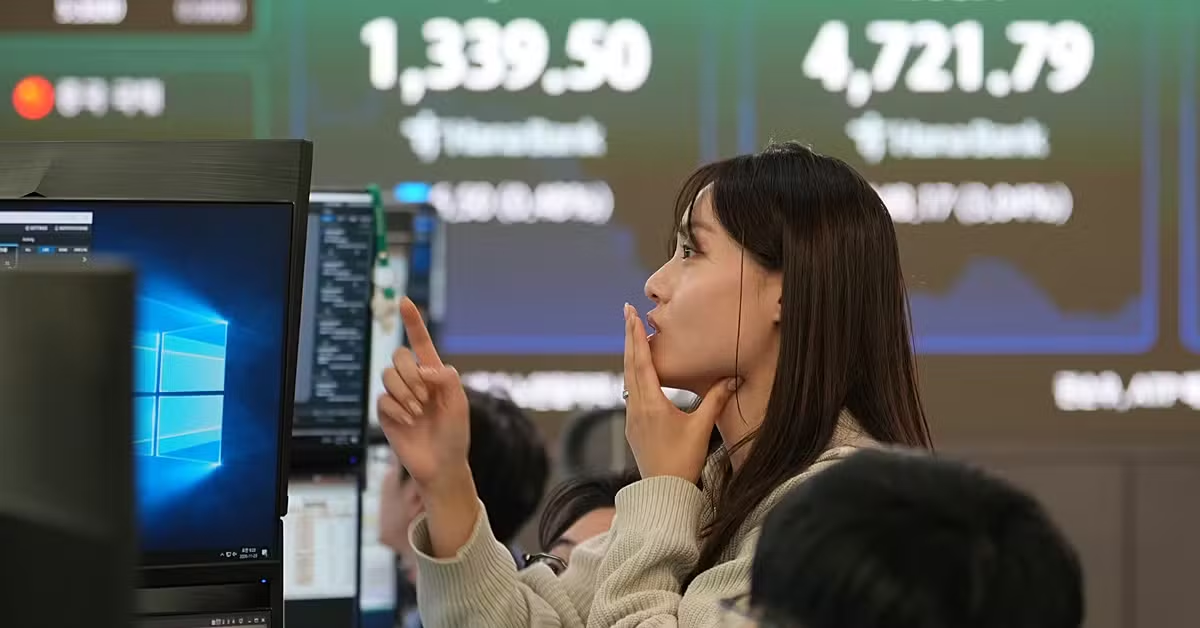
Asian tech stocks slide again as AI sell-off extends into a second week
Tech back in the firing line as traders track Wall Street rout
euronews.com· 4d
Asian tech back in the firing line as traders track Wall Street rout
channelnewsasia.com· 4d
Tech stock sell-off deepens in Asia
ft.com· 4d
South Korea’s stock market tumbles as AI bubble fears mount
aljazeera.com· 4d
US futures bounce while Asia markets brace for AI wipeout
reuters.com· 4d
Hong Kong Stocks Open Lower, Nasdaq Futures Climb
bloomberg.com· 4d
S&P 500 sinks 3.7% and the Nasdaq composite goes negative for the year
npr.org· 6d
Western Digital Stock Falls 12% in the Memory Chip Selloff. It Spun Off Its Flash Business Last Year and Now Sits 65% Below Its Record
247wallst.com· 6d
Nasdaq wipes out gains for the year as Anthropic IPO fails to quell AI nerves | CNN Business
cnn.com· 6d
NuScale Power Sinks 9% as AI Power Sell-Off Hits Nuclear Stocks; Constellation Drops 4%, Oklo Holds Steady
Applied Digital and Core Scientific Sink 12% as AI Infrastructure Sell-Off Deepens; TeraWulf Tumbles 10%
Vanguard's VXUS Falls 7% and VWO Drops 8.5% This Week as Taiwan's Stock Market Posts Its Worst Week Since 1991. Here's the Loss on a $1 Million IRA and What Rebalancing Rules Say to Do
AMD Stock Drops Another 7.0% Before the Bell and Taiwan Semiconductor Slides 4.2% as Nasdaq Futures Fall 1.6% After Asia's Chip Selloff
Global stock markets slump as Anthropic IPO fails to stem AI sell-off
theguardian.com· 7d
Anthropic shares fall 6% in premarket amid AI selloff as Nvidia, AMD shares drop
cnbc.com· 7d
Taiwan Stock Market Falls 6.2% to Cap Its Worst Week Since 1991 as KOSPI Closes Down 5.2% and Nikkei 225 Drops 5.1% in AI Chip Selloff
Tech stocks fall as Anthropic IPO fails to stem broader AI sell-off
South Korea's Stock Market and the Nikkei 225 Sink More Than 4% as the AI Selloff Spreads From Wall Street. Here's How Much of a Target-Date Fund Is in Samsung, SK Hynix and TSMC
Nikkei 225 Falls 4.5% and SoftBank Plunges 15% as Wall Street's AI Selloff Puts Asian Stocks on Track for Their Worst Week Since 2020
South Korea's Stock Market Sinks 4.6% as KOSPI Heavyweights SK Hynix and Samsung Fall 6% After Wall Street's AI Selloff
SoftBank plunges over 16% as AI sell-off hits Asian tech stocks following Anthropic debut
Asian tech stocks fall sharply after Anthropic's blockbuster IPO
nikkei.com· 7d
SanDisk Falls 7% as AI Chip Selloff Hits Memory Stocks Despite Evercore's $2,500 Target; Micron and Western Digital Drop 6%
Data centre construction stocks lose $4.2tn as boom in AI trade unravels
The AI trade was already unraveling: by November 15, data centre construction stocks had lost $4.2 trillion in value. Anthropic's initial public offering on November 19 briefly looked like a high point, its shares surging almost 40% at the open and closing 17% higher at $97.17 in the biggest IPO on record, surpassing SpaceX's June debut.
That quickly reversed. Asian technology shares fell sharply on Friday, November 20, with lingering concerns over artificial intelligence restrictions and export controls weighing on sentiment after Anthropic's debut. In Tokyo, SoftBank Group plunged 16.16% and Japanese chip stocks such as Tokyo Electron tumbled. Seoul's KOSPI fell more than 4%, triggering a five-minute pause on program selling, and foreign investors sold a net 636 billion won in a fifth straight session of net selling. Taiwan's main index lost 17.5% in the week, its worst since 1990, while MSCI's Asia-Pacific index headed for a 7% weekly loss, its worst since March 2020.
The selling crossed into Wall Street, where futures pointed to the losses being concentrated in chip and AI stocks. Nvidia closed 13.8% lower, its ninth decline in 10 trading days, and has dropped more than 25% since the Jensen Huang scandal erupted earlier in November. The Nasdaq Composite slumped 5.3%, wiping out its gains for the year, and the S&P 500 closed down 3.7% for its longest losing streak since the onset of the Covid-19 pandemic. Fears over the AI trade were worsened by midterm wins for candidates advocating slower data centre construction, and the souring mood followed the exit of Nvidia chief executive Jensen Huang and Anthropic's faltering debut.
Authorities moved to steady markets over the weekend: Taiwan's financial regulator ordered a further tightening of short-selling rules on Saturday, and China's stock exchanges announced support measures including eased margin financing requirements. On Monday, November 23, the sell-off continued, with Seoul's market diving more than 4% as SK Hynix and Samsung each dropped 4% and most Asian markets deep in negative territory, Tokyo closed for a holiday. The VIX fear gauge has spiked to its highest level since April 2025, the Nasdaq has lost almost a fifth of its value since its October record, and the US Commerce Department moved to close a loophole that let Chinese companies access Nvidia's powerful AI chips remotely.
Data centre construction stocks have lost $4.2tn in value as the boom in the AI trade unravels.
Asian technology shares fell sharply on the morning of Friday, November 20, 2026, with lingering concerns over artificial intelligence restrictions and export controls weighing on sentiment after Anthropic's initial public offering.
SoftBank Group shares plunged 16.16% on November 20, leading a broader sell-off in Asian technology stocks following Anthropic's market debut.
Japanese semiconductor stocks tumbled, with Tokyo Electron falling 7.19%, Lasertec 6.75% and Renesas Electronics 6.71%.
In South Korea, Nvidia suppliers SK Hynix and Samsung Electronics fell 6% and 4.7% respectively, and the Kospi declined 3.66%.
Nvidia slid 2.9% overnight, the Nasdaq Composite fell more than 2%, and the Dow closed below 50,000.
A commentary argued that SoftBank's sharp decline underscores growing investor concerns over its aggressive bets on artificial intelligence, particularly its exposure to OpenAI.
South Korea's KOSPI opened 4.1% lower on November 20 and fell as much as 4.8% to 4,889.57, dipping below 4,900 for the first time since February 2026.
Samsung Electronics fell 6.1% and SK Hynix 5.8% in Seoul morning trading, while Samsung Electro-Mechanics fell 10.7%, Hyundai Motor 4.3% and the KOSDAQ 4.5%.
Foreign investors sold a net 636 billion won, about $476 million, on Korea's main board by mid-morning, the fifth straight session of net foreign selling.
The won slipped 2.05 to 1,336.15 per dollar.
Han Ji-young, an analyst at Kiwoom Securities, said "Fund rotation immediately after a large initial public offering tends to be short-lived" and that the market looks oversold.
Sanjeev Rana, head of North Asia semiconductor research at CLSA, said "Earnings for 2027 are still pretty much in the bag."
Japan's Nikkei 225 fell 4.5% to 56,790 and SoftBank plunged 15% in Friday morning trading in Tokyo.
Taiwan's Taiex was down 6.3% before midday on November 20, after falling 4.4% the day before.
Hong Kong's Hang Seng fell 2.2%, the Shanghai Composite 2.0% and Australia's S&P/ASX 200 1.5%.
MSCI's Asia-Pacific index was headed for a weekly loss of about 7%, its worst since March 2020.
Kyle Rodda, senior financial market analyst at Capital.com, said the Anthropic offering was not enough to "assuage the overall concern about the outlook for the AI trade."
The Korea Exchange triggered a sell-side sidecar, a five-minute pause on program selling, on November 20, as the KOSPI fell 5.04% to 4,879.10 by midday.
Anthropic stock soared 17% in its debut on November 19, closing at $97.17 a share, in the biggest initial public offering on record, surpassing SpaceX's June debut.
Anthropic shares fell 6% in premarket trading on November 20, with Nvidia down 1.36% and AMD down 3.31%.
Taiwan's stock index dropped 6.7% on November 20 to its lowest point since mid-April, with the chipmaker TSMC down about 6%.
Anthropic's shares briefly surged by almost 40% when trading began at its debut on November 19.
The pan-European Stoxx 600 dropped 1.3% in the first 90 minutes of Friday trading.
Britain's FTSE 100 hit a five-month low on Friday morning, down 4.8% in the week.
Daniela Hathorn, a senior market analyst at Capital.com, said the IPO demonstrated that demand for AI exposure remains strong but has not overcome concerns about elevated valuations, profitability and the sustainability of investment spending.
Hathorn said the broader market mood has shifted from buying the dip towards questioning whether the correction has further to run.
Hathorn said the weakness in equal-weighted indices suggests selling pressure is no longer confined to a handful of technology giants, while Europe's recent outperformance has also faded.
Advanced Micro Devices fell another 7% before the bell on November 20 after a 7.7% drop on November 19, leaving it down 14.2% in two days and 30% below its October 6 record close.
Nasdaq 100 futures fell 1.6% while Dow futures were flat in pre-market trading, a gap suggesting the selling was concentrated in chip and AI stocks.
Taiwan's stock market closed out its worst week since 1991, with the Taiex down 6.2% on the day, while the KOSPI closed down 5.2%, the Nikkei 225 5.1% and Hong Kong's Hang Seng 1.9%.
Germany's DAX and the Euro Stoxx 50 each fell 2.0%, and London's FTSE 100 fell 0.6%.
Nvidia has closed lower for six sessions in a row, and the VanEck Semiconductor ETF fell for a sixth straight session, sitting 35% below its June high.
The SPDR S&P 500 ETF closed lower for a sixth straight session, its longest losing streak since April 2024.
Jeremy Phillips said the gap between flat Dow futures and falling Nasdaq 100 futures was a sign the selling was concentrated in chip and AI stocks, while cautioning that pre-market trading is thin and Thursday's session also started higher before turning down.
Taiwan's main stock index lost 17.5% in the week ending November 20.
Vanguard's Total International Stock ETF fell 7% in the week to November 20 and its FTSE Emerging Markets fund fell 8.5%.
Applied Digital and Core Scientific each fell 12% in morning trading on November 20, leaving Applied Digital down 50% for 2026, and TeraWulf fell 10% to $10.45.
Michael Burry said in a post on X that he "tried to warn" investors about CoreWeave and other neocloud and chip names.
The Nasdaq Composite turned negative for 2026.
Nuclear stocks split as the AI power trade unwound, with NuScale Power down 9% to $3.48, Constellation Energy down 4% to $242.83 and Cameco down 3%, while Oklo held nearly steady at $20.82.
The S&P 500 fell 2.1% on November 20, putting it on track for a seventh straight daily loss, its longest losing streak since February 2020.
The Nasdaq Composite fell 3.6% on November 20, wiping out its gains for the year and leaving it down almost 1% for 2026.
The Dow fell 0.5% on November 20, cushioned by gains in healthcare and consumer staples, and both the Dow and the S&P 500 dipped into correction territory, 10% below their peaks of August 5 and October 6.
Anthropic's shares plunged 13% on November 20 to around $84.40, just above its $83 IPO price.
Wall Street's three main indices were on track for their worst week since early April 2025.
Steve Sosnick, chief strategist at Interactive Brokers, said there is a real exodus out of tech stocks and that buying the dip has given way to selling the rally, or just selling.
David Kelly, chief global strategist at JPMorgan Asset Management, said there is a fear of too much froth and enthusiasm in the tech bet, while calling the correction a mild cold rather than a fatal illness that should be over in a week or two.
Western Digital fell 12% to about $261 on November 20 without company news, putting it on pace for a seventh one-day drop of 10% or more in 2026.
Seagate Technology fell 12%, SanDisk 15% and Micron Technology 12% in the sell-off in memory and storage stocks.
The S&P 500 closed down 3.7% at 6,910.39 on November 20, its worst weekly loss since April 2025, capping a seven-day losing streak, its longest since the onset of the Covid-19 pandemic, with final figures steeper than earlier reports had shown.
The Nasdaq composite slumped 5.3% to 22,617.73, ending negative for the year, with a weekly loss just shy of its worst since March 2020, and the Dow fell 1.9% to 48,147.33.
Nvidia closed 13.8% lower, its ninth decline in 10 trading days, and has dropped more than 25% since the Jensen Huang scandal erupted earlier in November.
Advanced Micro Devices sank 13.3%, Micron Technology 13.9% and Broadcom 12.1%, and the PHLX Semiconductor Index sank 10.7%.
Anthropic's stock fell 9.1% to $88.30, about 23% below its Thursday peak of $115.10, but stayed above its $83 IPO price.
Corning slid 10.9% and Bloom Energy gave up 15.3%.
Fears over the AI trade were worsened by midterm wins for candidates advocating slower data centre construction.
Baird market strategist Michael Antonelli said, "The whole notion that AI can continue to spend unlimited amounts of money and support the stock market, I think the notion of that is ending as we speak, that's what's being priced right now."
Antonelli also said, "I don't think that means that the overall bull market that started in October 2022 is over."
US equity-index futures bounced after the sharp Friday sell-off, while Hong Kong shares dipped and Taiwan's Taiex fluctuated following wider support measures.
US stock futures bounced at Monday's open, with Nasdaq 100 futures up about 2% and S&P 500 futures up around 1%, while Japanese and Hong Kong futures pointed lower and Australian stocks opened 0.5% down.
The Nasdaq's 10% weekly drop was its largest since the pandemic panic of March 2020.
Taiwan's shares ended the week down 17%, their biggest weekly fall since 1990.
Taiwan's financial regulator ordered a further tightening of short-selling rules on Saturday.
China's stock exchanges announced support measures, including easing requirements for margin financing.
The souring mood followed the exit of Nvidia chief executive Jensen Huang and Anthropic's faltering debut.
South Korea's finance ministry said on Sunday that South Korea will be ready to deploy market stabilisation funds immediately should the market continue to fall.
South Korea's Kospi fell as much as 3.7% in early trading on Monday, November 23, continuing the tech-led sell-off across the Asia-Pacific region and the United States.
Seoul's market dived more than 4% on Monday as SK Hynix and Samsung each dropped 4%, while Taipei flickered between gains and losses and Hong Kong, Shanghai, Sydney, Singapore, Wellington and Jakarta were deep in negative territory; Tokyo was closed for a holiday.
Nvidia plunged 14% in New York on November 20, and the Nasdaq has lost almost a fifth of its value since hitting a record high in October 2026.
The VIX fear gauge spiked to its highest level since April 2025.
The US Commerce Department moved to close a loophole that allowed Chinese companies to access Nvidia's powerful AI chips remotely.
Stephen Innes of SPI Asset Management said SK Hynix and Samsung are not peripheral players in the AI boom but two of its most important semiconductor suppliers.
Innes said their continued weakness suggests investors are still more interested in reducing exposure than celebrating a few hours of improved sentiment in US futures.
Fiona Cincotta of Forex.com said nerves have been showing in the AI trade amid increased scrutiny over AI capital expenditure, the scale of investment, the returns and when they might materialise.
Cincotta said the Democrats taking control of Congress, which is expected to slow the AI buildout, combined with expectations of higher rates for longer, are fueling concerns about the sector.
South Korea was considering a stock-market stabilisation fund not used since the global financial crisis.

