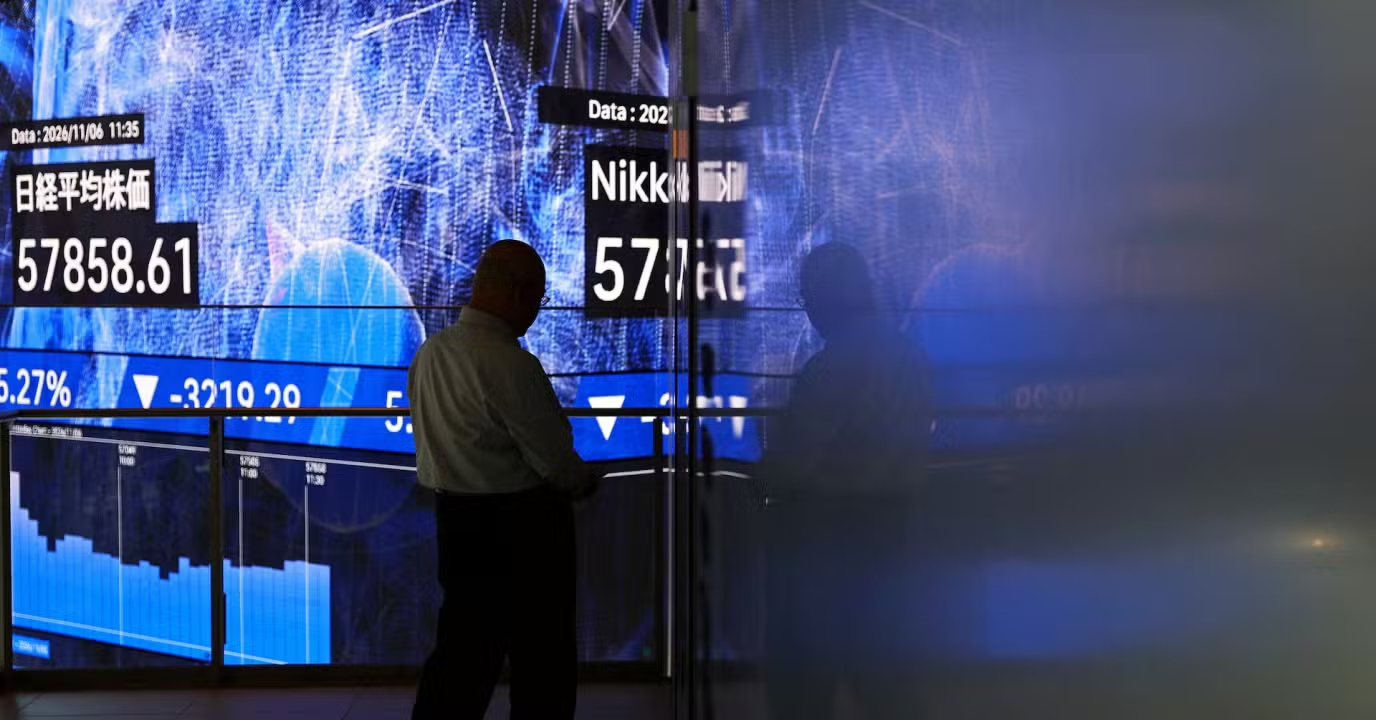
Asian stocks rebound with Wall Street closed for Thanksgiving after AI sell-off month
Is this a dead turkey bounce?
reuters.com· 13h
Stocks advance in Asia after volatile US trading over AI risks
ft.com· 42h
SoftBank Stock Drops Another 15% as Slump from AI Eclipses Covid
wsj.com· 2d
Tech firms back in crosshairs as Huang rally reverses
channelnewsasia.com· 2d
Aasian pörssit syöksyvät
yle.fi· 2d
Stocks retreat as AI rebound stumbles, tariff threats loom
Asian markets lose ground as AI fears return
SoftBank drops over 11% as Wall Street AI sell-off ripples across Asian tech names
cnbc.com· 2d
Tech back in the firing line as traders track Wall Street rout
euronews.com· 4d
Asian regulators rush to support sagging markets as AI trade falters
Asian tech back in the firing line as traders track Wall Street rout
Tech stock sell-off deepens in Asia
South Korea’s stock market tumbles as AI bubble fears mount
aljazeera.com· 4d
The AI bust is a growing threat to China's economy and a 'moment of real danger' for President Xi Jinping, analyst warns | Fortune
fortune.com· 5d
Chip Stocks are Now Repeating What Happened in 2001
247wallst.com· 6d
Anthropic IPO fails to calm AI jitters as tech stocks plummet
lemonde.fr· 6d
Vanguard's VXUS Falls 7% and VWO Drops 8.5% This Week as Taiwan's Stock Market Posts Its Worst Week Since 1991. Here's the Loss on a $1 Million IRA and What Rebalancing Rules Say to Do
Taiwan Stock Market Falls 6.2% to Cap Its Worst Week Since 1991 as KOSPI Closes Down 5.2% and Nikkei 225 Drops 5.1% in AI Chip Selloff
South Korea's Stock Market and the Nikkei 225 Sink More Than 4% as the AI Selloff Spreads From Wall Street. Here's How Much of a Target-Date Fund Is in Samsung, SK Hynix and TSMC
South Korea's Stock Market Sinks 4.6% as KOSPI Heavyweights SK Hynix and Samsung Fall 6% After Wall Street's AI Selloff
Asian tech stocks fall sharply after Anthropic's blockbuster IPO
nikkei.com· 7d
Taiwan Semiconductor Slipped 14% This Month Amidst Tech Contraction: 175% Gains to Materialize According to One Wall Street Desk
Chip Stocks Are Having Their Worst Two Months Since 2008
Asian markets mostly drop as AI stocks remain under pressure
apnews.com· 10d
Asian shares bounced back on November 27, with Japan's Nikkei 225 jumping 1.9% and South Korea's Kospi up 3.9%.
The rebound followed a month of losses across the AI trade. On November 17 South Korea's Kospi closed below 5,000 points for the first time since February, while the PHLX Semiconductor Index stood 23.9% below its September 30 close.
The selling peaked on November 20, when the PHLX index fell 10.73% in its worst week since September 2001 and Nvidia sank 14.01% to $125.53. Market analyst Jared Blikre counted 62 chip stocks that lost about $1.5 trillion that day.
Strong Nvidia earnings failed to stop the selling, and concerns were worsened by a reported spying scandal at the chipmaker. Taiwan tightened short-selling rules, China eased borrowing to buy stocks and South Korea considered a stabilisation fund not used since the global financial crisis.
Nvidia whipsawed the market. It announced chief executive Jensen Huang's resignation on November 17, a move tied to about $735 billion in lost market value across chip stocks. His return less than two weeks later sent Asian shares surging on November 24. The surge reversed on November 25, when Nvidia shed almost 6% and Tokyo, Seoul and Taipei sank again.
Asian stocks steadied on November 26, and the rebound held into the Thanksgiving break with Wall Street shut. Nasdaq futures rallied 2.4% and S&P 500 futures gained 1.6%, leaving the Nikkei 3.8% higher for the week and clawing back some of its 7.4% monthly loss.
Asian shares mostly declined on November 17, 2026, following further drops for artificial intelligence stocks on Wall Street ahead of Nvidia's earnings results.
South Korea's Kospi fell 2.6% to 4,968.48 on November 17, closing below 5,000 points for the first time since February 2026 and at its lowest level in six months.
Japan's Nikkei 225 lost 1.3% to 58,860.43, with SoftBank Group tumbling 3.9% to stand more than 33% lower over a month and Advantest slumping 4.4%.
Samsung Electronics fell 3.1% and SK Hynix dropped 1.8% in Seoul on November 17.
On Wall Street the previous day, the S&P 500 fell 1.9%, the Nasdaq composite lost 2.5%, and Nvidia sank 4.1% to again lead the market lower.
Nvidia was set to report its latest quarterly results on November 17, with interim CEO Colette Kress speaking to Wall Street.
The PHLX Semiconductor Index fell 5.28% on November 16, 2026, to 9,610.65, with all 30 members finishing lower.
From its September 30 close, the PHLX Semiconductor Index was down 23.9%, having fallen 15.36% in October and another 10.09% in November, on track for its worst two-month stretch since 2008 if it ends the month below about 9,817.
Analyst firm SemiAnalysis cut its AI accelerator spending forecasts by 28% for 2028 and 40% for 2030.
The US Commerce Department issued a new rule restricting remote access to advanced American chips.
Nvidia announced the resignation of chief executive Jensen Huang, a move tied to about $735 billion in lost market value across chip stocks.
In the month to November 19, 2026, Taiwan Semiconductor fell 13.72%, Intel dropped 40.6% to $54.67, United Microelectronics fell 30.43%, and GlobalFoundries slid 13.62%.
Asian tech shares fell sharply on the morning of November 20, 2026, as investors ran out of fresh catalysts after Anthropic's blockbuster initial public offering, with AI restrictions and export controls weighing on sentiment.
South Korea's Kospi fell as much as 4.8% on the morning of November 20, 2026, dipping below 4,900 for the first time since February.
Samsung Electronics dropped 6.1% and SK Hynix 5.8% in Seoul, while Samsung Electro-Mechanics lost 10.7%.
Foreign investors sold a net 636 billion won, about $476 million, of Korean shares on November 20, the fifth straight session of net foreign selling.
Kiwoom Securities analyst Han Ji-young said fund rotation immediately after a large initial public offering tends to be short-lived and that the market looks oversold.
CLSA's Sanjeev Rana said, 'Earnings for 2027 are still pretty much in the bag.'
The Kospi fell 5.04% to 4,879.10 in Seoul on November 20, and the Korea Exchange triggered a sell-side sidecar, pausing program selling for five minutes.
Japan's Nikkei 225 fell 4.52% to 56,758.00 in the afternoon session on November 20.
Taiwan's Taiex fell 5.46% on November 20, a day after losing 4.40%.
Taiwan's Taiex fell 6.2% on November 6, 2026, ending its worst week since 1991 with a 17.5% weekly loss.
South Korea's Kospi closed down 5.2% at 4,869.96 on November 6, and the South Korean exchange paused program selling for five minutes on both its boards.
Japan's Nikkei 225 fell 5.1% to 56,436.65 on November 6, a seven-month low and 23% below its 52-week high.
SoftBank Group fell 14.5% to 3,025 yen in Tokyo on November 6, leaving it 67% below its 52-week high.
Japanese chip and data center suppliers fell on November 6, with Advantest down 10.3%, Tokyo Electron down 7.1%, Kioxia down 11.7% and Lasertec down 9.2%.
MSCI's index of Asia-Pacific shares outside Japan was down 8.3% for the week ending November 6, its worst week since March 2020.
The November 6 selloff followed US losses on November 5, when the Nasdaq fell 2.3% after AMD sank 7.7% on a short seller's report.
Commentator Jeremy Phillips read the Seoul and Tokyo closes of November 6 as a sign that sellers stayed in control to the end.
The PHLX Semiconductor Index fell 10.73% on November 20, 2026, to 8,408.59, ending the week down 17.13%, its worst week since September 2001.
Nvidia dropped 14.01% to $125.53 on November 20, cutting its market value to about $3.65 trillion.
The S&P 500 fell 3.70% and the Nasdaq Composite dropped 5.28% on November 20.
Market analyst Jared Blikre counted 62 chip stocks that together lost about $1.5 trillion of market value on November 20.
Raymond James strategist Matt Orton argued the market differs sharply from 2000 because many chipmakers then traded on hope while today's biggest names earn large profits.
China's tech-heavy STAR 50 index had fallen 44% from its summer 2026 high as the AI sell-off spread.
Yardeni Research warned that the AI bubble had already popped in China and called the downturn a 'moment of real danger' for President Xi Jinping.
South Korea's Kospi fell as much as 3.7% in early trading on Monday, November 23, 2026, extending the previous week's tech-led sell-off.
In the week to November 20, the S&P 500 had closed 3.7% lower for a seventh straight loss and the Nasdaq Composite had erased all of its 2026 gains.
Investor concerns about the AI boom were worsened by a reported spying scandal roiling Nvidia.
Seoul's market dived more than 4% on November 23 as SK Hynix and Samsung each dropped 4%, while Tokyo was closed for a holiday.
Strong earnings from Nvidia failed to stop the selling.
The VIX volatility index spiked to its highest level since April 2025.
Taiwan tightened short-selling rules, China eased borrowing to buy stocks, and South Korea considered a stock-market stabilisation fund not used since the global financial crisis.
SPI Asset Management's Stephen Innes said Samsung and SK Hynix are two of the AI boom's most important semiconductor suppliers, and their continued weakness suggested investors were still reducing exposure rather than celebrating improved US futures sentiment.
Forex.com's Fiona Cincotta said nerves over AI capital spending and its returns, combined with Democratic control of Congress and expectations of higher rates for longer, were fueling concerns about the sector.
Asian technology stocks tumbled on Wednesday, November 25, 2026, led by a rout in Japanese semiconductor stocks, after an overnight sell-off on Wall Street.
Advantest plunged 12.26% and Tokyo Electron slumped 10.9% on November 25, while SoftBank Group shed 10% and Lasertec lost 10.15%.
Samsung Electronics and SK Hynix both fell more than 7% on November 25.
MSCI's broadest index of Asia-Pacific shares outside Japan fell 3.2% on November 25, with South Korean shares down as much as 6.4% and Taiwan down as much as 8.6% at the worst point.
Three people said the US Trade Representative's office was preparing to release findings of a probe into alleged excess industrial capacity among 16 major trading partners, which could pave the way for new tariffs.
Jensen Huang returned as Nvidia's chief executive earlier that week, and Nvidia fell 5.9% on November 25 as it surrendered the resulting gains.
Anthropic shares fell 6.5% to below their initial public offering price.
Copper prices fell 4.66% in Shanghai as the fizzling AI rally weighed on industrial metals.
Hua Nan Securities analyst Kevin Su said Asian markets were being sold off mainly because of the tariff issue, with rate hike expectations also suppressing risk appetite.
Pepperstone's Chris Weston said the re-emergence of tariffs from the US Trade Representative had been met with a collective sigh, and that traders appear reluctant to commit significant capital on the headlines alone.
Capital.com's Kyle Rodda said Wall Street pared its Monday advance as sobriety returned and a focus returned to fundamentals.
Japan's Nikkei 225 closed down 3.1% at 56,802.90 and South Korea's Kospi fell 4.8% to 4,764.70 on November 25, after both markets had risen several percent the previous day.
Jensen Huang returned as Nvidia's chief executive less than two weeks after resigning, and news of his return sent Asian stock markets surging on November 24.
Nvidia shares rocketed more than 31% on November 23, then shed almost 6% on Wall Street on November 25.
On November 25, Taipei sank 8%, Tokyo fell more than 3% and Seoul dropped more than 5%, a day after surging 9%, 3.9% and more than 6%.
AMD, Intel and Micron shares also took a hammering on Wall Street on November 25 after the previous day's surge.
On Wall Street on November 25, the Nasdaq shed 1.5% and the S&P 500 lost 0.5% while the Dow rose.
SPI Asset Management's Stephen Innes said the relief rally had acquired the characteristics of a dead-cat bounce, and that 'Professional investors (were) apparently using the opening provided by the Jensen Huang comeback to unload technology exposure rather than rebuild it.'
BNZ's Jason Wong said key issues continue to overhang the AI sector despite Huang's return, including whether investment in the sector will provide an adequate return and the threat of regulation under a new administration from next year.
SoftBank shares fell 14.8% on November 25, leaving the stock down 68% from its early-June 2026 high and erasing more than $200 billion in market value.
Asian stocks advanced on November 26, 2026, after a volatile US trading session driven by worries over artificial intelligence risks.
Asian shares bounced back on November 27 with Wall Street closed for Thanksgiving, with Japan's Nikkei jumping 1.9% and South Korea's benchmark share index up 3.9%.
Nasdaq futures rallied 2.4% and S&P 500 futures gained 1.6%, and the Nikkei stood 3.8% higher for the week, clawing back some of its 7.4% monthly loss.
Chinese chip stocks notch biggest ever one-day gains as Beijing signals broader market support
Investors see rising risk of SoftBank default as pressure grows on AI bets
Asian stocks rally as Huang's return to Nvidia revives the AI trade
Western Digital Stock Falls 12% in the Memory Chip Selloff. It Spun Off Its Flash Business Last Year and Now Sits 65% Below Its Record
Seagate Spikes 9%, Sandisk Surges 8% as CoreWeave's Results Revive AI Trade; Micron Climbs 7%

