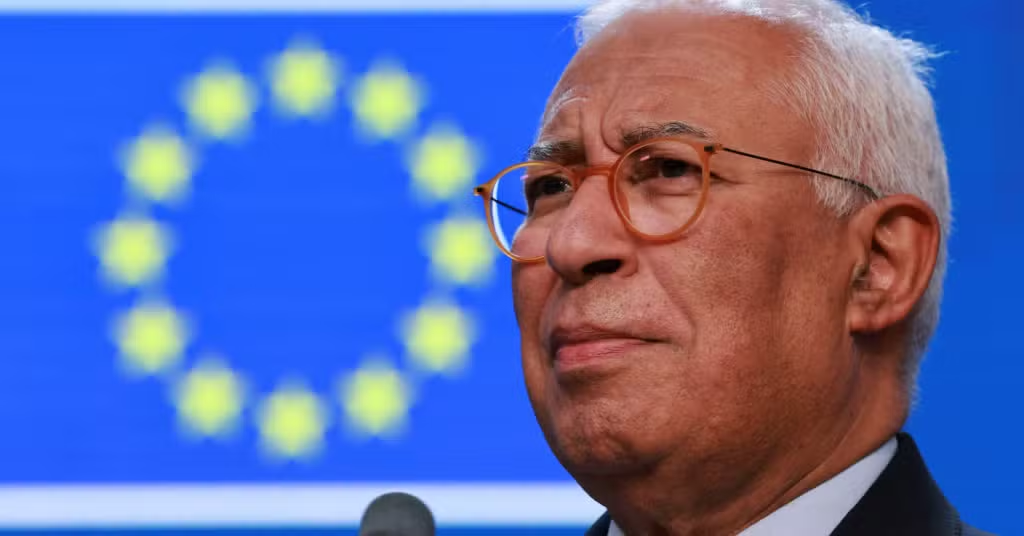
EU budget summit collapses as leaders plan December 17-18 retry on Ukraine loan
A Ukraine loan is in limbo after EU budget talks stall. Leaders will try again
pbs.org· 2h
EU leaders fail to break $1.7 trillion budget deadlock as political pressure mounts
cnbc.com· 6h
Why EU leaders are struggling to Le Pen-proof the bloc’s €1.6 trillion budget
reuters.com· 8h
EU-Gipfel: Wie der Milliarden-Streit über das Budget im Chaos versank
spiegel.de· 18h
EU summit ends in disarray as leaders cling to red lines and push back
euronews.com· 20h
EU leaders aim for budget deal before the end of the year, Merz says
Italy's Meloni talks tough on EU budget, warns Ukraine on Mediterranean strike
Bundeskanzler Friedrich Merz lehnt Kompromissvorschlag zu EU-Finanzen ab
EU's Costa aims to bring leaders closer to budget deal, as objections remain
EU-Gipfel: Merz pocht auf Einsparungen – aber an die Landwirte traut sich niemand ran
Live - EU summit: 'Listen to each other,' Costa tells leaders at budget talks
EU budget and Ukraine aid headed for collision at turbulent summit
Jetten zet zich schrap voor 'bloedig gevecht' over EU-begroting
nos.nl· 39h
EU leaders to wrestle with seven-year budget, Ukraine financing as they seek December deal
Les syndicats d’agriculteurs montent au créneau avant des discussions clés sur la nouvelle politique agricole commune
lemonde.fr· 40h
MEPs warn Costa: no approval without a bigger EU budget
Europe Tonight: Can the EU’s new budget compete with China and the US?
MEP Lucia Yar talks budget with Euronews' Europe Editor Maria Tadeo
Red lines and power plays in the EU's budget battle
António Costa kürzt, Friedrich Merz kritisiert dennoch den EU-Budget-Vorschlag
Budget UE: plus de 200 milliards d'euros d'économies proposées, Paris et Berlin font la moue
rfi.fr· 6d
Antonio Costa Proposes €1.78T EU Budget for 2028-2034, Preserves €100B for Ukraine
kyivpost.com· 6d
EU leaders' chair proposes new cuts to EU 2028-2034 budget draft, suggests digital tax
EU budget: Costa pitches more cuts, Big Tech tax to break deadlock
Avant le sommet de l’UE consacré à son budget, la France s’oppose à la baisse de 204 milliards proposés par le Conseil européen
liberation.fr· 6d
EU budget proposal keeps Ukraine funding unchanged as cost of Russia's war rises
kyivindependent.com· 6d
EU proposes Big Tech tax to boost budget
Latest EU budget proposal is 'very disappointing', French presidency says
Budget de l’UE : Antonio Costa, le président du Conseil européen, propose 204 milliards d’euros d’économies et une taxe numérique
Costa eyes tax on Big Tech to boost EU budget after Trump’s poor midterms showing
politico.eu· 8d
European Council President António Costa put a revised draft EU budget for 2028-2034 on the table on November 21, cut by 10% to €1.582 trillion and financed in part by a new 3% tax on large digital companies' revenue, while keeping up to €100 billion for Ukraine outside the spending ceilings. Many member states said at an ambassadors' meeting on November 23 that the draft was no basis for compromise, with a 17-strong Friends of Cohesion group led by Italy and Romania opposing cohesion cuts and frugal net contributors demanding deeper reductions. The European Parliament said it would not rubber-stamp any deal without its priorities, and several hundred farmers demonstrated in Brussels on November 26.
Leaders met on November 26-27 to settle the budget, which requires unanimous approval. German Chancellor Friedrich Merz rejected Costa's compromise at the summit as not cutting enough, and French President Emmanuel Macron called a rare mid-summit press conference to warn that negotiations could not be concluded after December 31, 2026. Frugal leaders boycotted Costa's small-group format as unfair pressure, talks ran 12 hours, some participants walked out, and the summit ended in disarray on November 27, with the €45 billion support loan for Ukraine relegated to an afterthought. Costa says 24 of 27 member countries back the Ukraine loan plan and must still win over the Czech Republic, Hungary and Slovakia.
Leaders plan to try again at a summit on December 17-18.
European Council President António Costa is considering asking governments to back a tax on tech companies such as Google and Meta to boost the EU's roughly €2 trillion budget and unlock a deal on its final size.
Costa is due to present a revised budget proposal for 2028-2034 on Saturday and is pushing leaders to agree the budget by the end of 2026, before elections in France, Italy and Poland.
Costa's team is considering replacing the Commission's contested business tax, CORE, with a digital levy, which Germany has warmed to without publicly backing.
The European Commission estimates a 3% tax on certain digital revenues would raise about €5 billion a year.
Costa is expected to propose cuts across the board in his Saturday proposal, including money for poorer regions, while leaving farmers' subsidies untouched.
Chancellor Friedrich Merz and Danish Prime Minister Mette Frederiksen opened the door to a tax on digital companies at a meeting of northern European leaders in Dublin.
Ireland, which hosts the European branches of US tech firms, has signaled it would oppose the EU digital levy.
Costa's team signaled in private discussions that it is ready to explore a tax on crypto firms over a longer timeline.
Siegfried Mureșan, the European People's Party's budget negotiator, says the probability of trade threats from the Trump administration has been reduced after the midterm results.
Booking.com CEO Glenn Fogel warned that digital levies and tougher regulations would hurt the business and the future of the European economy.
On November 21 Costa presented a revised draft EU budget for 2028-2034, cut by €204 billion from the European Commission's initial €2 trillion proposal.
The draft includes a 3% tax on large digital companies' annual revenue, puts the taxation of crypto-assets under study, and proposes financing through auctions of telecom frequencies.
Costa says at a press conference, "This tax is in no way directed against any company or state."
Siegfried Muresan says in a statement, "President Costa's proposal is simply unacceptable," adding that "Europe needs ambition and the means to face its growing challenges."
The French presidency says the new negotiating box is "very disappointing," that it falls short particularly on the Common Agricultural Policy and income support for farmers, and that it "does not constitute a basis for an agreement".
The draft taxes at 3% the net turnover from online advertising, digital intermediation services and user data of companies with EU turnover above €50 million and global turnover above €750 million.
The draft also includes plans for a levy on electronic waste and higher tobacco taxes.
Costa says at a press conference in Brussels, "I believe this proposal can bring us closer to a final agreement."
The proposal keeps EU budget support for Ukraine intact at €89 billion in 2025 prices, about €100 billion adjusted for inflation.
Interest payments on EU loans to Ukraine would be provided on top of the budget's spending ceilings, and the draft keeps wording allowing other parts of the budget to be cannibalized to help Ukraine.
Costa writes in the proposal, "Our commitment to Ukraine is central to our overall ambitions."
The European Parliament's conservative rapporteur estimates the yield of the proposed new revenues at between €18 billion and €32 billion a year.
Costa's proposal cuts a further €49 billion to €1.78 trillion in current prices, a 10% reduction worth €204 billion, and includes postponing the repayment of EU joint debt.
For the first time it cuts agricultural, fisheries and cohesion funding by €54 billion, takes €95.5 billion, or 16%, from competitiveness and defence, and hits Global Europe hardest with a €45 billion, 21% cut.
A mix of new and revamped EU-wide taxes is meant to raise €64 billion a year, with the 3% digital services tax as its main novelty.
The plan channels 30% of Emissions Trading System revenues to the budget, phased from 0% in 2028 to the full rate in 2034, raises the CBAM revenue share to 100%, and phases in a tobacco tax reaching 15% by 2034.
Levies on non-recycled plastic packaging waste rise from €0.80 to €1.25 per kilogram and on uncollected electronic waste from €2 to €2.25 per kilogram.
Repayments of NextGenerationEU debt in 2028-2034 are cut by €10 billion, and revenues from allocating radio spectrum for 5G and 6G networks are picked up for specific bands.
The plan gives a mandate to explore a levy on crypto-assets, which was deemed not ready to generate revenue from 2028.
Costa says he is confident the proposal is a good basis for moving towards a final agreement because it matches the EU's ambitions, keeps national contributions within reasonable limits and includes a balanced basket of new own resources.
A source from the Élysée calls the negotiating framework "very disappointing" and says it does not constitute a basis for an agreement.
German Chancellor Friedrich Merz says there will be no agreement on the EU budget without unanimous financial support to Ukraine.
Czech MEP Danuše Nerudová says the measures would help create a level playing field in the single market, where American digital giants often face lower taxes than European firms.
Compared with the Irish EU presidency's October draft, Costa's proposal cuts a further €40 billion to €1.582 trillion, and €180.6 billion against the original Commission proposal.
The cuts fall mainly on the European Competitiveness Fund, defence and external spending, while agriculture and cohesion money is relatively protected.
Costa proposes slowing the repayment of the capital of the more than €600 billion the EU will have jointly borrowed by the end of 2026, starting in 2028 and running to 2058.
Siegfried Muresan says, "This proposal is unacceptable to Parliament and cannot form the basis for our consent. The EU budget is an investment budget. Cuts, more cuts and a side of cuts are not an investment strategy."
Friedrich Merz says, "A just and fair burden-sharing arrangement can only be achieved through corrections on the revenue side."
The framework establishes a dedicated off-ceiling "Ukraine Reserve" of up to €100 billion in current prices, delivering support through budgetary guarantees, grants and macro-financial credit assistance.
Because the reserve sits above the standard expenditure ceilings, it offers flexibility without forcing cuts to cohesion or agricultural programs, and allows borrowing-cost subsidies and supplementary external-action allocations for Ukraine.
Costa says his proposal is 10 percent lower than the Commission's initial plan, a reduction of €204 billion in current prices, to keep national contributions at a reasonable level.
Friedrich Merz calls the proposal "a first step" whose amount "remains excessive," says "practically all EU countries must put their public finances in order," and calls it an increase of more than 40% of the European budget that is difficultly compatible with the current context.
Swedish Minister for EU Affairs Jessica Rosencrantz writes on X, "We are still far from a compromise."
Costa says, "This is a budget that is up to our ambitions. And it keeps national contributions within reasonable limits. Third, it contains a balanced basket of new own resources."
The European Parliament rejects the reduced budget as incapable of financing Europe's priorities such as defence, security and competitiveness, while welcoming the revenue proposals.
Friedrich Merz says the compromise is still not capable of gaining approval, that its volume is too high, and that an EU budget growing by more than 40% does not fit these times, while saying he is ready to work on a realistic and affordable budget and that agreeing by the end of the year is in everyone's interest.
At a four-hour meeting of EU ambassadors on November 23, many member states said Costa's proposal is not a basis for compromise and that negotiations are getting further away, with no practical outcome.
A 17-strong Friends of Cohesion group led by Italy and Romania opposes the proposal's cuts to cohesion funding.
Slovakia, Czechia, Hungary and Bulgaria want to opt out of the upcoming top-up of the Ukraine Support Loan while staunchly defending cohesion policy.
A compromise under discussion would let objecting countries opt out of the loan's €25 billion military strand while still backing its €20 billion civilian strand.
The frugal net contributors, including Germany, the Netherlands and Sweden, want cuts of several hundred billion euros but have no common position.
Slovakia's Prime Minister Robert Fico brands Merz's linking of the budget to Ukraine funding "blackmail" and threatens to use Slovakia's veto to block the EU budget.
Germany's ambassador rejected Costa's proposal as a basis for discussion at the ambassadors' meeting.
Members of the European Parliament condemned the proposed 10% cut and said they will not rubber-stamp any agreement unless their priorities are taken into account; adopting the budget requires the Parliament's consent by an absolute majority.
Siegfried Mureșan says at a press conference, "Prime ministers shall not dictate to the European Parliament what we should do," and that "Cut the budget, but protect me" is the motto of many prime ministers.
Mureșan accuses EU leaders of inconsistency, arguing they present security and competitiveness as priorities while effectively cutting funding for them.
Several hundred farmers of COPA-Cogeca were to demonstrate in Brussels on November 26 to pressure the budget negotiations, from which the next Common Agricultural Policy will follow.
French farm unions rally behind the cry that "Not one euro must be missing" from the future Common Agricultural Policy.
EU leaders meet on November 26-27 to discuss Costa's €1.582 trillion proposal, with the aim of agreeing the budget at a summit on December 17-18; the seven-year budget requires unanimous approval.
The proposal's biggest line item is around €740 billion for farmers and poorer regions, and it includes up to €100 billion for Ukraine, which diplomats say falls well short of the country's needs.
The EU plans to borrow €45 billion jointly to lend to Ukraine, repayable only when Russia pays war reparations, with Britain, Norway, Japan, Switzerland and Canada providing another €25 billion for 2027, covering that year's €70 billion gap.
Slovakia, the Czech Republic, Hungary and Bulgaria object to all members contributing to the €45 billion loan, while Germany and several other countries have made participation a condition of a broader budget deal.
Dutch Finance Minister Heinen, who earlier called the budget proposal a "no-go", says, "It is quite simple: the budget must get smaller or the national rebate larger," leaving room for negotiation.
Friedrich Merz threatens that Germany could veto the entire EU budget if Hungary, the Czech Republic, Slovakia and Bulgaria leave the rest to pay for the extra Ukraine support.
The Commission has tabled a €45 billion support loan backed by joint debt, covering two-thirds of the €70 billion gap in Kyiv's 2027 budget, on top of the ongoing €90 billion credit line.
The frugal net contributors, now joined by Austria and Belgium and rebranded as "modernisers", demand deeper cuts to agriculture and cohesion to channel more cash into defence, climate and technology.
Costa tells leaders ahead of the summit, "The time has come to reach an agreement."
The Élysée says the negotiations cannot go beyond December, since several member states, beyond the French presidential election, hold elections throughout 2027.
Marine Le Pen, the frontrunner in the French presidential election, has vowed to upend the deal and cap France's contribution at €5 billion per year.
France's government calls the compromise "highly disappointing" even though it includes the digital services tax Paris has long advocated.
Hungarian Prime Minister Péter Magyar says, "I think it would have been more useful to put forward a relatively good proposal rather than playing out a bazaar scene reminiscent of Cairo, Tunis, or Marrakesh".
Bulgarian Prime Minister Rumen Radev confirms Bulgaria will not seek a blank opt-out from the €45 billion Ukraine loan but will take part only in its €20 billion financial strand, dropping out of the €25 billion military strand.
Costa aims to bring leaders closer on three main areas: the budget's overall size, the distribution of its priorities, and the package of EU-wide taxes known as new own resources.
Romania's Nicușor Dan co-leads the Friends of Cohesion group with Italy, whose 17 members held a coordination meeting during the summit.
Spanish Prime Minister Pedro Sánchez skipped the summit to fight a snap election.
Costa urges the 27 leaders to have an open mind and move beyond their red lines, saying that unlike a national budget the European budget requires unanimity, so all must listen to each other to reach a common landing zone.
Radev says there will be no money from Bulgaria for weapons or for war in Ukraine.
Latvian Prime Minister Andris Kulbergs demands a bigger share of the budget for countries defending the EU's eastern border and says the budget must be concluded by the end of 2026.
Lithuania's Gitanas Nausėda calls Costa's proposal a very good starting point, while criticising the cuts to the Connecting Europe facility and the unfair treatment of regions at the eastern border.
Swedish Prime Minister Ulf Kristersson says the proposed cuts are moving in the right direction but warns it will be difficult to reach an agreement by the end of 2026.
Nicușor Dan says the latest proposal is not ideal and Europe should show greater ambition for 2028-2034.
Czech Prime Minister Andrej Babiš says it is not possible to link the financing of Ukraine with cohesion funding, that Kyiv's financing should be negotiated separately, and that the Czech Republic will fight for its cohesion money.
Dutch Prime Minister Rob Jetten says the budget on the table is not acceptable for Dutch taxpayers and needs to be modernised and downsized, while no EU member state should opt out of the €45 billion support loan to Ukraine.
Friedrich Merz rejected Costa's compromise at the Brussels summit, saying the proposed cut is not enough and the volume still too high, and dampened expectations of an agreement, saying the EU is at the very beginning of the negotiations.
Bulgaria's head of government Rumen Radev proposed two funds, one for military and one for civilian aid, to close Ukraine's €45 billion financing gap for 2027.
Merz says the EU consists of "27 and not 23 or 24" member states.
Merz rejects new debt at the EU level and says no one in Europe can have an interest in new flows of refugees from Ukraine if the war does not end.
Austrian Chancellor Christian Stocker backs Merz's demand, saying the EU needs a communal solution and that exceptions like those granted so far can no longer be the way.
Andrej Babiš demands the financing of Ukraine be negotiated separately and says he believes the EU will fight over this money.
Giorgia Meloni says EU leaders are "light-years away from a solution" on the budget.
Meloni says Italy is not willing to sign off on a budget under which it would have to give more to receive less.
Friedrich Merz says a day of talks brought "new movement" towards reducing the proposed size of the EU's next long-term budget.
Merz says leaders will not reconvene for new budget talks on Friday and will try to hammer out a deal at a two-day summit starting December 17, 2026.
The summit ended in disarray on November 27 as leaders split between the seven Frugals and the 17 Friends of Cohesion refused to abandon their red lines and openly questioned whether a deal could be reached by December 2026.
Budget negotiations began around midday on November 27 after the leaders settled the matter of Christine Lagarde's succession as European Central Bank president.
In the plenary session nobody caved, and Costa split the summit into small groups of frugals, then Friends of Cohesion, then the six largest member states, before geographically mixed breakout sessions.
The frugal leaders, seeing the format as unfair pressure in favor of the Friends of Cohesion, closed ranks and boycotted the small groups, which Costa continued without them.
Emmanuel Macron called a rare mid-summit press conference to warn that for political and democratic reasons negotiations cannot be reopened or concluded after December 31, 2026, and that failing means walking away empty-handed.
Macron's mid-summit press conference wiped out any chance of a breakthrough and precipitated the collapse of the talks.
Costa's early announcement that the talks would not continue on November 28 dampened the energy among national delegations and lowered expectations for a breakthrough.
The budget fight consumed the summit's energy, relegating the €45 billion support loan for Ukraine to an afterthought.
Costa says the meeting was "a necessary step in the process" and that "everybody knows that we cannot fail Europe".
Giorgia Meloni says she has no time limit, only specific conditions, and will sign the agreement when it is one she considers valid and fair for Italy.
Friedrich Merz says, "Are we any further ahead? Yes and no. We are trying to define which direction it is going."
Merz says the cuts will not stop at the €204 billion proposed by Costa, that the budget will become less, and that how much it will then be is open.
Ursula von der Leyen and Friedrich Merz say they have "not yet come to a conclusion".
Budget talks at the summit ran 12 hours, and some participants walked out as conflicts emerged around spending priorities and aid for Ukraine.
Costa said after the meeting that some member states asked for further reductions, most opposed further cuts, and some even proposed reversing some cuts.
A big sticking point is whether interest on the €45 billion Ukraine loan comes out of the budget or gets fresh money, since Ukraine repays only once Russia pays war reparations.
Costa says 24 of 27 member countries back the Ukraine loan plan, with Bulgaria limiting its share to economic needs, and he must still win over the Czech Republic, Hungary and Slovakia.
Emmanuel Macron says he is willing to sign a good agreement at the December 17-18 summit, that France will not accept more cuts, and that narrowing Europe's ambitions would be a strategic error.
Friedrich Merz says the two days set aside for the next budget talks could run longer and that he wants to be home by Christmas.
Hungarian Prime Minister Péter Magyar says he has seen zero results from the talks and a deal by Christmas looks unlikely.
Irish Prime Minister Micheál Martin voices strong opposition to the proposed digital services tax, saying that in principle a digital tax sends out all the wrong messages.
Ursula von der Leyen says the digital services tax gathered broad support inside the negotiating room and she sees good prospects for a solid package of new own resources.
Costa says the negotiation process is normal because member states defend their national interests, and that it was very useful to establish the parameters of a possible landing zone in December.

