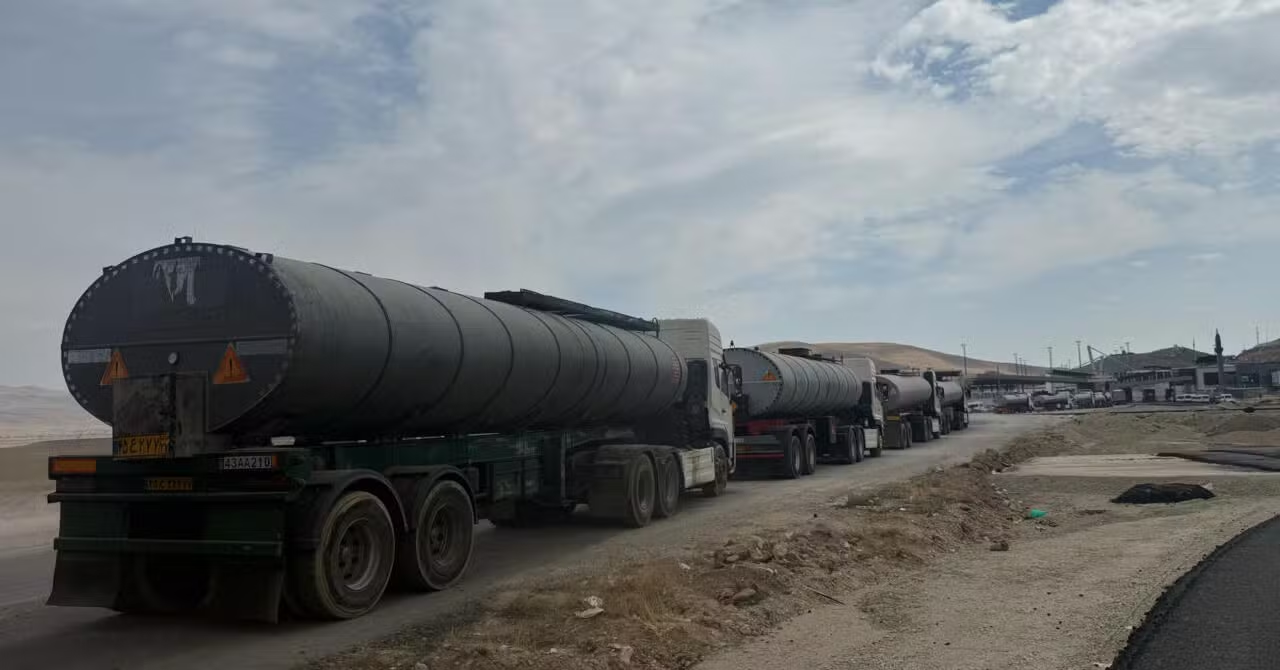
Iraq closes 2 Kurdish crossings as federal takeover advances
Irak: la lutte contre le trafic de pétrole accroît la pression sur Téhéran
rfi.fr· 18m
Why is Trump backing Iraq’s anti-smuggling campaign?
aljazeera.com· 22h
Trump backs Iraqi PM’s oil smuggling crackdown
Trump backs Iraqi leader's efforts to assert more state authority
reuters.com· 45h
How an oil feud is deepening rift between Baghdad and Iraq’s Kurdish region
Iraq denies reports of troop movements towards Kurdish region
Iraq’s top court rules government can take over Kurdish borders, oil fields
Irak: le Premier ministre ordonne la prise de contrôle des postes-frontières au Kurdistan
Iraqi PM orders ministry to manage oilfields in areas under Kurdish control
On 24 November 2026, Prime Minister Ali al-Zaidi ordered federal management of oilfields in four provinces and all crossings in the Kurdistan region, and directed that oil exports go through the federal Oil Ministry.
The next day, he ordered unofficial crossings between Iraqi and Kurdish territory closed. An inquiry commission that had visited northern Iraq earlier in November informed the government's decisions, while several Kirkuk security officials were dismissed.
Also on 25 November, Iraq's Federal Supreme Court ruled that federal authorities could deploy troops along international borders, oversee border agencies, and oversee and audit oil and gas fields, with regional and provincial governments sharing responsibility for managing output.
Thousands protested in Erbil on 26 November against the planned takeover. Iraq's four presidencies agreed to hold national dialogue on 1 December to resolve the crisis.
Iraq has now closed two crossings in the Kurdistan region, one with Syria and one with Iran.
On 24 November 2026, Iraqi Prime Minister Ali al-Zaidi ordered the federal Energy Ministry to manage oilfields in Diyala, Kirkuk, Salahuddin and Nineveh provinces that are under Kurdish security control.
Ali al-Zaidi ordered the Border Crossings Authority to take over all crossings in the Kurdistan region.
Ali al-Zaidi directed the Kurdistan Regional Government to allow crude oil and petroleum product exports only through the federal Oil Ministry.
Ali al-Zaidi removed the head of the Border Crossings Authority and suspended the North Oil Company director general and deputies pending an investigation.
Ali al-Zaidi's office said the directive was based on the principle that 'national sovereignty is indivisible and protecting Iraq's wealth is a battle for survival in which the state puts an end to all forms of smuggling.'
Ali al-Zaidi ordered all unofficial crossings between Iraqi and Kurdish territory closed.
An inquiry commission that had traveled to northern Iraq earlier in November informed the government's decisions.
Several security officials in Kirkuk province were dismissed.
The Kurdistan Democratic Party and the Patriotic Union of Kurdistan jointly denounced the measures as unilateral and said they violated the region's rights and constitutional powers.
Kurdistan Region Prime Minister Masrour Barzani said he was surprised by the government's announcements.
Masrour Barzani called the measures 'totally unacceptable', said dialogue would continue and 'the door remains open' to an agreement, and stressed the importance of 'protecting the Kurdistan region and safeguarding its experience'.
On 25 November 2026, Iraq's Federal Supreme Court ruled that the federal government could deploy troops along international borders, including in the Kurdistan region.
The court ruled that federal authorities could oversee border agencies, coordinating with regional and provincial governments on customs administration.
The court ruled that the federal Oil Ministry could oversee and audit oil and gas fields, while Baghdad shared responsibility with regional governments and producing provinces for managing their output.
Renad Mansour said Iraq's judiciary was 'very much supportive' of the government's campaign to establish a centralised political order and that the government was seeking to reclaim sovereignty because Iraq was 'such a fragmented state where there isn't a centre'.
A senior Shia politician close to Ali al-Zaidi said the prime minister was seeking to dismantle a 'state within a state', restrain armed factions operating above state authority and set clearer limits on Kurdish authority over strategic economic and security matters.
The Kurdistan Regional Government said it was working with federal authorities to combat corruption and called for an end to oil smuggling across Iraq.
On 26 November 2026, Border Forces Commander Mohammed Abdul Wahab Sukkar al-Saidi said the command had begun closing unofficial crossings with neighbouring countries.
Thousands of people protested in Erbil against the government's planned takeover of border crossings and oil operations.
Iraq's four presidencies agreed to hold a national dialogue on 1 December 2026 to resolve the crisis.
Iraqi government spokesperson Haidar al-Aboudi said there was 'no truth' to reports of army units moving towards the Kurdistan region, that oil smugglers were diverting 'tens of billions' into 'private pockets and accounts', and that public employee salaries in the region were not part of the dispute.
Ali al-Zaidi said 'national sovereignty is indivisible' and described protecting Iraq's wealth as 'a battle for existence'.
The Kurdistan Regional Government's Council of Ministers rejected 'any attempt to return Iraq to a centralised system'.
Kurdistan Region President Nechirvan Barzani said addressing the region in 'military language' 'does not solve any problem'.
Al Jazeera correspondent Mahmoud Abdel Wahed said protesters believed the plan 'touches on their sovereignty and their territorial integrity' and 'undermines the constitutional rights of the Kurdish people'.
Salim Zakhour said the court ruling gave Baghdad a legal basis to act, adding that 'the court's decision is final and decisive' but that 'there is a political problem'.
The Kurdistan Regional Government called Baghdad's measures 'a violation of the constitution and an infringement on the region's rights' and rejected 'the language of threats' and a military approach.
Erbil said it supported efforts to fight corruption and smuggling and called for dialogue and full implementation of the constitution.
The Kurdistan Democratic Party and the Patriotic Union of Kurdistan jointly called Baghdad's decisions 'unexpected and deeply surprising' and said weakening the Kurdish political entity was a 'red line'.
On 26 November 2026, Iraq closed 2 crossings in the Kurdistan region, one with Syria and one with Iran.
US President Donald Trump said, 'We support Iraqi Prime Minister Ali al-Zaidi's efforts to assert state authority throughout Iraq, stop the smuggling of Iraqi oil, end corruption, and bring all weapons under the exclusive control of the state.'
Iraqi Oil Minister Basim Mohammed said, 'We are in contact with the Kurdistan region to ensure the optimal management and preservation of our oil wealth. The oilfields in the region and Basra belong to all Iraqis and remain under the Iraqi flag.'
Iraqi Oil Minister Basim Mohammed said Iraq would not be lenient towards 'any drop of oil exported outside legal contexts'.
Kurdistan Regional Government spokesman Peshawa Hawramani said, 'We are not in favour of clashes and disagreement, but that does not mean we accept the violation of Kurdistan's rights guaranteed by the constitution'.
Sajad Jiyad said Ali al-Zaidi's strategy 'is aligned with what America wants for Iraq and for its Iran policy' and that cutting off oil flows was 'exactly what US policy is right now: maximum pressure through economic blockade'.
Salim Zakhour said Trump's post was a clear message of support to Iraq's federal government and to Kurdish authorities that Baghdad's measures had strong American backing.
Kurdistan Region Prime Minister Masrour Barzani called Baghdad's measures unconstitutional and rejected them outright.
An adviser to Iran's supreme leader said Iraq should remain vigilant and should not become an instrument for implementing Donald Trump's policies.
Trump backs Iraqi leader's efforts to assert more state authority
channelnewsasia.com· 45h
What next for Iraq’s push against militias following Jurf al-Sakhar deal?
En Irak, l'armée s'apprête à entrer dans un bastion du groupe pro-iranien Kataeb Hezbollah
france24.com· 9d
Iraq reaches compromise with Kataib Hezbollah over armed group’s stronghold

